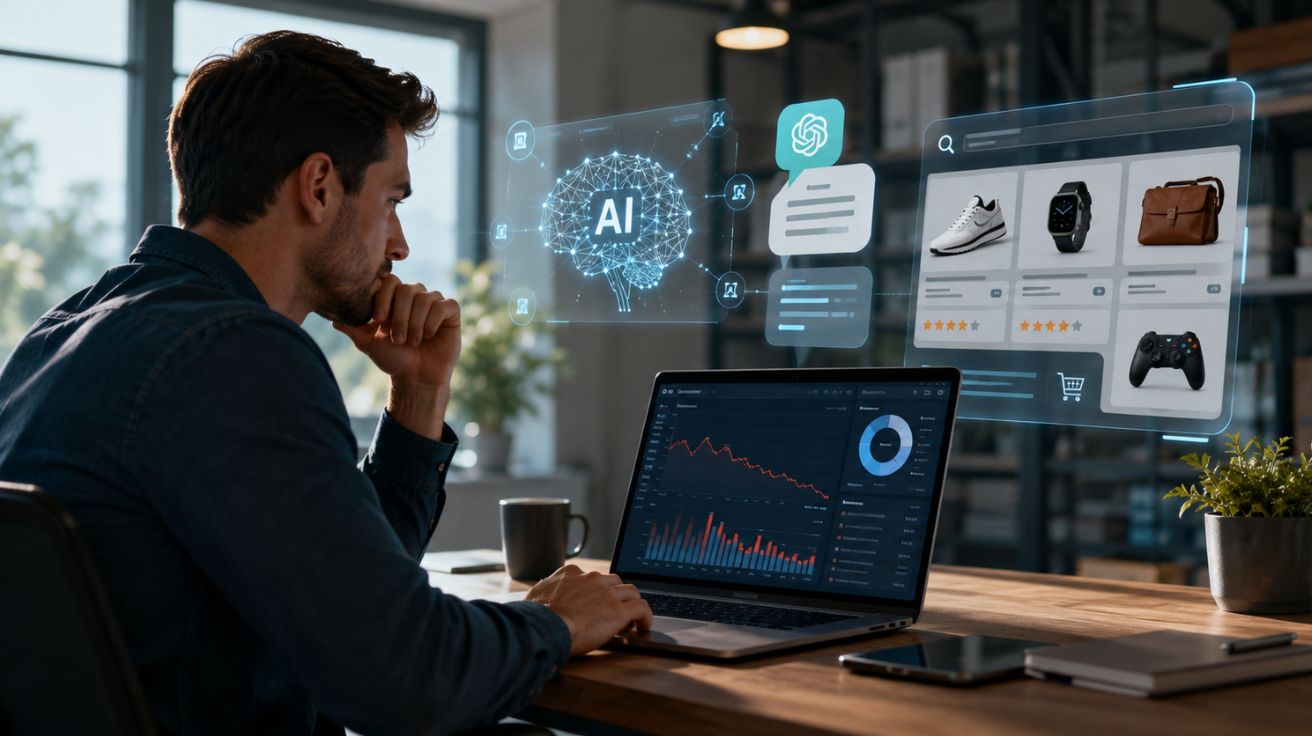

Running an ecommerce store in 2026 has become harder than it has ever been, and most founders cannot quite explain why. Ad costs on Meta and Google keep climbing, organic traffic looks flat on Shopify dashboards, conversion rates are quietly slipping, and the search behavior of actual buyers has shifted in ways that traditional ecommerce SEO playbooks never accounted for. ChatGPT now answers product comparison queries before users ever reach a category page. Perplexity recommends specific stores by name when buyers ask for advice. Google’s AI Overviews summarize product features and pricing without sending the click through to the merchant. A store that ranked well in 2023 can be losing thirty percent of its high intent traffic in 2026 without any visible drop in keyword positions. The fix starts with proper ecommerce SEO services that understand how AI search now intermediates between buyers and product pages, not generic catalog optimization that worked five years ago.
The Quiet Crisis Hitting Online Stores
The numbers tell a story most ecommerce dashboards hide. A US based Shopify store selling skincare can show stable Google rankings for “best vitamin C serum” while losing forty percent of its category page traffic year over year. The reason is not a Google algorithm update or a competitor outranking them. The reason is that buyers now ask ChatGPT “which vitamin C serum should I buy under fifty dollars” and the assistant lists three brands by name, none of which are the store. The store’s product page is still there. The Google ranking is still there. The buyer never sees either of them because the buyer never searches anymore. The buyer asks, and the AI answers, and the brands cited inside that answer win the purchase.
This shift is hitting categories unevenly. Beauty, supplements, electronics, home goods, and apparel are seeing the steepest impact because these are exactly the categories where buyers ask AI assistants for recommendations rather than typing into Google. Within three years, ecommerce SEO will be defined less by category page rankings and more by product level citations inside generated answers, and the brands that adapt early will own significant market share by the time competitors catch up.
Four Hidden Reasons Ecommerce Stores Are Losing Traffic
The patterns showing up across declining ecommerce brands in 2026 are remarkably consistent.
- Thin product detail pages without entity context. Most product pages have a title, a few bullet points, a description, and reviews. AI search engines need much more: ingredient or component breakdowns, comparison context, use case framing, and entity references that connect the product to broader knowledge graphs. Without this, the product is invisible to LLM citation even if it ranks on Google.
- No structured data for AI parsing. Product schema is common but incomplete. The schema that matters in 2026, full attribute coverage, review aggregation with proper entity references, FAQ markup for common buyer questions, comparison data structured for AI consumption, is missing from most stores.
- Category pages built for keywords, not intent. Most ecommerce category pages are optimized for high volume keywords with thin descriptions and a product grid. They miss the buyer questions, comparison frameworks, and decision support content that AI engines now treat as authority signals. The result is category pages that rank but do not get cited.
- Missing third party authority. Products that get recommended inside ChatGPT and Perplexity answers tend to be products that have been written about in independent publications, reviewed by trusted creators, and mentioned in expert content. Most ecommerce stores have zero strategy for this kind of off page authority building.
How UnoSearch Approaches Ecommerce SEO in the AI Era
The team at UnoSearch has built its ecommerce practice around US facing online stores that need to win across both traditional search and AI search simultaneously. Their approach starts with full catalog auditing that goes beyond standard product page optimization. They evaluate schema completeness, entity definition for each product line, internal linking architecture across category and product pages, and topical depth in the supporting content that drives buyer research.
From there, the team builds AI ready product page templates that include the contextual information LLMs need for citation: structured comparison data, use case framing, ingredient or component breakdowns, and properly marked up FAQ content. They also work on the off page authority layer most ecommerce agencies ignore, helping client brands earn mentions in independent publications, creator reviews, and expert content that feeds AI citation behavior. Published outcomes include a 192 percent lift in organic add to cart conversions for a D2C fashion brand, which came from rebuilding category pages around buyer intent rather than keyword volume.
For US based online stores working with Indian execution teams, this kind of integrated approach matters because ecommerce SEO can no longer be split into “we’ll optimize your product pages” and “we’ll handle backlinks” as separate workflows. The brands winning AI citation in 2026 are the ones where on page entity work, schema completeness, content depth, and off page authority are coordinated as a single discipline.
What to Look For in an Ecommerce SEO Partner in 2026
If you run an online store, a few criteria separate genuine ecommerce specialists from agencies treating ecommerce as a generic SEO category. The partner should be auditing product schema, not just page titles. They should be evaluating AI citation visibility for your products, not just Google rankings. They should be building category pages around buyer intent and decision support, not just keyword targets. They should be reporting on revenue per traffic source, not just session counts.
The most useful diagnostic question to ask any potential partner is: “Show me an example where you got a client product cited inside a ChatGPT or Perplexity recommendation.” Partners who can demonstrate this have adapted to 2026.
Final Thoughts
The next two years will sort the ecommerce winners from the laggards. Stores that adapt to AI mediated search behavior will compound their advantage as more buyers shift discovery into generative engines. Stores that keep optimizing only for traditional Google rankings will watch their organic revenue slowly drain even as their dashboards show stable positions. The choice is not whether to adapt but how quickly. For founders thinking about the broader landscape of running and scaling a modern business online, this overview of business and entrepreneurship trends provides useful context on how digital commerce is evolving.
Read More: The Complete Guide to Understanding ISO Certification for Business Success Growth


Leave a Comment