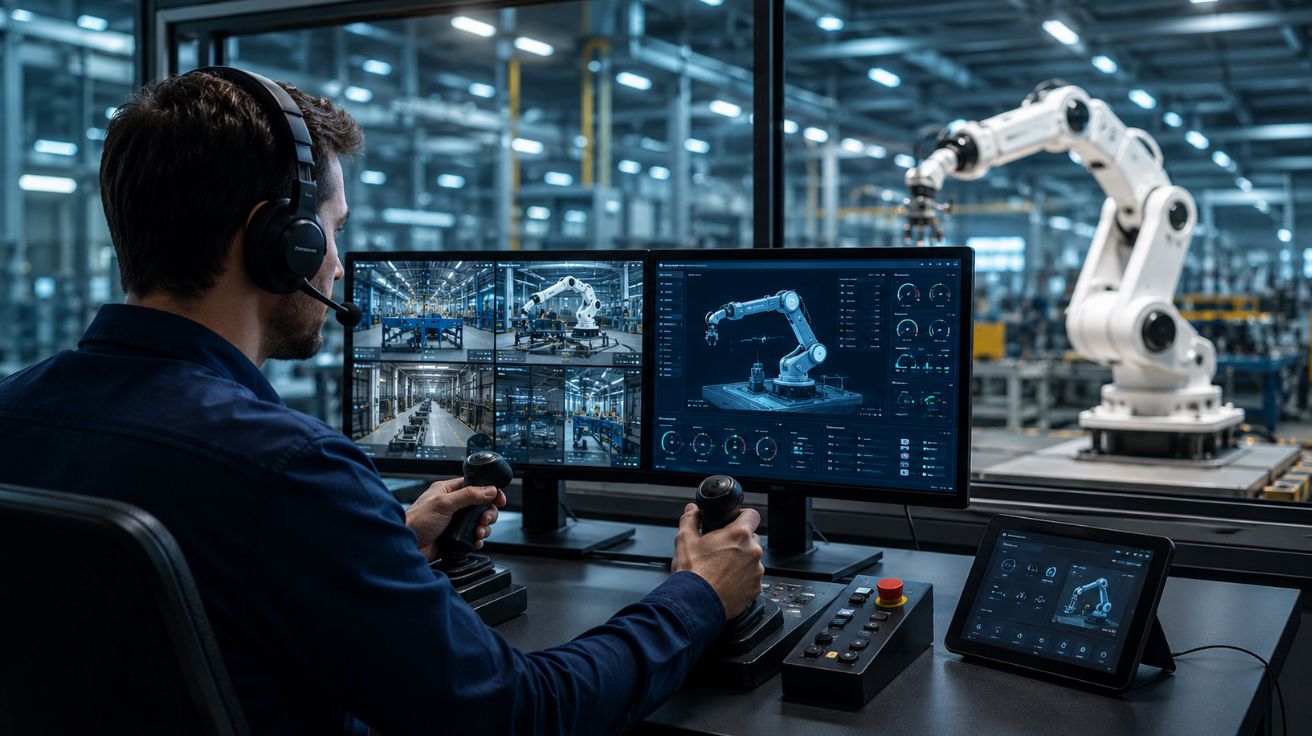

As robotics continues to evolve, businesses are looking for smarter ways to improve efficiency, accuracy, and scalability. One of the most important innovations in this space is robot teleoperation, a system that allows human operators to control or assist robots remotely in real time.
For robotics companies, understanding teleoperation is essential. It bridges the gap between full automation and human intelligence, enabling robots to perform effectively in complex, real-world environments.
What Is Robot Teleoperation?
Robot teleoperation is the process of controlling robots from a remote location using human input. Instead of relying entirely on automation, teleoperation allows operators to guide robots when needed.
This can include:
- Navigating robots through complex environments
- Performing precise or delicate tasks
- Responding to unexpected situations
Teleoperation ensures that robots can adapt to real-world conditions that automation alone may not handle effectively.
How Robot Teleoperation Works
Robot teleoperation uses a combination of hardware and software to enable remote control and communication.
Key components include:
- Control Interfaces – such as joysticks, keyboards, or virtual reality systems
- Communication Systems – secure networks that transmit data in real time
- Sensors and Cameras – provide live feedback to operators
- Software Platforms – process data and enable smooth interaction
These technologies allow operators to monitor and control robots with high precision, even from long distances.
Why Teleoperation Matters for Robotics Companies
For robotics companies, teleoperation is not just an add-on; it is a critical part of delivering reliable solutions.
Benefits include:
- Improved performance in unpredictable environments
- Reduced operational errors through human intervention
- Enhanced safety in high-risk situations
- Greater flexibility across different use cases
By integrating teleoperation, companies can increase the effectiveness of their robotic systems.
Key Use Cases of Robot Teleoperation
Teleoperation is used across many industries where automation alone is not enough.
Common applications include:
- Logistics and Warehousing – managing picking, sorting, and transport robots
- Healthcare – assisting medical robots and patient support systems
- Retail – supporting in-store robots and customer interactions
- Security and Surveillance – guiding patrol robots in real time
- Hazardous Environments – operating robots in dangerous or hard-to-reach areas
These use cases highlight the versatility of teleoperation in modern operations.
Teleoperation vs Fully Autonomous Systems
While fully autonomous systems aim to operate without human input, they often face limitations in real-world environments.
Teleoperation offers a more balanced approach by:
- Allowing robots to operate independently when possible
- Enabling human control when needed
- Reducing risks and improving decision-making
This hybrid model ensures better performance and reliability.
Challenges of Robot Teleoperation
Despite its advantages, teleoperation also comes with challenges that businesses need to address.
These include:
- Network latency affecting real-time control
- The need for secure communication systems
- Training operators to handle complex tasks
- Integrating teleoperation with existing systems
However, with the right setup and support, these challenges can be managed effectively.
The Role of Teleoperation Support Services
Many robotics companies rely on professional robot teleoperation support services to manage their systems efficiently. These services provide trained operators who monitor and control robots in real time.
With expert support, businesses can:
- Reduce downtime
- Improve system performance
- Ensure consistent operations
- Scale more efficiently
Future of Robot Teleoperation
As robotics technology continues to advance, teleoperation will play an even bigger role. Improvements in AI, connectivity, and user interfaces will make remote control faster and more precise.
Future trends include:
- Integration with AI-assisted decision-making
- Use of virtual reality for immersive control
- Faster and more reliable communication networks
- Expansion into more industries
Teleoperation will remain a key part of robotics innovation.
Final Thoughts
Robot teleoperation is a powerful solution that combines automation with human expertise. It allows robotics companies to deliver more reliable, flexible, and scalable systems.
While robots handle routine tasks, human operators provide the judgment needed to manage complex situations. Together, they create a smarter and more efficient approach to automation.
Read More: LLM API Explained: How One API Can Reach Every Model


Leave a Comment