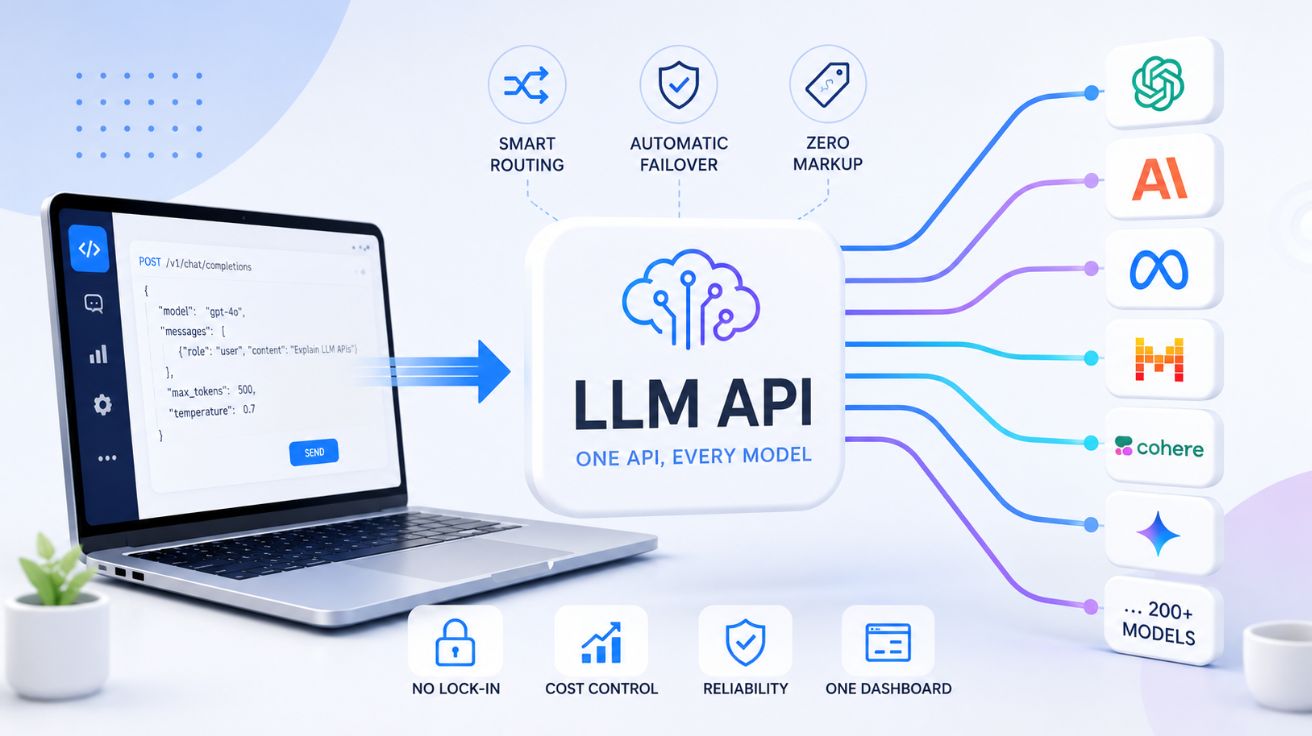

An LLM API is the bridge between your application and a large language model: your code sends a prompt, the API returns a completion. It is what powers every AI feature you have shipped, from a chatbot to a summarizer to an autonomous agent. But the phrase hides an important ambiguity — “an LLM API” can mean a single provider’s endpoint, like one company’s chat API, or it can mean a unified API that reaches many models at once. The difference decides how flexible, reliable, and affordable your app will be a year from now.
The unified approach is what tools like OrcaRouter provide: an OpenAI-compatible LLM router that turns one endpoint into access to 200+ models, with smart routing and automatic failover, and no markup on tokens. Before we get there, let’s cover what an LLM API actually is, why binding your code to a single provider’s API becomes a problem, and how one API for every model solves it.
What Is an LLM API?
An LLM API exposes a language model over HTTP. You send a request containing your messages, a model name, and settings like the maximum output length; the model runs inference and returns generated text (and, increasingly, tool calls, structured output, or streamed tokens). You are billed per token — the units of text going in and coming out. That billing model is why cost discipline matters, and why the price you pay per token is worth scrutinizing.
Practically every provider offers an LLM API, and most now follow a similar request shape. That convergence is what makes a unified API possible in the first place.
The Problem With a Single-Provider API
Wiring your app directly to one provider’s API is the fastest way to start — and the slowest way to change later. Four problems compound over time:
- Lock-in — your integration speaks one provider’s dialect, so adopting a better or cheaper model elsewhere means rewriting code.
- Fragility — if that provider has an outage or rate-limits you, your app goes down with it.
- Cost rigidity — you pay that provider’s rate for every task, even the simple ones a cheaper model could handle.
- Sprawl — add a second or third provider and you now juggle multiple keys, SDKs, and dashboards.
None of these hurt on day one. All of them hurt by the time your AI feature is load-bearing.
One API for Every Model
The fix is to put a thin layer between your app and the providers — a gateway that exposes a single LLM API and forwards each request to whichever model you choose. Your code integrates once; adding, switching, or falling back to another model becomes a configuration change instead of a rewrite.
OrcaRouter is built this way. One OpenAI-compatible endpoint reaches 200+ models across providers, with smart routing to send each request to the right model and automatic failover when one is unavailable. Because it charges zero markup, you pay each provider’s published rate directly and nothing extra for the routing. In practice you get:
- No lock-in — one integration, any model, swapped with a single string.
- Reliability — automatic failover keeps requests flowing through provider outages.
- Cost control — route cheap tasks to cheap models, premium tasks to premium models.
- One dashboard — usage, cost, and logs across every model in one place.
Why OpenAI Compatibility Matters
The best unified LLM APIs are OpenAI-compatible — they accept the same request format as the OpenAI API. That single detail is what makes adoption painless: you keep your existing SDK and code and simply point them at a new base URL. There is no new library to learn and no rewrite, so trying a unified API costs you minutes, not a sprint.
What to Look for in an LLM API
When you evaluate a unified LLM API, weigh five things:
- Zero markup so you pay real token prices.
- Model breadth so you are never boxed in.
- OpenAI compatibility so your code just works.
- Reliability, meaning fast automatic failover and solid routing.
- Observability plus governance so a team can see spend and apply guardrails.
Score candidates against those five and the strong options separate quickly from the weak ones.
How to Get Started
Adopting a unified LLM API is a one-line change:
- Create a free account and generate an API key.
- Point your existing OpenAI SDK at the gateway’s base URL.
- Choose a model — and route different tasks to different models as you scale.
- Switch models any time by changing one string; watch cost and usage in one dashboard.
Who Benefits Most From a Unified LLM API
A unified LLM API pays off most for four kinds of teams. Product teams shipping AI features in production, where reliability and the freedom to upgrade models matter more than any single vendor relationship. Multi-model products that deliberately use different models for different features and want one integration instead of several. Cost-sensitive, high-volume apps that need to route cheap work to cheap models and only pay premium prices where quality demands it. And any team that simply expects the model landscape to keep changing — which, in 2026, is every team. If you will only ever call one model, a direct integration is fine; the moment a second model enters the picture, the unified approach starts saving real time.
The pattern also future-proofs your codebase. New models launch constantly, prices move, and today’s best model rarely stays on top for long. With a unified LLM API, adopting the next breakthrough is a one-line change instead of a migration — so your team spends its time on the product, not on plumbing, and never has to argue about a rewrite just to try a model that launched last week.
The Bottom Line
An LLM API is table stakes; which shape of it you adopt is the real decision. Bind your code to one provider’s endpoint and every future improvement in the market costs you a rewrite; bind it to one unified endpoint and those improvements become one-line upgrades. In a field this fast, the second option isn’t a convenience — it’s the strategy.
Want one API for every model? Start free with OrcaRouter — a single OpenAI-compatible endpoint to 200+ models, smart routing and automatic failover, zero markup.
FAQ
How Many Tokens Is a Typical Request?
As a rough feel: a word is about 1.3 tokens in English, so a 500-word prompt runs ~650 input tokens and a few-paragraph answer ~200–400 output tokens. Long documents and code inflate counts quickly, and non-English text often tokenizes less efficiently — measure with a token counter before budgeting.
Do LLM APIs Keep My Conversation History?
No — the API itself is stateless, which surprises many first-time builders. Your application stores the history and resends the relevant parts each call; anything you don’t resend, the model has never seen, no matter how recent it was.
What Rate Limits Should I Expect From an LLM API?
Providers cap both requests per minute and tokens per minute, and the caps differ by account tier. Production apps should treat 429 responses as normal weather: retry with backoff, and keep a second model configured so bursts overflow instead of failing.
Read More: Why Creators Are Turning to AI Avatar Videos for Always-On Content


Leave a Comment