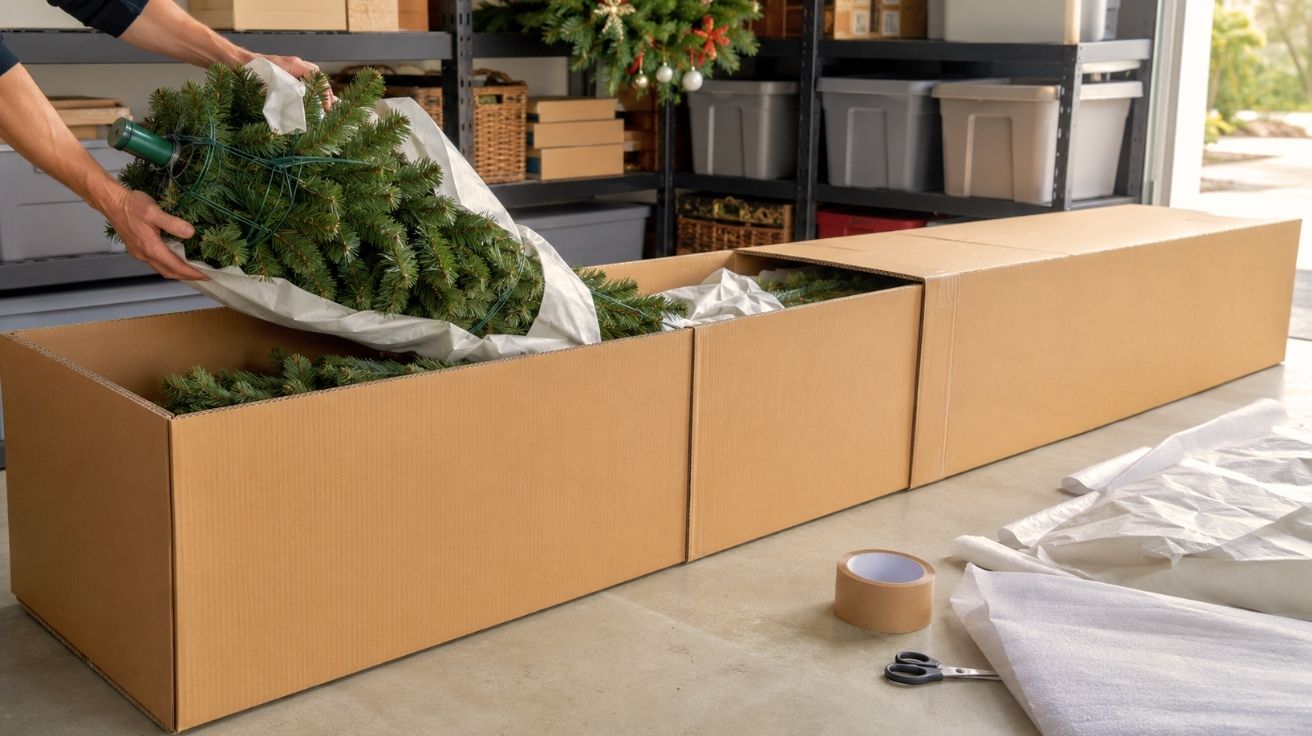

Every year, the same problem surfaces in homes, event venues, and commercial properties alike: a large artificial tree gets packed away improperly, and by the time it is needed again, it is crushed, misshapen, or missing components. For a standard six-foot tree, improvised storage solutions often scrape by. For a nine-foot tree, they rarely do. The scale of the item demands a storage approach that accounts for its length, its fragility, and the conditions it will endure over long-term storage in a garage, attic, or storage unit. Getting this right the first time prevents unnecessary expense and the frustration of discovering damage when the tree is needed again.
Why Standard Storage Solutions Fail Large Artificial Trees
A nine-foot artificial tree is not simply a larger version of a smaller one. Its sections are longer, its branches are denser, and the structural frame that holds it upright is more rigid and more susceptible to permanent bending under improper compression. When this kind of tree is folded into a generic storage bag, rolled into plastic sheeting, or stacked horizontally beneath other items in a garage, the pressure applied over months causes branch wires to bend permanently, tip clusters to flatten, and center poles to warp. The result is a tree that no longer assembles cleanly and requires significant re-shaping before it can be displayed properly, if it can be salvaged at all.
The core issue is that most storage products designed for artificial trees were built around the average consumer item, which sits in the six-foot range. A telescoping storage box addresses this gap directly by offering an adjustable internal length that accommodates the actual dimensions of large artificial trees without forcing compression. Rather than bending the tree to fit the container, the container adjusts to fit the tree. This distinction matters because it eliminates the mechanical stress that is the primary source of long-term damage.
Those looking at purpose-built options for large trees will find that a telescoping storage box is specifically designed to extend in length, allowing the tree sections to lie flat and undisturbed rather than packed at angles that compromise their shape over time.
The Hidden Cost of Improper Storage
Artificial trees represent a significant upfront investment, particularly at the nine-foot scale. Premium pre-lit models with full branch profiles can cost hundreds of dollars, and when properly maintained, they can remain in excellent condition for many years. Improper storage shortens that lifespan substantially. Branch tips that are repeatedly compressed lose their ability to hold shape. Wire frames bent under weight eventually snap or deform beyond recovery. Lighting systems integrated into the branches are especially vulnerable, as physical stress on the branches can result in broken wire connections that cause partial or complete light failure.
Beyond the tree itself, there is a time cost. A tree that has been poorly stored requires extensive re-shaping before it can be assembled. For commercial properties, event venues, or businesses that use large decorative trees, a damaged or unusable tree creates an operational gap that is difficult to address on short notice.
What Makes a Telescoping Box the Right Format for Long Tree Sections
A telescoping box is a two-piece corrugated cardboard construction in which one section slides over or into the other, allowing the overall length of the container to be adjusted before it is sealed. This format was originally developed for industrial and commercial shipping applications where item lengths vary and rigid standardization is impractical. The same structural logic applies to storing large artificial trees. A nine-foot tree, when broken down into its sections, produces pieces that often exceed the length of fixed-dimension storage products. A telescoping format solves this without requiring the user to cut, modify, or improvise.
Corrugated cardboard, when properly constructed, offers a combination of rigidity and cushioning that is well suited to protecting delicate branch structures. According to the Technical Association of the Pulp and Paper Industry (TAPPI), the fluted inner layer of corrugated board acts as a continuous column structure that absorbs and distributes compressive load, which is precisely the kind of protection needed when boxes are stacked in storage. This means a correctly rated telescoping cardboard box can support weight from above without transferring that pressure to the contents inside, making it an effective solution for storing large artificial trees while helping preserve their shape and structural integrity over time.
Rigidity Without Brittleness
One of the practical advantages of corrugated cardboard over hard plastic storage bins is its balance between rigidity and flexibility. Hard plastic bins can crack under impact, warp under temperature extremes, and become brittle over time, particularly in unheated garages or attics where temperatures fluctuate significantly. Corrugated cardboard maintains its structural integrity across a wide range of conditions and, if damaged, can be replaced at a fraction of the cost of a rigid plastic alternative.
How to Prepare a Nine-Foot Tree for Storage
The preparation process before a tree goes into any storage container determines how well it is preserved. A telescoping box provides the right dimensions, but the condition of the tree going in affects whether it comes out in usable shape later. Start by completely disassembling the tree. Each section should be separated fully rather than partially collapsed, as partially collapsed sections leave branch wires under tension that can lead to permanent bends over time.
Once disassembled, fold the branches inward toward the center pole before placing each section into the box. This reduces the overall diameter of each section and minimizes pressure against the interior walls of the container.
Protecting Pre-Lit Components
Trees with integrated lighting systems require additional care during storage. The wire connections along each branch are among the most delicate components and are vulnerable when sections shift during storage. Wrapping individual sections loosely in tissue paper or unprinted packing paper provides a protective buffer against abrasion.
Power cords and connection points should be coiled neatly and secured close to the center pole rather than left hanging freely, where they can snag on other components or become kinked during handling.
Sealing and Labeling the Box
After placing all tree sections inside the telescoping box, seal every seam with reinforced packing tape, including the overlapping joint between the two telescoping sections. This prevents movement during handling and helps maintain structural integrity.
Clearly label the box with its contents, assembly orientation, and the location of any separately stored accessories. Proper labeling reduces unnecessary handling and minimizes the risk of accidental damage during storage or retrieval.
Storage Environment and Long-Term Preservation
The storage environment is just as important as the container itself. Moisture remains the biggest concern. Corrugated cardboard can absorb moisture over extended periods, reducing its strength and potentially encouraging mold growth. Store the box on shelves or wooden pallets rather than directly on concrete floors to reduce exposure to ground moisture.
Keep the box stored horizontally instead of vertically. Horizontal storage distributes weight evenly across the tree sections, while vertical storage concentrates pressure on the lower sections, increasing the likelihood of branch deformation.
Conclusion
Properly storing a nine-foot artificial tree requires the right storage container and careful preparation. A telescoping cardboard storage box provides the flexibility needed for oversized tree sections, protects against compression damage, and offers dependable performance across repeated storage cycles. Combined with proper disassembly, careful branch folding, secure packing, and a dry storage environment, it offers a practical and cost-effective solution for preserving large artificial trees for years to come.
Read More: 7 Massachusetts Energy Efficiency Programs Most Homeowners Never Apply For (And How to Qualify)


Leave a Comment