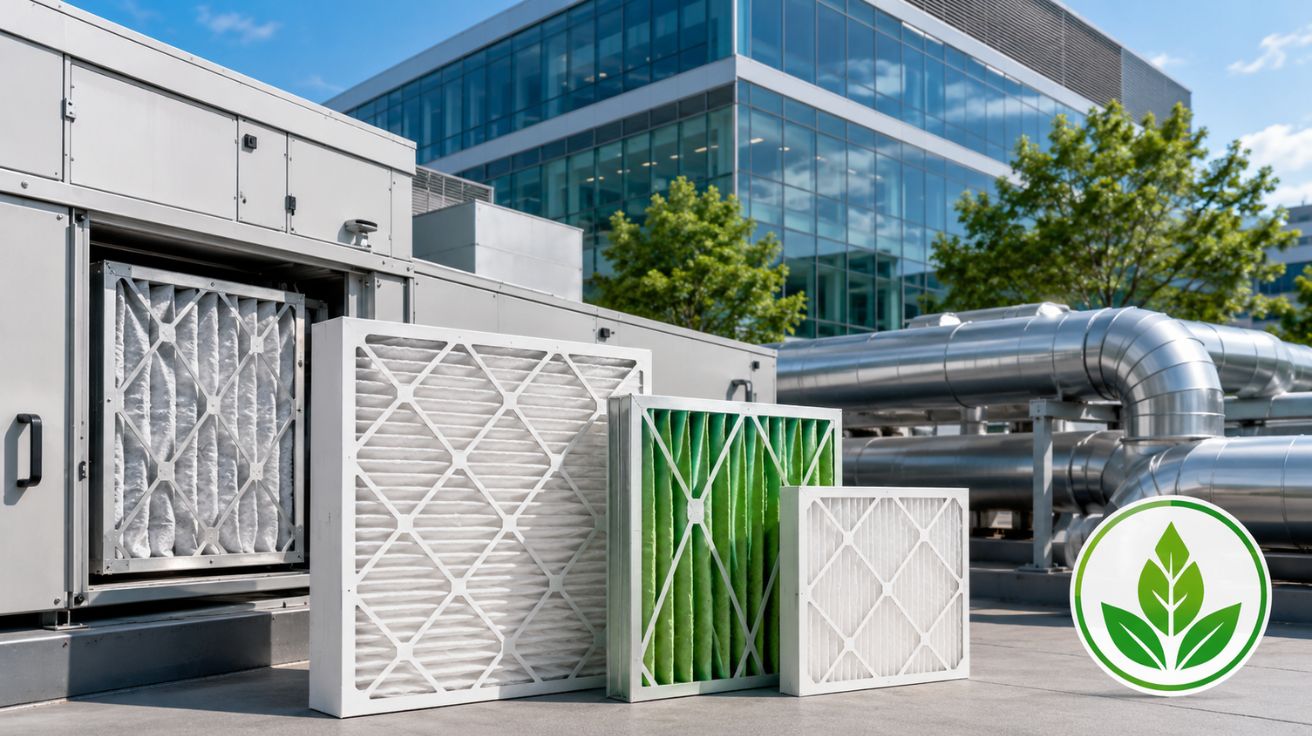

Commercial building operators in the United States are under increasing pressure to meet sustainability benchmarks while keeping their mechanical systems running efficiently. LEED certification, developed by the U.S. Green Building Council, has become a widely adopted standard for evaluating the environmental performance of commercial buildings. Within that framework, indoor air quality is not a secondary concern — it is a scored category that directly affects whether a building achieves or maintains its certification level.
HVAC filtration sits at the intersection of that indoor air quality requirement and the daily operational demands of a building. Choosing the wrong filter — one that fails to meet the performance thresholds required under LEED — can affect air quality test results, increase energy consumption, and introduce compliance risks that are difficult to correct after the fact. This guide walks through how commercial building managers, facilities directors, and mechanical contractors can approach filter selection with clarity and consistency.
What LEED Compliance Actually Requires From HVAC Filtration
LEED compliance in the context of HVAC filtration is tied primarily to the Indoor Environmental Quality (IEQ) credit category. This category evaluates the quality of air delivered to building occupants, and filtration performance is one of the measurable inputs. The standard draws from established ASHRAE guidelines, particularly those related to minimum ventilation and air cleaning requirements, to define what constitutes acceptable filtration in a certified building.
When specifying or procuring leed compliant hvac filters, facilities teams need to understand that compliance is not simply about choosing a high-efficiency product. It involves selecting a filter that meets a defined minimum particle removal efficiency, functions correctly within the existing system design, and can be documented as part of the building’s ongoing maintenance record. Suppliers that provide filters specifically rated for LEED applications, such as those listed through services like leed compliant hvac filters, can help facilities teams confirm that the products they are purchasing align with the applicable credit requirements.
The Role of ASHRAE Standards in Filter Selection
ASHRAE sets the baseline performance standards that LEED references when evaluating HVAC system adequacy. The specific standard most relevant to commercial filtration requirements covers minimum efficiency ratings and ventilation benchmarks. A filter selected without reference to this standard may perform adequately in normal conditions but still fall short of what a LEED reviewer expects to see in the project documentation.
This matters operationally because LEED certification involves periodic review and, in some cases, recertification. If a building’s filtration specifications are updated during a renovation or maintenance cycle without verifying ASHRAE alignment, the building can lose credit points it previously earned. The cost of correcting that gap is almost always higher than the cost of getting the specification right initially.
How Building Type and Occupancy Patterns Affect Filter Specifications
Not all commercial buildings have the same filtration requirements under LEED, and the differences are meaningful. An office tower with consistent occupancy and central air handling has different air quality demands than a mixed-use facility with retail, food service, and office tenants sharing a mechanical system. The type of activity occurring in the building influences the particle load, the humidity exposure of the filters, and the frequency with which filter replacement becomes necessary to maintain rated performance.
Facilities managers who apply a single-filter specification across an entire portfolio without adjusting for occupancy type and use patterns often encounter situations where filters are replaced too infrequently in high-demand zones or replaced too often in low-demand areas. Neither condition serves the building well from a cost or compliance standpoint.
High-Occupancy and High-Traffic Zones
In areas of a commercial building that see heavy foot traffic, consistent activity, or the regular presence of particulate-generating processes — such as a commercial kitchen, a fitness facility, or a loading area with proximity to an air intake — filters experience accelerated loading. An accelerated loading rate means the filter reaches its capacity point sooner, which in turn increases pressure drop across the air handling system. Elevated pressure drop reduces airflow efficiency and increases the energy demand of the system’s fans and motors.
From a LEED standpoint, energy performance is also a scored category. A filter that degrades air handling efficiency contributes to energy penalty points that work against the building’s overall certification score. This connection between filtration maintenance and energy performance is one that building operators sometimes overlook until they receive an energy audit or certification review that identifies the issue.
Low-Occupancy and Storage Areas
In portions of a commercial building with limited occupancy — mechanical rooms, storage areas, archive spaces — the temptation is to reduce filtration quality on the assumption that air quality matters less in spaces where people rarely spend time. That assumption creates a compliance risk. LEED evaluates the system as a whole, and air that circulates through under-filtered zones can re-enter occupied spaces. Maintaining consistent filtration across all air-handling zones is a more defensible and reliable approach than applying uneven standards based on perceived occupancy.
Evaluating Filter Efficiency Ratings in the Context of LEED Requirements
Filter efficiency is typically expressed through a standardized rating system that describes the filter’s ability to capture particles of a given size range. In the United States, the MERV rating scale — Minimum Efficiency Reporting Value — is the most widely used. The American Society of Heating, Refrigerating and Air-Conditioning Engineers has established the testing methodology behind MERV ratings, and LEED certification requirements reference specific points on that scale when defining acceptable filter performance.
Selecting a filter based on MERV rating alone, however, is not sufficient. The MERV rating reflects performance under controlled test conditions, which may not replicate the actual operating environment of a given building. Humidity, temperature variation, and particulate composition in the real building environment all influence how a filter performs relative to its rated specification. This means the selection process needs to account for real-world conditions, not just catalog specifications.
The Relationship Between MERV Rating and System Compatibility
A higher MERV rating does not automatically produce a better outcome in every system. Filters with higher particle capture efficiency create greater resistance to airflow. If the air handling unit was designed to operate within a specific static pressure range, installing a filter with a significantly higher MERV rating than the system was designed for can reduce airflow volume, cause the system to strain against increased resistance, and in some cases trigger fault conditions or component wear.
This is particularly relevant in older commercial buildings where the mechanical systems were specified before leed compliant hvac filters became a common procurement requirement. In those cases, a facilities engineer may need to assess whether the air handling units can accommodate the filtration performance required for LEED compliance, or whether system modifications are needed before the upgrade can be implemented correctly.
Documentation and Maintenance Records as Part of LEED Compliance
Filter selection is only part of what LEED evaluators look at when assessing indoor environmental quality. The maintenance record associated with those filters is equally important. LEED certification requires that buildings demonstrate ongoing operational performance, not just the installation of the right products. A building that purchases the correct leed compliant hvac filters but replaces them irregularly, fails to document replacement dates, or cannot demonstrate consistent adherence to a maintenance schedule will face difficulty during certification review.
This operational dimension is often where well-intentioned facilities teams encounter problems. The equipment is correctly specified, the installation is done properly, but the record-keeping does not support the certification claim. Establishing a documented maintenance protocol from the outset — one that ties filter replacement schedules to both manufacturer guidance and LEED requirements — eliminates this gap.
Building the Maintenance Record Into Procurement Workflows
One practical approach is to integrate HVAC filter procurement into a workflow that automatically generates documentation at the point of purchase and installation. When filters are ordered through a supply chain that tracks product specifications, quantities, and delivery dates, those records can be pulled directly into a LEED compliance file without requiring manual data entry or reconstruction from paper logs.
This approach also creates a reliable baseline for auditing. If the building is audited during a recertification cycle, the procurement records serve as evidence that the correct products were being used consistently over the covered period. Buildings that rely on informal or inconsistent record-keeping often find themselves unable to demonstrate compliance even when the actual filtration practice was correct.
Working With Contractors and Vendors to Maintain Compliance Over Time
Commercial buildings rarely remain static. Tenant buildouts, mechanical system upgrades, changes in occupancy, and renovations all create moments where HVAC filtration specifications can drift from their original LEED-aligned baseline. Each of these transitions represents a point where a contractor or facilities vendor might substitute a different product — one that may be adequate for general HVAC use but does not meet the specific requirements tied to leed compliant hvac filters.
Preventing that drift requires clear communication of the building’s compliance requirements to every vendor and contractor who interacts with the mechanical system. This includes establishing written specifications that are referenced in every maintenance contract and work order related to HVAC, not just in the original construction or certification documents.
Vendor Selection Criteria Beyond Price
When evaluating vendors for ongoing filter supply, price is rarely the most important variable for a building with active LEED obligations. What matters more is the vendor’s ability to provide products that are consistently rated and documented, to respond quickly when replacement is needed, and to maintain records that support the building’s certification file. A vendor who offers lower prices but inconsistent product documentation introduces more operational risk than the savings justify.
Facilities managers who have managed LEED-certified buildings through multiple certification cycles tend to prioritize:
- Supply chain reliability.
- Documentation capability over unit pricing when selecting HVAC filter vendors.
That priority reflects hard-won experience with what actually matters during a certification review.
Conclusion
Choosing HVAC filters for a LEED-certified commercial building is not a purchasing decision that can be made by product specification alone. It requires an understanding of how filtration performance connects to the broader certification framework, how occupancy and system design affect real-world filter behavior, and how documentation practices support or undermine compliance over time.
The buildings that maintain LEED certification consistently across recertification cycles are typically those where filtration is treated as a managed operational function rather than a routine supply purchase. That means aligning product selection with ASHRAE-referenced standards, accounting for building-specific factors that affect filter load and performance, and maintaining the kind of records that allow a building to demonstrate compliance clearly and completely when it matters.
For facilities directors, building owners, and mechanical contractors working in the commercial sector, the investment in getting filtration right from a LEED standpoint pays returns that extend beyond certification points — it supports better indoor air quality, more efficient mechanical system performance, and a more defensible compliance record over the life of the building.
Read More: How to Choose the Right Stainless Steel Hollow Ball for High-Pressure Float Valve Systems


Leave a Comment