
Children’s furniture is replaced more often than it should be. The most common reason is not wear or damage but developmental mismatch: a piece that worked well for a toddler no longer suits a pre-schooler, or a bookshelf sized for picture books cannot accommodate the chapter books and school readers that arrive at age six. The cost of replacing furniture at each developmental transition adds up quickly. Understanding how to choose pieces that span multiple stages, or that adapt to them, is one of the most practically valuable things a parent can do before making any significant furniture purchase for a child’s bedroom.
Key Takeaways
- Children’s furniture that adapts across developmental stages costs more per purchase but significantly less per year of use than pieces designed for a single stage.
- Adjustable components, such as movable shelf heights, convertible configurations, and removable dividers, are the features most directly linked to longevity across stages.
- Neutral finishes and timeless designs age better across childhood than character-themed or trend-driven pieces, which date quickly and become incongruous as the child grows.
- Bookshelves are among the children’s bedroom furniture pieces with the longest potential useful life, remaining relevant from around 12 months through to adolescence with the right design.
- Build quality is the underlying factor in whether a piece actually lasts. A well-made adjustable bookcase will outlast three cheaper fixed-format alternatives in both structural integrity and visual quality.
The True Cost Of Stage-Specific Furniture
| Approach | Upfront Cost | Replacements Needed | Total Cost Over 10 Years | Quality Trade-off |
|---|---|---|---|---|
| Stage-specific pieces replaced at each transition | Lower per purchase | 3 to 4 replacements | Higher total | Often lower quality |
| Adaptable quality piece that spans stages | Higher per purchase | 0 to 1 replacements | Lower total | Higher quality sustained |
| Premium adaptable piece | Highest per purchase | 0 replacements | Lowest total | Maximum quality sustained |
What Makes A Children’s Furniture Piece Adaptable
Adjustable Shelf Heights
The single most useful feature in a children’s bookshelf or bookcase for longevity is adjustable shelf heights. A bookcase with shelves fixed at heights suited to picture books will be poorly configured for chapter books and school readers. One with shelves that can be repositioned on standard shelf pin holes can be reconfigured as the collection and the reading habits change. This is a feature worth looking for explicitly rather than assuming it is standard.
Convertible Formats
Some children’s furniture pieces are specifically designed to convert between formats as the child grows. A cot that becomes a toddler bed. A low front-facing bookshelf that can be reoriented to a spine-out format as the child develops reading independence. A storage unit with removable dividers that can be reconfigured as the nature of what needs storing changes. These convertible designs offer the longest useful life because they actively adapt to the child rather than simply enduring through stages they were not designed for.
Neutral Design That Ages Well
A bookshelf with a character print will be outgrown visually before it is outgrown functionally. A bookshelf in natural timber or a neutral painted finish will remain visually appropriate from the nursery years through to adolescence without any modification. Neutral design is not a compromise. It is a longevity strategy. The piece looks as right at age ten as it did at age two, without any change to the furniture itself.
Construction Quality That Handles Daily Use
A piece of children’s furniture that adapts to multiple stages also needs to survive them. Panels that bow under load, joins that loosen with repeated stress, and finishes that chip at corners and edges will compromise the piece’s functionality before its design potential is exhausted. Solid timber or thick quality MDF with reinforced joins, appropriate finish adhesion, and structural stability under the loads children apply are the construction qualities that allow a furniture piece to actually deliver on its multi-stage promise.
The Bookshelf As The Best Long-Term Investment In Children’s Furniture
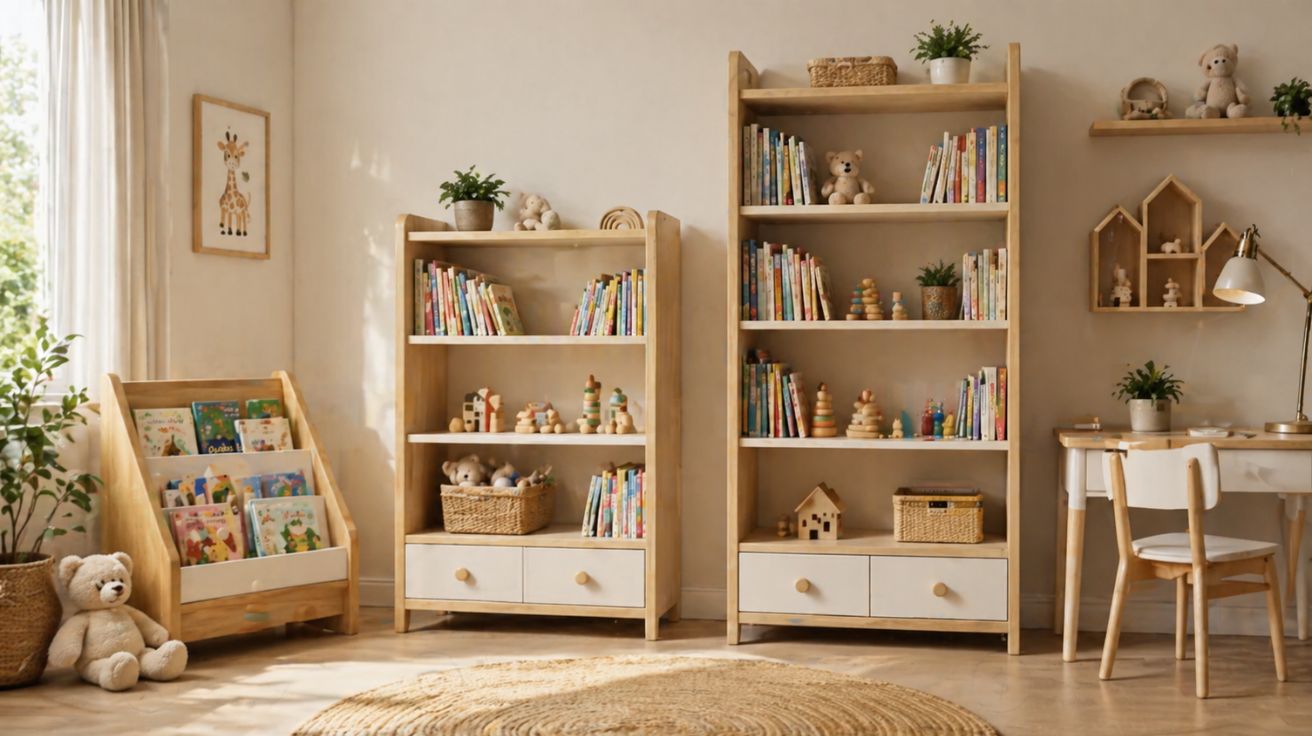
Among all children’s bedroom furniture categories, the bookshelf has the longest potential useful life when chosen well. A low front-facing bookshelf introduced at 12 months for board books remains in use through the picture book years. Upgraded to a mid-height bookcase at age four, the piece serves the pre-school and early school years. A tall adjustable bookcase at age seven serves the established reader through primary school and into secondary school. No other category of children’s bedroom furniture spans that range of developmental stages within a single piece category.
For a range of children’s bookshelves designed to span multiple developmental stages, visit children’s bookshelves for every stage.
Frequently Asked Questions
How Do I Identify Adaptable Children’s Furniture Before Buying?
Look for explicit descriptions of adjustable components in the product specification: shelf pin holes, movable shelves, convertible configurations, or modular sections. Read the product description carefully rather than relying on the product image, which typically shows the piece in one configuration. Ask the retailer if the piece can be configured differently from what is shown.
Is It Worth Paying More For Adaptable Furniture?
For pieces that will be used intensively and daily, yes. A bookshelf used every day for ten years costs far less per year at a higher upfront price if it does not need replacing at ages four, seven, and ten. A dresser the child uses every day for eight years represents better value at a higher upfront price than one replaced after three years of use. The calculation is less clear for pieces used less intensively or for shorter durations.
What Should I Look For In A Children’s Bookshelf To Assess Build Quality?
Panel thickness is the clearest indicator: 18mm or above for MDF, solid timber for premium pieces. Join quality at the corners and where shelves meet the side panels. The stability of the unit on a flat surface before wall anchoring. The smoothness and adhesion of the finish at edges, which is where cheaper finishes tend to fail first. The rigidity of the back panel, which contributes structural stability to the whole unit.
At What Point Should I Replace A Child’s Bookshelf Rather Than Adapt It?
When the collection has genuinely outgrown the piece’s maximum capacity, when the format no longer suits the child’s reading habits and cannot be reconfigured, or when structural compromise such as bowing shelves or loose joins makes the piece functionally unsafe. Visual wear alone is not a reason to replace a structurally sound piece. A light sand and repaint can refresh a wooden bookshelf’s appearance significantly without requiring replacement.
Final Thoughts
Choosing children’s furniture with longevity as a primary criterion is not about spending more. It is about spending better. A bookshelf that adapts from the first board books through to the school-age reading collection costs less in total than the three stage-specific alternatives it replaces, and delivers higher quality at every stage in between. The calculation is straightforward once the ten-year view replaces the immediate purchase view.
Read More: Reducing Energy Costs With A Ceiling Cassette Mini Split


Leave a Comment