
Introduction and Market Relevance
Across Canadian warehouses, manufacturing plants, and retail facilities, workers regularly need elevated access for maintenance, inventory retrieval, and installation tasks. Ladders are unstable at height. Scissor lifts are expensive for occasional use. A TMG forklift work platform attaches to standard forklift forks, providing a secure elevated work area. Canadian safety managers, maintenance supervisors, and warehouse operators use these platforms for safe personnel lifting where dedicated aerial lifts are not available.
Common Applications and Lifting Method
Forklift work platforms are commonly used for:
- Lighting fixture repair and replacement
- Racking system installation and maintenance
- High shelf inventory retrieval
- Duct and sprinkler system access
- Signage installation and repair
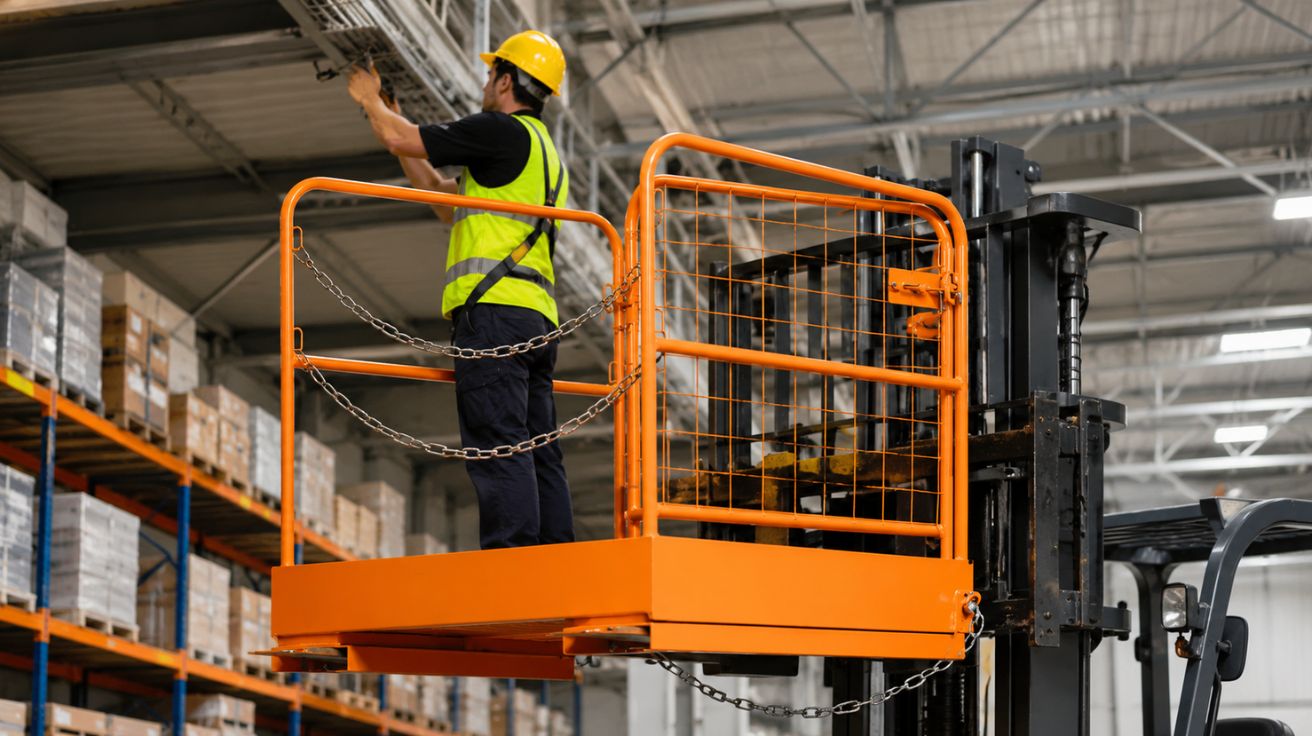
The platform attaches to standard forklift forks using safety chains or straps. The 36 by 36 inch platform provides ample standing space for one worker plus tools. The safety cage with hand rails surrounds the worker, preventing falls. The non-slip floor provides secure footing even in wet conditions.
Safety Features and Fall Protection
Falls from height are a leading cause of workplace fatalities. The work platform addresses this hazard through multiple safety features. The full-perimeter guard rail prevents workers from stepping off the edge. The kick plate prevents tools from being kicked off the platform. The cage extension provides overhead protection from falling objects in some configurations.
Key safety features:
- Full guard rail enclosure on all sides
- Non-slip floor for secure footing
- Kick plate to prevent tool falls
- Safety chain attachment to forks
- Foldable design for compact storage
Regulatory Compliance and Training Requirements
In most Canadian jurisdictions, using a forklift to lift personnel requires specific safety measures. The work platform must be approved for personnel lifting. The forklift must be inspected before use. The operator must be trained in personnel lifting procedures. The work platform provides the approved enclosure required by regulations.
Occupational health and safety regulations typically require:
- Forklift rated for the combined weight of platform, worker, and tools
- Platform securely attached to forks
- Worker wearing fall protection anchored to the platform
- Forklift operator remaining at controls during lifting
- Pre-use inspection of platform and forklift
Portability and Storage Efficiency
Unlike scissor lifts that require significant floor space, the work platform stores compactly when not in use. The foldable design reduces the platform height for storage against a wall or on a storage rack. The 800 pound capacity handles one worker with tools and materials. The 36 by 36 inch footprint fits through standard doorways.
Safety Practices and Operational Guidelines
Safe work platform operation requires several key practices:
- Verify forklift capacity exceeds total load
- Inspect platform for damage before each use
- Secure platform to forks with safety chains
- Worker must wear fall protection anchored to platform
- Forklift operator remains at controls while worker is elevated
Never move the forklift while the worker is on the elevated platform. Raise and lower the platform only when the worker is in position. The forklift must be on level ground before raising the platform. Sudden stops or starts can cause the worker to lose balance.
Advantages and Limitations
Advantages of a forklift work platform include:
- 36 by 36 inch work area
- 800 pound load capacity
- Full guard rail enclosure
- Non-slip floor for safety
- Foldable for compact storage
- Uses existing forklifts
Limitations to consider:
- Requires forklift operator during use
- Limited to forklift lift height
- Worker must wear fall protection
- Not for use on rough terrain forklifts
- Platform cannot be moved while occupied
Real-World Application Example
A Canadian warehouse in Ontario had 30 foot high racking. Replacing burned-out light fixtures required either renting a scissor lift or using a ladder. Ladders were unstable at that height. The maintenance supervisor purchased a forklift work platform. A certified forklift operator lifted the maintenance worker to the fixture height. The worker stood in the guarded platform and replaced the light safely. The platform stored against the wall when not in use.
Conclusion and Future Outlook
TMG Industrial Forklift work platforms enable Canadian warehouses to perform elevated maintenance safely without dedicated aerial lifts. The combination of guard rails, non-slip floor, and foldable design makes these platforms practical for facilities with occasional height access needs. As workplace safety regulations continue emphasizing fall protection, demand for approved personnel lifting attachments will likely increase. Future designs may include tool trays and integrated fall protection anchor points.
Safety managers should evaluate forklift work platforms for any facility requiring occasional elevated access. The 36 inch by 36 inch platform and 800 pound capacity make this attachment suitable for diverse Canadian warehouse maintenance applications.
Read More: How Risk Management Improves Large-Scale Development Projects


Leave a Comment