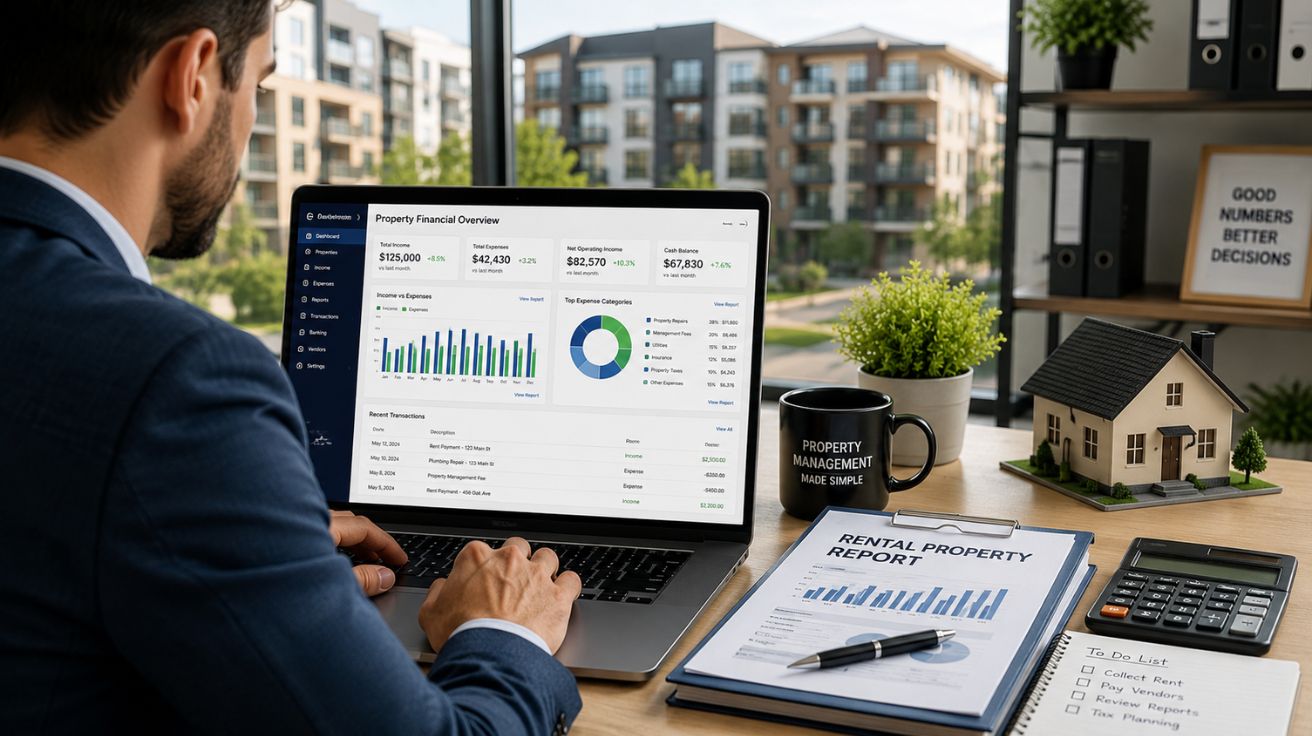

Managing rentals is a business, not a hobby. Once you’re collecting rent, paying vendors, tracking repairs, and preparing for tax season (often across multiple units), your bookkeeping system becomes the backbone of the operation. The problem is that many property managers still rely on spreadsheets, paper receipts, and “I’ll clean it up later” processes that don’t scale and don’t hold up well under pressure.
That’s why real estate management accounting software has become a must-have for modern property managers. Instead of piecing together income and expenses from multiple sources, purpose-built software centralizes your financials, reduces errors, and keeps you ready for reporting—whether it’s a monthly owner statement or an end-of-year tax filing.
What Accounting Software for Rental Property Actually Does
Rental-focused accounting software is designed to manage the financial side of rentals in one place. Rather than just tracking totals, it helps you organize the categories and documentation that rental businesses depend on—rent income, late fees, vendor expenses, deductions, and property-level reporting.
In other words, it’s not “accounting software in general.” Real estate investment accounting software is built for the reality that you’re managing repeating transactions, multiple properties, and tax-sensitive expense categories.
If you’re evaluating accounting software for real estate investors, look for tools that go beyond basic bookkeeping and support reporting, categorization, and rental workflows.
The Biggest Reasons Property Managers Need Real Estate Management Accounting Software
Automation Saves Time Every Month (Not Just at Tax Time)
Property management includes a long list of repetitive financial tasks:
- Recording rent payments
- Applying late fees
- Pulling performance reports like profit and loss
Accounting software can automate much of this documentation so you don’t have to rebuild your records by hand each month.
That time adds up fast, especially when you’re managing more than a few doors. Automation isn’t just a convenience—it’s how you protect your attention for higher-value work like leasing, tenant communication, and portfolio decisions.
Fewer Manual Entries Means Fewer Costly Errors
Manual entry is where the most common bookkeeping issues happen:
- Typos
- Duplicated transactions
- Missed expenses
- Miscategorized charges
The article highlights that many platforms reduce this by allowing imports from spreadsheets and syncing transactions from banks and cards through APIs, keeping records more accurate and current.
For a property manager, “small” errors can have real consequences:
- Overstated income can distort owner reporting and cash flow decisions
- Missing expenses can reduce legitimate deductions
- Incorrect records can delay tax prep and increase audit risk
Real estate management accounting software helps prevent those issues by reducing how often you have to touch the data manually.
Tax Prep Gets Easier When Your Books are Already Organized
Tax season is where disorganized rental accounting gets expensive—in both money and stress. The source explains that accounting software can generate tax forms and tax-ready reports, track deductible expenses, and sort expenses into IRS categories so you’re not scrambling later.
It also notes that recordkeeping matters for compliance and audit risk, since the IRS expects detailed rental records to support income and deductions. When your system is consistent all year, you’re not trying to reconstruct an entire financial history in April.
It Can Cost Less Than Paying for One-off Tax Help
Many property managers assume software is an “extra,” but the cost comparison is often the opposite. The article cites pricing context from 2023 showing that CPA fees for a basic Form 1040 were expected to average a few hundred dollars, and that adding rental-specific filing elements like Schedule E increases the total further. Meanwhile, many software subscriptions can be under $30 per month and provide year-round value.
Even if you still work with a tax professional, organized books reduce billable cleanup time—so your accountant can focus on strategy and compliance instead of data entry.
Key Features to Look for in Real Estate Investment Accounting Software
Not every platform fits every portfolio. But the article outlines several features that matter for rental operators, especially as you grow.
A User-friendly Interface
If the software is hard to navigate, you’ll avoid it—which defeats the purpose. Ease of use helps you stay consistent with rent tracking, expense entry, and reporting, even if you don’t have an accounting background.
Tailored Reporting
Property managers need visibility. Look for reports that can be customized around what you actually manage—cash flow, net income, and expense breakdowns by property or unit—so you can quickly assess performance and spot problems early.
Mobile Access
Rental issues don’t wait until you’re back at your desk. Mobile access lets you check financials, transactions, and reports while you’re in the field or between showings.
Scalability
Software should keep working when you add units and expand services. The article emphasizes choosing a system that can accommodate growth without forcing you into a major process overhaul later.
Compliance Considerations Property Managers Can’t Ignore
How you file depends on ownership structure, and that affects the records you need. The article points out that individuals typically report rental income and expenses on Schedule E, while entity owners (like some LLC structures) may use different forms (such as Form 8825) and provide income details through Schedules K-1.
That’s another reason accounting software for real estate investors matters: it helps ensure the way you track income and expenses supports the way you’re required to report it.
Putting It All Together
Accounting software is a practical upgrade that improves accuracy, reduces administrative drag, and keeps property managers prepared—month to month and year to year. If you’re still handling rental bookkeeping manually, switching to real estate investment accounting software is one of the fastest ways to reduce risk and reclaim time.
And if you want an even smoother workflow, many property managers pair accounting tools with a dedicated property management platform (for rent collection, leases, and maintenance).


Leave a Comment