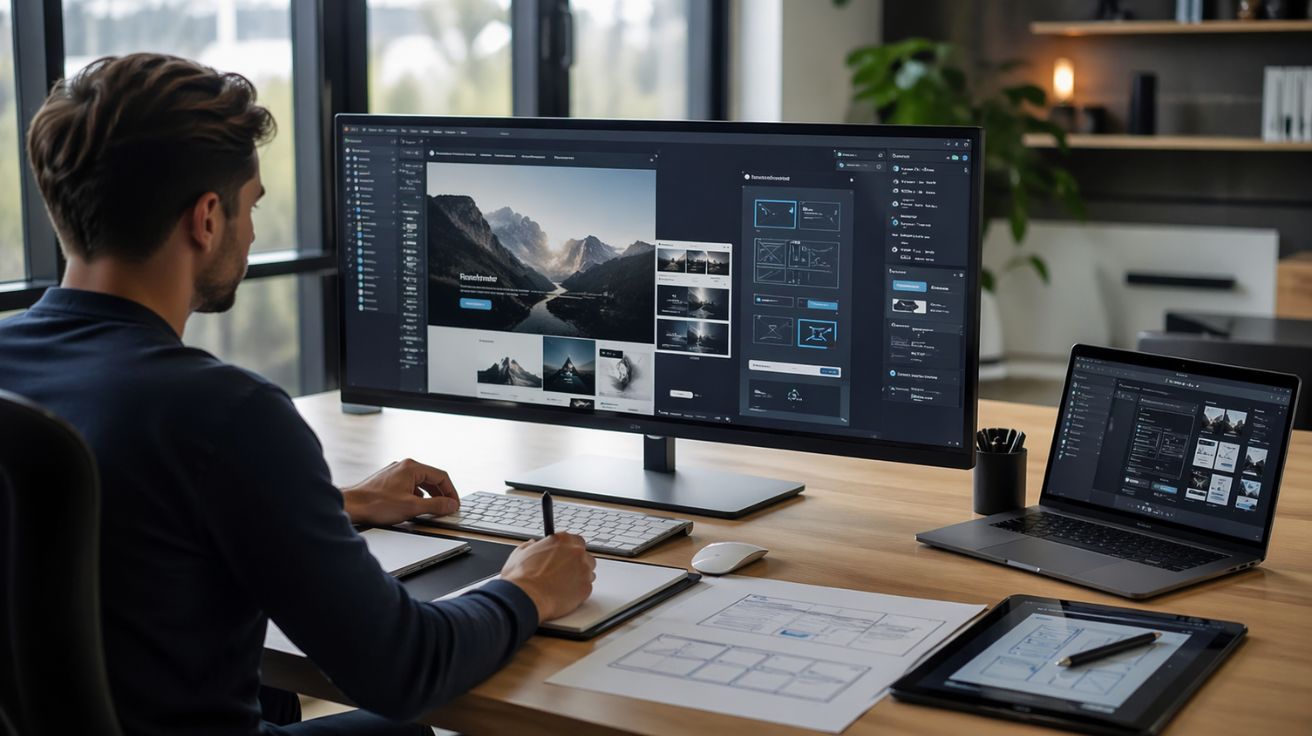

A uniquely bespoke web design is a digital ecosystem engineered from the ground up to solve specific business challenges through custom code and strategic psychology. While a template forces you to cram your business vision into a pre-defined box, a bespoke solution builds the box around your specific objectives. In today’s market, a “pretty” website is the bare minimum; the real competitive advantage lies in creating a high-performance tool that converts passive browsers into high-value clients.
The fundamental flaw with generic or template-based websites is that they are built for the masses, which inherently means they are optimized for no one. They arrive bloated with redundant code, rigid layouts, and a visual “sameness” that renders your brand invisible. We have moved past the era where simply “having an online presence” was enough. Success now demands specialized user journeys where every millisecond of load time and every pixel of the interface must earn its place.
If your digital platform isn’t actively widening your competitive moat, it’s a liability.
What “Bespoke” Really Means in Web Design
In agency circles, “bespoke” is often weaponized as a buzzword for a higher price tag. In reality, it represents a rigorous methodology rooted in data and discovery. It is the commitment to understanding a user’s cognitive load before a single wireframe is drawn.
Bespoke means technical sovereignty. Whether you need to sync a proprietary CRM, an intricate billing engine, or a custom AI-driven recommendation tool, you aren’t fighting against the limitations of a third-party theme. To read further into how these digital strategies are architected, one must look at the convergence of brand storytelling and modular engineering. It is the difference between a suit bought off the rack and one hand-stitched by a master tailor; one merely covers you, while the other is built to move with you.
Why Generic Web Design Fails Modern Businesses
Many businesses opt for templates because they offer a path of least resistance. However, as a brand matures, the “hidden tax” of the template begins to drain resources.
The Rigidity Trap
Templates are inherently inflexible. When your business model pivots or you launch a new service line, you often find the “theme” cannot adapt. This leads to “hacking” the code, creating a fragile, “Frankenstein” backend that breaks during the slightest update.
Performance Degradation
Generic designs are packaged with every feature a potential buyer might need. This results in massive code bloat. Your site ends up loading heavy scripts for elements you don’t even use, which tanks your Core Web Vitals and alienates mobile users.
Friction-Heavy Conversion
Templates are designed to look impressive in a sales demo, not to navigate a skeptical B2B buyer through a complex funnel. Here’s where things change: a bespoke site allows you to dictate the narrative flow, removing friction exactly where your data shows users are dropping off.
Core Principles Behind Truly Bespoke Web Design
Strategy Before Design
An elite agency never opens Photoshop first. The process begins with “What is the primary business objective?” Strategy involves deep-tissue competitor benchmarking and defining KPIs that actually matter to the bottom line.
Precision User Behavior
Bespoke design leverages heatmaps and rigorous user testing. We don’t guess where a user might look; we architect the visual hierarchy so that the desired action becomes the path of least resistance.
Scalable Architecture
Custom web design solutions are built for the business you will be in three years, not just the one you are today. The architecture is modular, meaning you can add features, from multilingual modules to complex ERP hooks,without starting from scratch.
Key Features That Make a Website Truly Bespoke
A modified website design focuses on “invisible” features that drive tangible results:
- Custom User Journeys: We create “branching” logic. A returning high-ticket client should not see the same interface as a first-time visitor.
- Business-Specific Functionality: Whether it’s a custom ROI calculator or a secure portal for stakeholders, these are engineered as core components, not clunky plugins.
- System Interoperability: Your website should act as your business’s central nervous system, communicating effortlessly with your CRM, inventory, and marketing stacks.
Comparison: Template vs. Bespoke
| Aspect | Template-Based Design | Bespoke Web Design |
|---|---|---|
| Flexibility | Confined by theme settings | Unlimited; built to your specs |
| Performance | High bloat; slower speeds | Clean code; optimized for speed |
| Scalability | Rigid and prone to breaking | Modular; built for future growth |
| Cost vs Value | Low entry cost; high long-term debt | High entry cost; superior long-term ROI |
| User Experience | Predictable and generic | Modified to specific user personas |
Benefits of Bespoke Web Design for Growing Businesses
The benefits of bespoke websites manifest in your balance sheet long after the site has launched.
- Superior Conversion Rates: By removing the “choice paralysis” found in generic layouts, bespoke sites guide users toward the finish line with much higher efficiency.
- Brand Authority: High-end clients can spot a template instantly. A custom site signals that you are an industry leader who values quality and detail.
- SEO Dominance: Clean, semantic code and elite performance metrics are rewarded by search engines. A bespoke site gives you the technical foundation to outrank the competition.
When Should a Business Invest in Bespoke Web Design?
Total honesty is required here: not every business needs a bespoke site immediately. If you are in the “proof of concept” stage, a template is a pragmatic choice. However, if you are scaling, have secured significant funding, or your business model relies on a unique digital workflow, a template is a bottleneck. You should invest in bespoke when the cost of lost leads and manual workarounds exceeds the investment of a custom build.
Why the Right Partner Matters
The technology is only as good as the hands that wield it. You need a partner that functions more as a consultant than a vendor. Ronins stands out because they prioritize the “why” behind every design choice, ensuring the final product is a functional business asset. By reviewing their previous work, it becomes clear how strategic engineering converts vision into market share.
FAQs
Is bespoke design significantly more expensive?
The upfront cost is higher because it requires more man-hours of high-level strategy and engineering. However, the lack of ongoing “fix-it” costs and higher conversion rates typically result in a much lower total cost of ownership.
How long is the development cycle?
A high-stakes bespoke project typically requires 12 to 24 weeks. This covers everything from deep discovery and architecture to custom development and stress testing.
Will my team be able to manage the content?
Yes. We typically build on “headless” or highly customized backends that are actually simpler to use than standard themes because we remove all the clutter your team doesn’t need.
Does this help with organic search rankings?
Absolutely. Google prioritizes user experience (UX) and speed. Bespoke sites allow for granular control over technical SEO that templates simply cannot match.
Conclusion
In a saturated digital market, a bespoke web design is the most effective way to decouple your brand from the noise. It is an investment in your company’s long-term scalability and market authority. By moving away from the “one-size-fits-all” mentality, you reclaim control over your brand narrative and your conversion funnel.
Your website should be your hardest-working employee. If it isn’t, it’s time to build a better one.
Read More: Twitch Growth Guide: How To Build Viewership From Zero With Social Media Tools


Leave a Comment