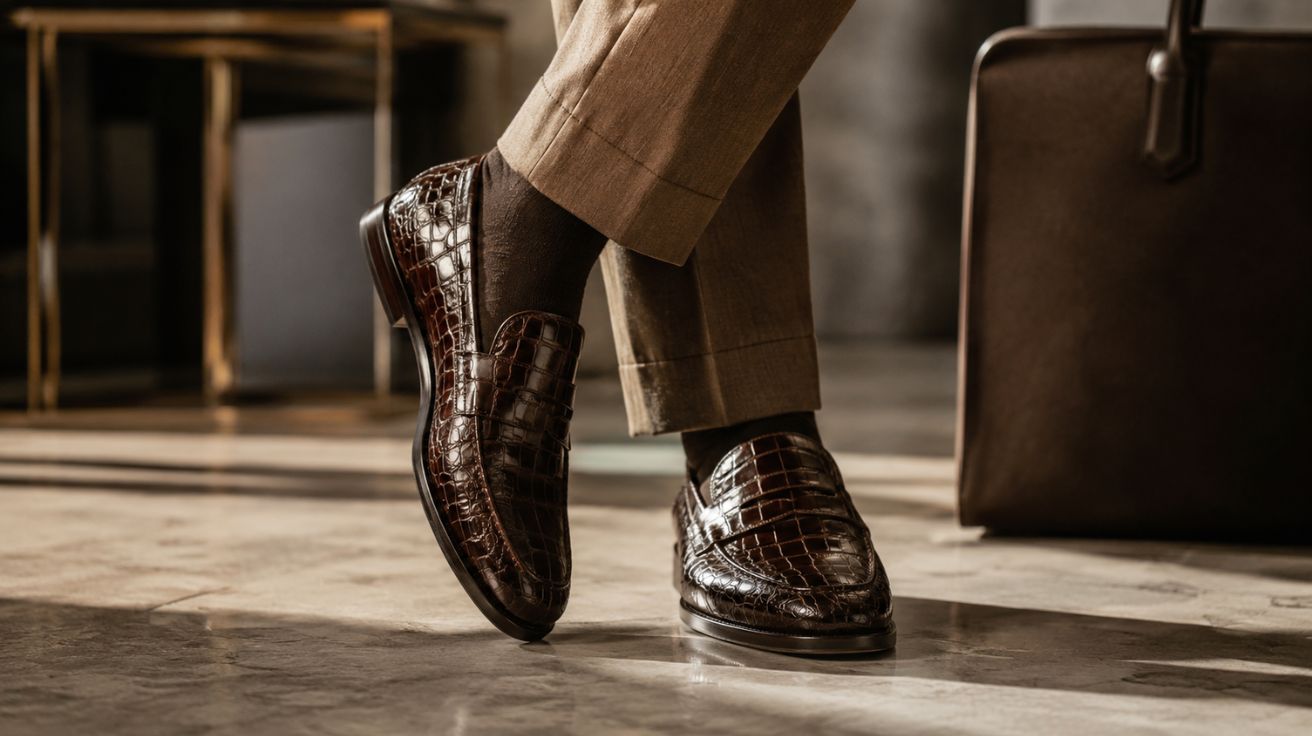

In an age of quiet luxury and conspicuous minimalism, texture has become the new status signal. And no surface carries more cultural weight than scaled skin.
The Quiet Declaration of Shoes
There is a moment, when dressing, that most men do not consciously register but that shapes everything that follows. It is the moment of choosing the shoe. Not the jacket, not the watch. The shoe. Because while every other garment can be explained or contextualized, a shoe is a declaration. It is what you stand in. And what you stand in, it turns out, tells a room quite a lot about what you stand for.
This idea has never been more relevant than right now, when the vocabulary of luxury has been quietly but completely rewritten. For most of the 20th century, status in men’s dress was communicated through logos, labels, and obvious expense. A man wearing a designer monogram was legible to anyone who could read the brand. The code was crude, but it was efficient. It worked.
Then something shifted. As luxury democratized, as fast fashion began producing convincing replicas of once-exclusive logos, the truly wealthy began to withdraw from visible branding altogether. The signal changed. Quiet luxury arrived not as a trend but as a correction — a recalibration of how those with actual refinement chose to communicate it. And in that recalibration, texture stepped forward as the primary language.
Texture as the New Status Signal
Texture, as a status signal, is almost impossible to fake. A logo can be reproduced. A silhouette can be copied. But the way light moves across a surface that has been tanned, treated, and finished over many months — that resists imitation at every price point below a certain threshold. It is felt as much as seen. People recognize it without necessarily knowing why.
No texture in menswear carries more cultural freight than scaled leather. It is the oldest luxury material in the Western wardrobe, appearing in the courts of European nobility before it appeared in any department store. It has been worn by American presidents, Italian industrialists, jazz musicians, and film directors. It communicates restraint and appetite simultaneously, which is a very rare thing for a material to achieve. It suggests that the man wearing it has taste refined enough to choose something understated, and confidence secure enough to choose something that is, unmistakably, not for everyone.
“Texture communicates restraint and appetite simultaneously — a very rare thing for any material to achieve.”
The Cultural Legacy of the Penny Loafer
The penny loafer, as a silhouette, is the ideal vehicle for this kind of communication. It is one of the most democratic and recognizable shapes in American footwear history. Originating in Norway as a fisherman’s practical slip-on, it arrived in the United States via G.H. Bass in 1936, where it was adopted by prep school students, jazz musicians, and eventually by nearly every demographic that valued looking put-together without looking like they were trying. The penny loafer says: I know the rules well enough that I do not need to perform them.
When that silhouette is executed in crocodile, the conversation becomes more complex and considerably more interesting. The casual ease of the loafer form is held in productive tension with the deliberate luxury of the skin. The result is a shoe that operates on two registers at once: approachable in shape, uncompromising in material. It is, in sartorial terms, a very sophisticated sentence.
Why Crocodile Loafers Matter Today
The modern man who reaches for a pair of crocodile loafers mens stylists and tastemakers increasingly recommend is not, in most cases, trying to signal wealth in any obvious way. He is trying to signal something more specific: that he understands quality at the level of material, that he has moved past the phase of dressing to impress and into the phase of dressing to satisfy himself. There is a difference between those two projects, and the shoe is one of the clearest places that difference becomes visible.
This is why footwear has come to occupy such a central position in the quiet luxury conversation. Clothing can be hidden beneath a coat. A bag can be set down. But shoes are always present, always in contact with the world, always absorbing the wear and light of wherever you happen to be. They age visibly. They carry a history that other garments do not. A pair of well-maintained exotic leather shoes, worn over years, tells a story of deliberate care that no new garment can replicate.
The Penny Loafer and American Identity
There is also something worth saying about the relationship between the loafer and American identity specifically. Unlike the Oxford or the Derby — both of which carry a distinctly European, slightly formal inflection — the penny loafer is an American archetype. It belongs to campus lawns and jazz clubs and the relaxed confidence of a country that, at its best, never confused formality with seriousness. Rendering it in crocodile is not a betrayal of that spirit. It is an elevation of it: taking a shape that already speaks fluent American ease and giving it the material vocabulary of deep, considered luxury.
That combination is, ultimately, what the most interesting men’s shoes have always done. They find a form that is already culturally fluent and push it into new territory — not so far that it becomes unfamiliar, but far enough that it rewards attention. The next time you find yourself looking at a man’s shoes and thinking, without quite knowing why, that they tell you something true about him, it is almost certainly the texture doing the talking. It almost always is.
Read More: Executive Guide: Summer Eye Protection & Professional Style


Leave a Comment