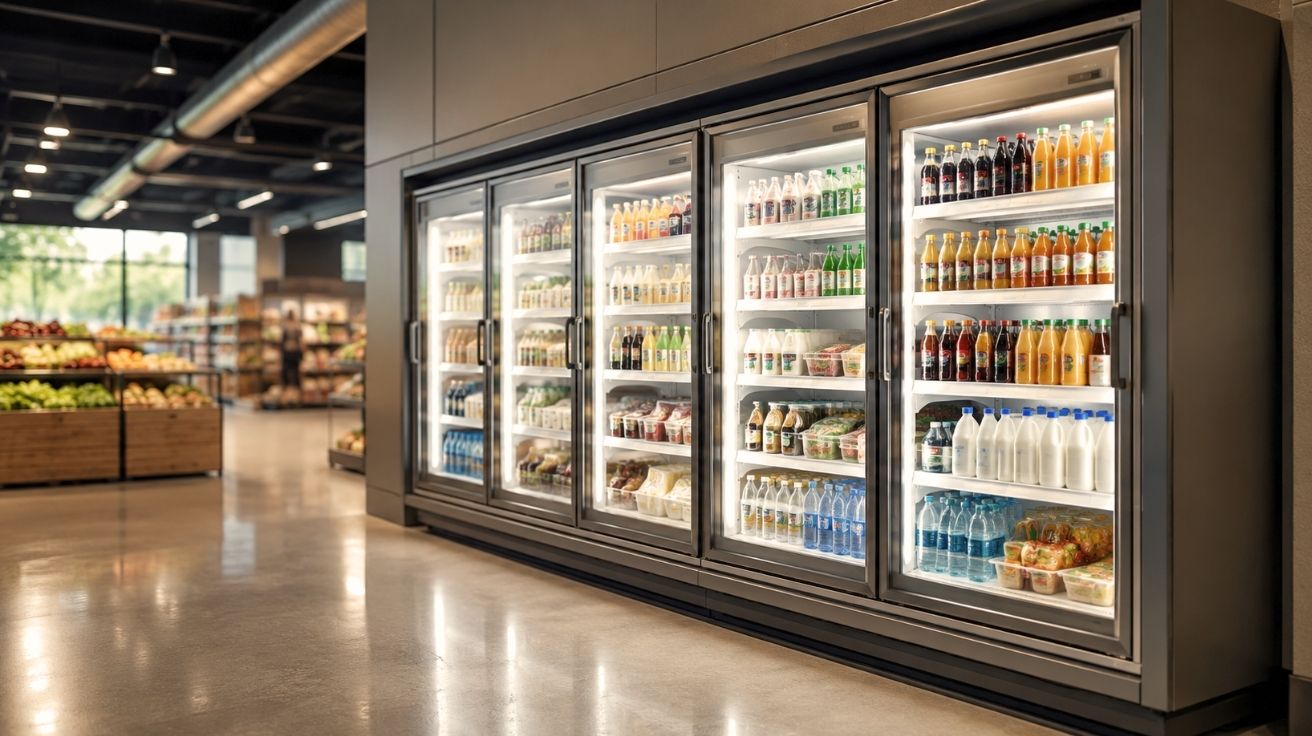

For small grocery operators, convenience store owners, restaurant managers, and food service buyers, refrigeration is not a discretionary expense. It is a core operational requirement that directly affects product quality, compliance, and daily revenue. When that equipment needs to be replaced, upgraded, or added for the first time, the purchasing decision carries real financial weight.
In 2025, the US market for commercial refrigeration equipment has shifted noticeably. Supply chain conditions have stabilized somewhat since the disruptions of prior years, but material costs, energy standards, and installation labor have not returned to pre-2020 levels. Business owners making refrigeration decisions today are operating in a cost environment that looks different from what older pricing guides or rule-of-thumb budgets would suggest.
This article breaks down the actual cost factors business owners should understand before purchasing or replacing commercial cooler equipment with sliding door access — including what drives price variation, what ongoing costs look like, and where buyers commonly underestimate the total investment.
What a Sliding Door Cooler Actually Costs in the Current Market
A sliding door cooler is a category of commercial refrigeration unit designed for high-traffic retail and food service environments, where the door mechanism needs to withstand repeated daily use while maintaining a consistent internal temperature. The sliding configuration is generally preferred over swing-door designs in tighter floor plans and high-traffic aisles, because it reduces the clearance required for operation and minimizes cold air loss during access cycles.
In 2025, entry-level commercial units from established manufacturers are generally priced between $1,500 and $3,500 for reach-in configurations. Mid-tier units with better insulation ratings, stainless interiors, and more durable door hardware fall in the $3,500 to $7,000 range. High-capacity or multi-section units designed for grocery or convenience store environments often exceed $8,000 before installation. Buyers researching specific product configurations can review available inventory options through resources like this sliding door cooler catalog to understand current product availability and configuration variety.
Why Price Ranges Vary So Significantly
The wide spread in pricing is not arbitrary. It reflects real differences in construction quality, refrigeration capacity, door hardware durability, and compliance with current energy efficiency standards. Units built for light commercial use — such as a small café or office break room — are not engineered to the same operational tolerance as units deployed in a convenience store that opens and closes dozens of times per hour.
Door hardware is one of the most consequential cost variables. Sliding mechanisms that use commercial-grade aluminum track systems and dual-pane insulated glass hold up significantly longer under daily stress than consumer-adjacent designs. The cost difference between adequate and durable hardware is often absorbed within the first year of operation, simply through reduced service calls and parts replacement.
Import Pricing Versus Domestic Manufacturing
A meaningful portion of the commercial refrigeration market is now supplied by import manufacturers, particularly from Southeast Asia. These units have become more common in the sub-$2,000 price tier and attract buyers focused on upfront cost. The tradeoff is that parts sourcing for repairs can be slower and more complicated, and the units may not carry the same certification standards that US-based operations require for health department compliance.
For buyers in regulated environments — licensed food establishments, licensed retailers, or any facility subject to inspections — the certification status of the equipment is not a minor detail. Units that lack NSF or UL certification may create compliance exposure that ultimately costs more to resolve than the original savings on equipment price.
Installation and Site Preparation Costs
The purchase price of commercial refrigeration equipment is rarely the full cost of getting it operational. Installation involves electrical work, potential flooring reinforcement, and in some configurations, minor construction to ensure proper ventilation around the compressor. These costs are frequently underestimated by first-time buyers or businesses upgrading older equipment that was installed under different conditions.
Electrical Requirements and Their Impact on Budgeting
Most commercial cooler units require a dedicated electrical circuit. Depending on the existing electrical infrastructure at the site, this can be a minor adjustment handled during a standard service call, or it can require panel upgrades and licensed electrician work that adds several hundred to over a thousand dollars to the project cost. In older retail or restaurant buildings, this is one of the most common sources of budget overrun during equipment installation.
It is worth noting that the US Department of Energy has continued to tighten energy efficiency standards for commercial refrigeration equipment, as outlined in updated federal appliance standards guidelines. Units sold in 2025 must meet more stringent energy consumption benchmarks than equipment from even five years ago. This is generally a benefit to operators over time, but it can also mean that older electrical setups were not designed with current draw requirements in mind, creating an additional layer of pre-installation assessment.
Delivery and Placement Logistics
Commercial refrigeration units are heavy, often requiring liftgate delivery service and at least two-person placement. For businesses in urban locations, buildings with freight elevator restrictions, or spaces with narrow doorways or aisles, logistics costs add up quickly. White-glove delivery and placement services are available from most commercial equipment distributors but are typically quoted separately from the unit price.
Operating Costs Over the Equipment Lifecycle
The total cost of a commercial refrigeration unit is not fully visible at the point of purchase. Energy consumption, maintenance, and eventual component replacement contribute meaningfully to what a business actually pays over the working life of the equipment. For operators managing tight margins, understanding these ongoing costs is as important as evaluating the purchase price.
Energy Consumption as a Monthly Cost Factor
Refrigeration is consistently one of the largest contributors to electricity consumption in food retail and food service environments. A single commercial cooler unit running continuously represents a substantial portion of a business’s monthly utility bill. Units with higher-quality insulation, tighter door seals, and more efficient compressors consume measurably less power over time. For operators replacing older equipment, the energy savings from a modern high-efficiency unit can partially offset the higher upfront cost within two to three years.
The condition of the door seals on a sliding door cooler configuration is particularly relevant to energy performance. Worn or improperly seated seals allow cold air to escape during and between access cycles, forcing the compressor to run more frequently. This is one of the first maintenance items that degrades silently — operators often don’t notice the increased energy draw until they compare utility bills directly.
Maintenance, Parts, and Service Contracts
Commercial refrigeration units require periodic preventive maintenance to sustain performance and avoid unplanned failures. Condenser coil cleaning, door gasket inspection, temperature calibration, and compressor monitoring are standard service tasks. Depending on the unit, these can be handled by in-house facilities staff or require a certified HVAC-R technician.
Service contracts through equipment dealers or independent refrigeration contractors typically run between $150 and $400 annually for a single unit, depending on contract terms and geographic market. Some operators choose to forgo contracts and pay for service as needed — a reasonable approach for businesses with newer equipment and low service history, but a riskier model as units age past the five-year mark.
Factors That Affect Price at the Point of Purchase
Not all buyers pay the same price for equivalent equipment. Several factors influence what a business will actually pay when purchasing commercial cooler units, and understanding them helps operators negotiate more effectively and plan more accurately.
- Volume purchasing: Businesses buying multiple units at once — such as a grocery chain equipping a new location — generally receive tiered pricing from distributors that is not available to single-unit buyers.
- Timing within the fiscal calendar: Equipment distributors often discount end-of-model-year inventory in the third and fourth quarters, creating opportunities for buyers with flexibility on timing.
- Geographic market: Installation labor, local permitting requirements, and distributor competition all vary by region, which means the same unit can cost meaningfully different amounts to bring fully online in different US markets.
- Financing terms: Leasing or financing arrangements affect cash flow differently than outright purchase, and the total cost over a lease term often exceeds the unit’s purchase price by a substantial margin when interest and fees are included.
- Trade-in or removal credit: Some distributors offer credit toward a new purchase when they remove and dispose of old equipment, which can reduce net cost and simplify logistics for the buyer.
Closing Perspective
Business owners evaluating commercial refrigeration in 2025 are navigating a market where the gap between surface-level pricing and total cost of ownership is real and consequential. The unit price is the starting point, not the full picture. Installation requirements, energy performance, service needs, and compliance considerations all contribute to what a business actually spends over the working life of the equipment.
The most common mistake buyers make is treating refrigeration as a commodity purchase — selecting based on the lowest available price without accounting for the operational environment the unit will be placed in, the regulatory requirements it must meet, or the hidden costs that emerge after installation. Equipment that appears to save money at the time of purchase often generates those savings back in service costs, energy inefficiency, or premature replacement within a few years.
A well-matched unit, properly installed and maintained, typically outperforms the economics of a cheaper alternative within two to three years of operation. For operators building or upgrading commercial refrigeration into their facilities, that longer view is the one that holds up against real business outcomes.
Read More: Top 10 Signs Your Business Needs Software to Track Labor Costs Against Sales in Real Time


Leave a Comment