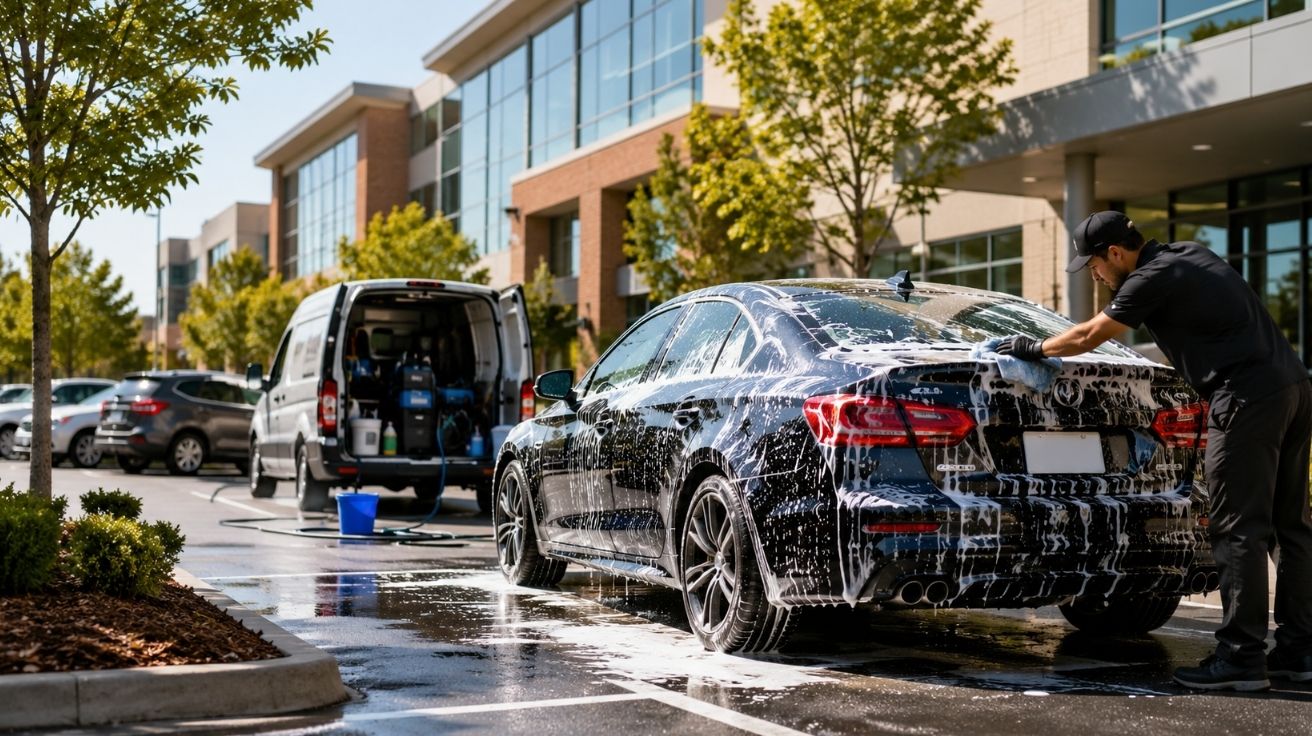

Most commercial property managers think about ROI in terms of tenant retention, occupancy rates, and capital improvements. Car washing rarely enters that conversation. Yet across retail centers, corporate campuses, mixed-use developments, and business parks, the decision to offer on-site vehicle cleaning has measurable consequences for how a property is perceived, how long visitors stay, and how tenants evaluate their lease renewals. The value isn’t obvious at first glance, which is exactly why it tends to be overlooked until a competitor offers it first.
This article examines the operational and commercial logic behind adding vehicle cleaning services to a commercial property, and why the return on that decision often exceeds what property managers initially expect.
What a Parking Lot Car Wash Actually Represents for a Commercial Property
A parking lot car wash is a mobile or scheduled vehicle cleaning service brought directly to a property’s parking area, allowing vehicles to be cleaned while owners are already on-site for another purpose. It eliminates the need for drivers to make a separate trip to a car wash facility, which changes the service from something people plan around to something they simply benefit from. That shift in user experience has implications that go beyond convenience.
For property managers, this type of service functions as an amenity layer — similar to adding EV charging stations or covered parking — but with lower infrastructure demands. The service is typically operated by a third-party provider, requires no permanent installations in most configurations, and can be scaled based on property size and visitor volume. What it provides to the property, however, is a tangible, visible differentiator that tenants and visitors notice immediately.
The Difference Between an Amenity and a Value Driver
There is a meaningful distinction between an amenity that people appreciate in theory and one that influences real behavior. Free coffee in a lobby is appreciated. A gym that opens at 5 a.m. retains tenants. A parking lot car wash falls into the second category because it directly reduces friction in a person’s day. Employees who park for eight hours can return to a clean vehicle without adjusting their schedule. Retail shoppers who spend an hour in a center leave with a better overall impression of the visit. This type of embedded convenience shifts how people feel about a location without them necessarily articulating why.
In competitive commercial real estate markets, these subtle behavioral effects compound over time. Tenants notice when their employees comment positively about the building. Retailers notice when dwell time increases. The amenity becomes part of the building’s identity rather than just a line item in the property brochure.
How the Economics Work Without Direct Revenue Generation
One of the reasons commercial property managers hesitate to introduce vehicle cleaning is the assumption that it only makes financial sense if the property charges for it. In reality, the most common model involves a third-party provider who either operates independently on-site or charges tenants directly, leaving the property with no direct cost exposure but all of the reputational benefit. Some properties do negotiate revenue-sharing arrangements, but that is secondary to the primary value proposition.
The real financial case rests on indirect returns: lower tenant churn, higher lease renewal rates, and stronger positioning during new tenant negotiations. According to research published by the Building Owners and Managers Association, building amenities consistently rank among the top factors tenants cite when deciding whether to renew commercial leases. When a property offers services that reduce daily friction for employees and visitors, it directly addresses one of the most common reasons tenants begin exploring alternatives.
Tenant Retention and the True Cost of Vacancy
Vacancy is expensive in ways that are not always fully accounted for in operating budgets. Beyond lost rent, vacancy creates costs associated with re-leasing commissions, tenant improvement allowances for new occupants, and the reputational effect of visible empty space. When a property retains a tenant who might otherwise have left for a competitor building offering more modern amenities, it avoids all of those downstream costs. A parking lot car wash service, if it contributes even modestly to that retention, generates a return that is disproportionate to the cost of offering it.
This is particularly relevant in markets where the gap between available commercial space and tenant demand is narrow. In those environments, tenants evaluate properties more carefully, and differentiated amenities carry more weight in the decision-making process.
Operational Considerations That Property Managers Often Underestimate
Introducing any third-party service into a commercial property involves coordination, liability management, and scheduling discipline. Vehicle cleaning services are no different. The operational side of a parking lot car wash program requires attention to water management, vehicle handling protocols, insurance verification, and access scheduling. Properties that treat this as a simple vendor arrangement without these considerations tend to encounter avoidable problems.
Water drainage in parking structures and surface lots is a genuine concern. Depending on local environmental regulations, runoff from vehicle cleaning must be managed appropriately. Reputable service providers operate with water containment or reclamation systems that address this, but property managers should verify these practices before signing any service agreement. Environmental compliance is not an area where assumptions are appropriate.
Scheduling and Visitor Flow Management
The timing of vehicle cleaning operations matters more than most property managers anticipate. A service running during peak arrival and departure windows creates congestion and frustration rather than convenience. The most effective programs are scheduled during mid-day periods or staggered across zones to avoid interfering with normal traffic flow. Properties that establish clear operational windows and communicate them to tenants in advance see significantly better reception than those that introduce the service without structure.
Communication also plays a role in perception. When tenants and their employees understand how the service works, when it operates, and what to expect, they engage with it as a benefit. When it appears unannounced or without explanation, it can generate confusion or concern about vehicles being moved or accessed without clear authorization.
Liability, Insurance, and Vendor Vetting
Vehicle damage claims, however rare, are a realistic exposure when any service operates in a parking area. Property managers should require that service providers carry appropriate commercial liability coverage and name the property as an additional insured where applicable. This is standard practice across most professional service contracts but is sometimes skipped in informal arrangements. A well-structured vendor agreement that outlines responsibility for damage, operating boundaries, and incident reporting procedures protects both parties and reduces ambiguity if problems arise.
The Visitor Experience Effect and Its Commercial Consequences
Commercial properties are increasingly evaluated not just by the quality of their interior spaces but by the overall experience of being there. Parking areas, which are often the first and last touchpoint of any visit, set the tone for that experience in ways that are easy to underestimate. A well-maintained lot with an active, professional cleaning service signals that the property is managed attentively. That signal extends to how visitors perceive the tenants operating within it.
For retail and mixed-use properties specifically, the relationship between visitor experience and commercial performance is direct. Shoppers who feel that a center is well-maintained and thoughtfully managed spend more time there. That extended dwell time increases the probability of additional purchases and return visits. A parking lot car wash contributes to the maintenance signal even on days when it is not actively operating, simply because its presence implies a standard of care that visitors register, even if they cannot immediately identify its source.
How Tenants Use Amenities in Their Own Recruitment and Retention Efforts
Commercial tenants — particularly office occupants — compete for talent in the same way that properties compete for tenants. When a building offers amenities that employees value, tenants can incorporate those amenities into their own workplace communication. An office that can tell prospective hires that their vehicle will be cleaned while they work is offering something that most competitors cannot match. This type of secondhand value creation strengthens the tenant’s connection to the property and increases the practical cost of relocating, which is one of the most reliable forms of tenant retention available to property managers.
Closing Thoughts
The return on offering a parking lot car wash at a commercial property is rarely immediate and almost never appears on a single line in a financial model. It accumulates through lower vacancy exposure, stronger tenant relationships, improved visitor perception, and a property identity that stands apart in a market where most buildings offer the same standard set of features. The service itself is straightforward. The decision to offer it, however, requires understanding how indirect value is created in commercial real estate and being willing to act on it before the building across the street does. Property managers who treat amenities as a strategic layer rather than a cost center are typically the ones whose properties perform more consistently across market cycles. Vehicle cleaning is a small piece of that, but it is a piece that is consistently underestimated.


Leave a Comment