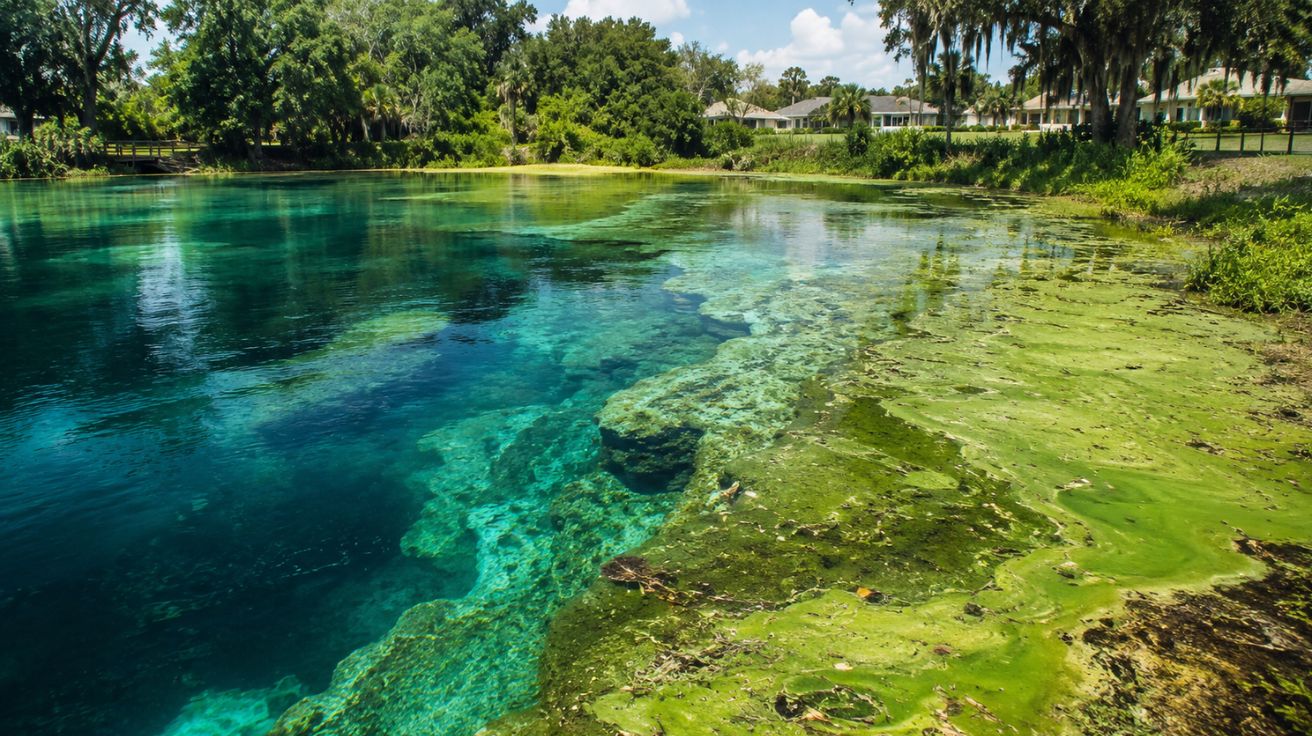

Florida sits atop one of the most productive aquifer systems in North America. The Floridan Aquifer — a vast underground reservoir of limestone-filtered freshwater stretching beneath nearly the entire state — supplies drinking water to millions of residents, feeds hundreds of springs, sustains ecosystems that exist nowhere else on earth, and supports agriculture across the region. It is one of Florida’s most critical natural assets, and it is under pressure from a source that doesn’t make headlines as often as industrial pollution or urban runoff: the septic systems serving roughly 2.7 million Florida homes.
The connection between residential septic systems and groundwater quality is not complicated. It is simply underexamined by the people living above those systems.
How The Contamination Pathway Works
A conventional septic system treats wastewater in two stages. The septic tank separates solids from liquid, with anaerobic bacteria beginning the decomposition process. The clarified liquid — effluent — then flows into the drain field, where it percolates through the soil. In ideal conditions, the soil filters pathogens and absorbs excess nutrients before the water reaches the water table. In Florida, the conditions are frequently not ideal.
The state’s geology is the fundamental problem. In many parts of Central and North Florida, the soil layer between the surface and the aquifer is thin, sandy, and highly permeable. Water — and whatever it carries — moves quickly through it. The slow, multi-stage filtration process that removes nitrogen, phosphorus, and pathogens from septic effluent in the kind of deep clay soils found in other regions simply doesn’t have enough depth or contact time to work in many Florida locations.
The result is that nutrients from septic effluent — primarily nitrogen in the form of nitrates — move through the soil and into the aquifer at rates that conventional systems were not designed to address. Once in groundwater, nitrates travel with the water table, eventually surfacing in springs, lakes, rivers, and coastal estuaries.
The Spring Problem That Reveals The Scale
Florida’s freshwater springs are among the most visible indicators of what is happening in the aquifer. Historically, Florida’s springs ran clear and cold, with remarkably low nutrient levels maintained by the natural filtering properties of the limestone aquifer. In recent decades, many have been overtaken by dense growth of algae and aquatic plants — a direct response to elevated nitrogen concentrations in the water flowing from the aquifer.
State water management districts and environmental researchers have extensively documented this trend. In spring systems where detailed studies have been conducted, septic system nitrogen consistently emerges as a significant contributor to the nutrient load — in some cases the dominant one, particularly in spring catchment areas with dense residential development that predates more stringent treatment requirements.
Downstream, the nitrogen that originates in residential septic systems contributes to the algal blooms that have made Lake Okeechobee and Florida’s coastal estuaries internationally notorious. The connection is diffuse and travels through complex hydrological pathways, which makes it easy to underemphasize in conversations dominated by agricultural runoff and point-source industrial discharge.
But the volume is not small. Millions of conventional systems, each discharging effluent that has not had nitrogen removed, collectively represent a substantial ongoing nutrient load to Florida’s water systems.
Why Florida’s Geology Makes This Uniquely Acute
The same karst limestone geology that makes the Floridan Aquifer so productive also makes it extraordinarily vulnerable. Karst topography is characterized by dissolution features — sinkholes, fractures, and conduits in the limestone — that create direct pathways between the surface and the aquifer. In areas with karst topography, the assumption that soil will filter septic effluent before it reaches groundwater can be almost entirely false. Effluent can travel through a sinkhole or fracture directly into the aquifer without meaningful filtration.
This is one of the reasons that what is an aerobic septic system has become a practically important question for Florida homeowners — particularly those on smaller lots, near water bodies, over high water tables, or in designated groundwater protection zones. Aerobic treatment units address the nitrogen problem differently from conventional systems: by introducing oxygen into the treatment process, they support aerobic bacterial activity that more completely breaks down organic matter and reduces nitrogen concentrations in the effluent before it ever reaches the soil.
The effluent discharged to the drain field is measurably cleaner, and some aerobic systems include final disinfection steps that reduce pathogens to levels approaching reclaimed water standards.
The Regulatory Direction Of Travel
Florida has been tightening its septic system regulations with increasing urgency over the past decade, and the trend line is clear. Several counties in ecologically sensitive areas have already implemented requirements for advanced treatment systems — or for connection to municipal sewer — in zones where conventional systems pose documented groundwater risks. The Florida Department of Health and the state’s water management districts have both been pushing for more comprehensive transition plans, and legislative discussions about statewide upgrade requirements for systems near water bodies have become a regular feature of the annual session.
For homeowners, this regulatory direction means that the question of whether their current system meets future standards is becoming more pressing than it might appear. A conventional system that complies with today’s requirements in a given location may not comply with the requirements that will be in place when the property changes hands or when a new permit is required.
The groundwater beneath Florida is a shared resource. The systems that process household waste above it are not a separate concern — they are part of the same conversation, whether or not that connection is comfortable to acknowledge.
For more interesting topics visit NV Times


Leave a Comment