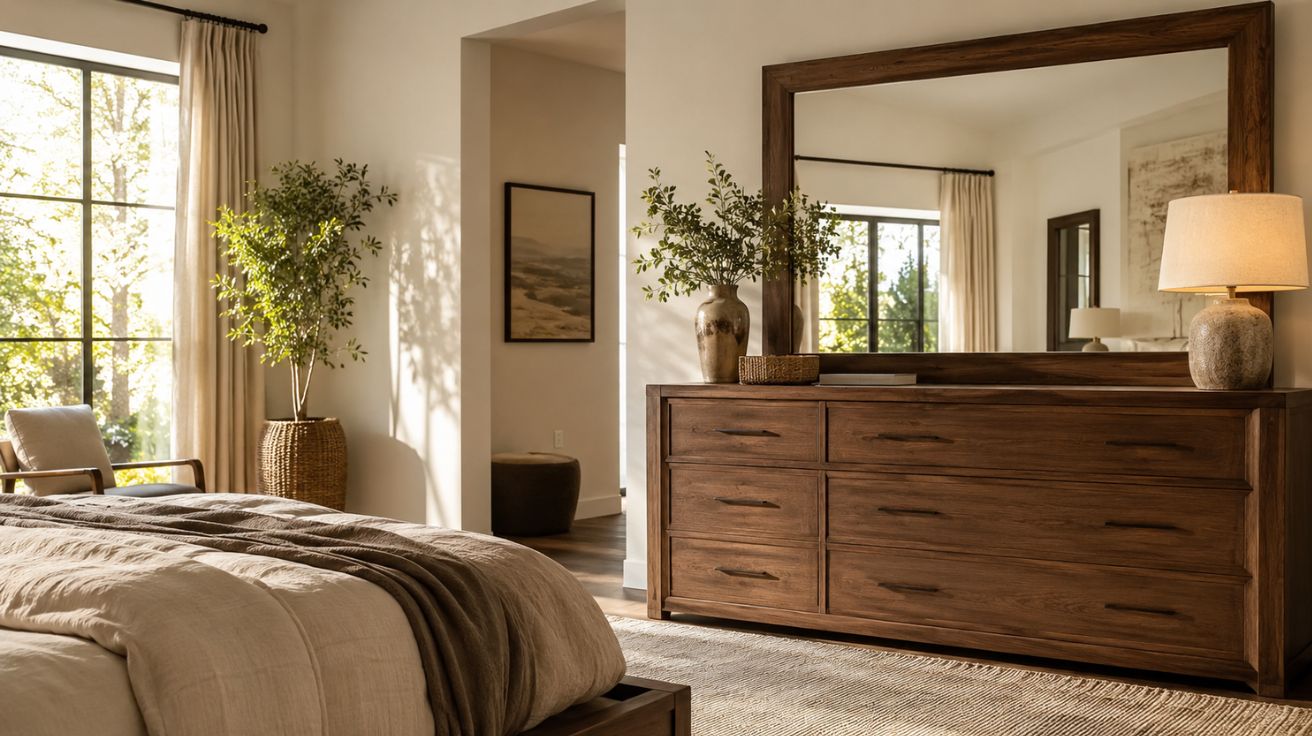

The Physics of Reflected Light.
To understand why placement matters so much, it helps to think about what a mirror actually does: it reflects. What it reflects is determined entirely by what it faces. A mirror that faces a wall reflects the wall. A mirror that faces a window reflects the window — and in doing so, effectively creates a second light source in the room, bouncing natural daylight into corners and onto surfaces that the original window could never reach directly. This is one of the oldest tricks in the interior designer’s toolkit, and it is as effective in a small Maine bedroom in February as it was in an eighteenth-century French salon.
The implication is important: a mirror should almost never face a blank wall if there is any other option. The most valuable placement for a mirror is directly opposite, or at an angle to, the room’s primary source of natural light. In a bedroom, this typically means placing the mirror on the wall that faces the window rather than beside it — so that the glass catches and redistributes daylight across the room rather than simply reflecting back the interior.
The Size Mistake Almost Everyone Makes.
The most common mirror sizing error is choosing one that is too small for the wall or space it’s intended to occupy. A compact mirror on a large wall creates a visual discontinuity — the eye registers the mirror as a small object in a large field rather than as a defining element of the composition. It floats awkwardly rather than anchoring the space.
Interior designers use a general rule that is worth knowing:
- A mirror hung above a piece of furniture — a dresser, a console, a sideboard — should be approximately two-thirds to three-quarters the width of the surface beneath it.
This ratio creates visual balance between the horizontal furniture mass and the vertical reflective element above it. A mirror that is narrower than half the furniture width below it will always look like an afterthought regardless of how beautiful it is on its own.
Floor mirrors have their own sizing logic. A full-length floor mirror leaning against a wall should be tall enough to reflect a standing person from at least mid-torso up, and ideally from head to toe. The lean, rather than the hang, is part of the design intention — it creates a casual architectural quality that wall-mounted mirrors at the same scale cannot achieve.
The Frame Is Furniture, Not Decoration.
One of the reasons mirrors are frequently underchosen is that buyers focus on the glass and treat the frame as a secondary consideration — essentially packaging. This is the wrong way to think about it. In a room where the mirror is hung above a dresser or beside a bed, the frame is in constant visual conversation with every other piece of solid material in the space. It should be selected with the same care as any other piece of furniture.
A solid wood frame — particularly one from a maker who treats the frame as genuine cabinetry, with proper joinery, quality finish, and material consistency with the bedroom’s other pieces — integrates into a room’s design in a way that a cheap stamped frame simply cannot. The investment is visible in daily life, in the way the piece holds its presence in the room rather than receding into background noise.
For homeowners in southern Maine exploring mirrors in Portland, ME, the distinction between a mirror selected as a commodity and one chosen as a considered design element becomes especially apparent when seen alongside quality bedroom furniture — where the frame’s material and finish either harmonize with the room’s other woodwork or undercut it.
Placement Errors That Undermine Everything.
The single most widespread mirror placement mistake is hanging it too high. This happens for a understandable reason — people tend to hang mirrors at the same height they hang artwork, which is usually centered at eye level for a standing adult. But a bedroom mirror hung at this height will reflect the ceiling more than the room, and will show a standing person’s forehead rather than their full face.
The general rule for a mirror hung above a dresser is to position it so that the lower edge sits four to eight inches above the furniture surface — close enough to feel connected to the piece below it, and low enough to actually reflect the person standing in front of it.
Getting these decisions right — size, placement, frame, orientation to light — transforms a mirror from a practical object into the room’s most dynamic design element. No renovation required.
Read More: Kids Bookshelves: How To Choose The Right One For A UK Child’s Bedroom


Leave a Comment