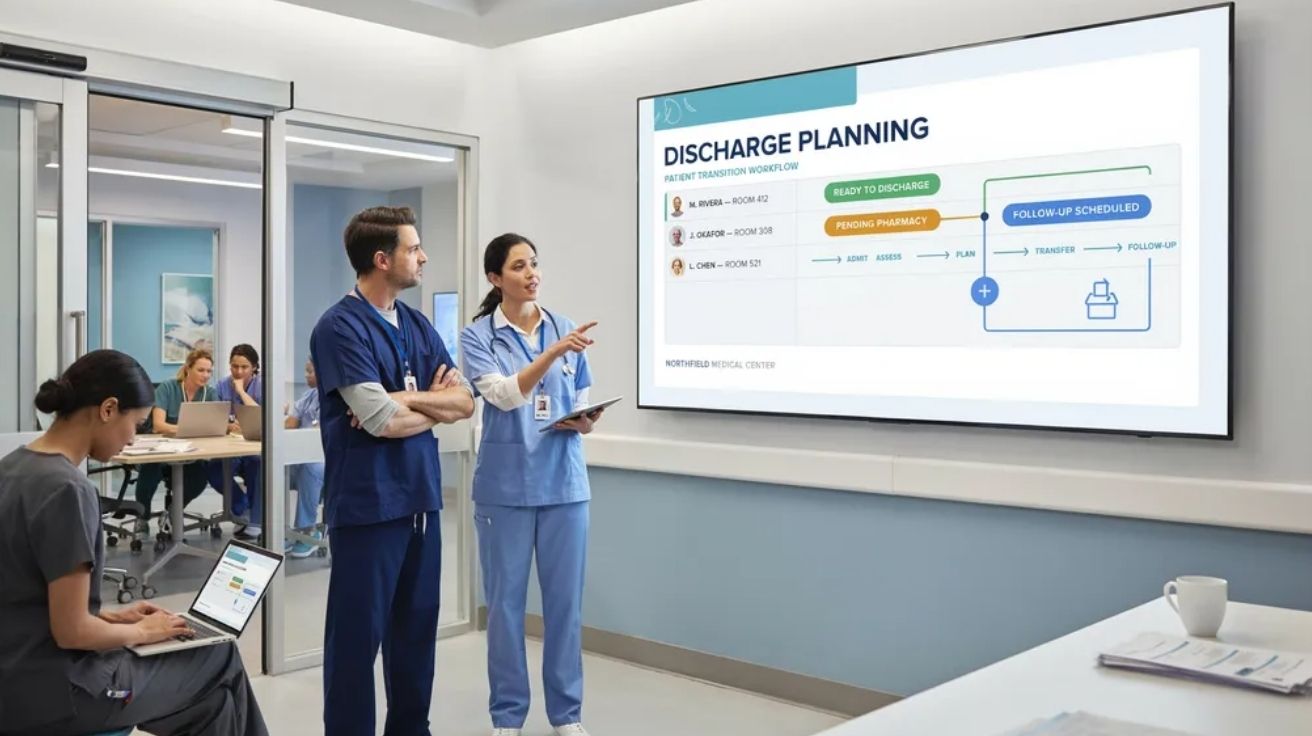

Hospital discharge is one of the most operationally dense moments in a patient’s care journey. It involves coordinating between clinical teams, case managers, post-acute providers, payers, and patients themselves — often under time pressure and with incomplete information. When that coordination breaks down, the consequences are measurable: delayed beds, preventable readmissions, care gaps, and strained staff resources.
Across US health systems, discharge planning has gradually shifted from a paper-based, case-manager-driven process to one that relies heavily on software to manage workflows, track patient status, and coordinate transitions of care. But the technology market for discharge planning tools has matured unevenly. Some platforms are deeply integrated with electronic health records. Others operate as standalone tools. Some prioritize post-acute placement. Others focus on care coordination documentation or communication between providers.
For health system administrators, case management directors, and clinical operations leaders evaluating these tools, the challenge is not finding options — it is knowing how to evaluate them against the specific demands of their patient population, care setting, and operational structure. This framework is designed to support that evaluation process in a structured, grounded way.
Understanding What Discharge Planning Software Actually Does
Discharge planning software is a category of clinical operations technology designed to organize and manage the workflow of transitioning patients out of acute care settings into the appropriate next level of care. This includes identifying post-acute needs, coordinating with skilled nursing facilities or home health agencies, documenting clinical criteria for placement decisions, communicating with payers, and tracking patient status until the transition is complete.
The scope of what these tools handle varies considerably. Some focus narrowly on post-acute referral management — helping case managers identify facilities, send clinical documentation, and track acceptance responses. Others include broader care coordination features such as length-of-stay management, social determinants of health screening, and discharge barriers tracking. A thorough Patient Discharge Planning Software guide can help health system teams map the available categories of functionality against their specific operational requirements before beginning vendor conversations.
Understanding the functional scope is important because purchasing a narrowly focused tool for a health system with complex social and clinical discharge barriers — or buying a feature-heavy platform for a smaller facility with simpler workflows — creates its own operational friction. The first step in any evaluation is defining what discharge planning means within your organization, not what a vendor defines it to be.
Referral Management Versus Care Transition Coordination
These two concepts are often treated as interchangeable, but they reflect different operational realities. Referral management is transactional: a case manager identifies a post-acute provider, sends clinical information, and tracks acceptance. Care transition coordination is relational and longitudinal: it involves managing communication across multiple parties over the full arc of the patient’s movement from hospital to community.
A platform built primarily for referral management may handle the transactional elements efficiently while leaving gaps in follow-up communication, readmission risk tracking, or patient and family engagement. Health systems that experience high readmission rates often find that the discharge event itself was managed appropriately, but the transition period following discharge was not adequately supported. Knowing which problem your organization is trying to solve helps determine which type of tool actually fits.
Evaluating Integration With Existing Clinical Systems
Patient discharge planning software does not operate in isolation. It sits within an existing technology environment that typically includes an electronic health record, a case management module, a utilization management system, and possibly separate tools for social work documentation or payer communication. How well a discharge planning platform connects with these systems directly affects whether it reduces or adds to the documentation burden on clinical staff.
Integration is a practical concern with real workflow consequences. If a case manager must manually transfer patient information from the EHR into the discharge planning tool, the risk of data entry errors increases and the efficiency gains from using the software are partially offset. If the platform cannot pull admission data, diagnosis codes, or length-of-stay information automatically, staff will compensate with workarounds — which eventually become normalized gaps in process.
HL7 and FHIR Compatibility in Practice
Most established EHR vendors and a growing number of clinical software platforms support data exchange using standards developed and maintained by Health Level Seven International, the organization responsible for the HL7 and FHIR standards that govern clinical data interoperability in the US. Discharge planning platforms that support these standards are more likely to integrate cleanly with major EHR systems without requiring custom development.
That said, integration capability on paper does not always translate to smooth implementation in practice. During vendor evaluation, it is worth asking specifically which EHR systems the platform has live, tested integrations with — not just which standards it supports. References from health systems using the same EHR as yours provide more useful information than technical documentation alone.
Impact on Case Manager Workflow
The people who use discharge planning software daily are typically case managers and social workers operating under significant caseload pressure. A platform that requires excessive data entry, has a non-intuitive interface, or generates notification overload will face adoption resistance regardless of its feature set. Workflow fit is not a secondary consideration — it is a primary one. During any evaluation process, involving frontline case management staff in demonstration sessions and pilot testing is essential to getting an honest picture of usability.
Assessing Post-Acute Network Coverage and Placement Capabilities
For health systems with significant volume of patients requiring post-acute placement — skilled nursing, long-term acute care, inpatient rehabilitation, or home health — the quality and breadth of the platform’s post-acute provider network matters directly to operational outcomes. A discharge planning tool that connects to a narrow set of post-acute facilities, or that lacks real-time visibility into facility bed availability and clinical capabilities, creates placement delays that affect throughput, patient experience, and potentially care quality.
Some platforms maintain their own networks of post-acute providers. Others integrate with third-party directories or rely on health system-maintained provider lists. Each approach has tradeoffs. A platform-maintained network may offer more reliable and current data but may not reflect the specific provider relationships your health system has built over time. A system that allows you to manage your own preferred provider lists may offer more flexibility but requires ongoing administrative maintenance.
Matching Patient Clinical Profile to Post-Acute Capabilities
Placement decisions are not simply about finding an available bed. They involve matching a patient’s clinical needs — wound care requirements, rehabilitation intensity, medication management complexity, behavioral health conditions — to the capabilities of available facilities. Software that supports this matching process with structured clinical criteria helps reduce inappropriate placements and subsequent transfers, which are costly for health systems and disruptive for patients.
The more structured and consistent the platform makes the clinical matching process, the less dependent outcomes are on individual case manager knowledge of specific facilities. This is particularly relevant in health systems with high staff turnover or large geographic service areas where consistent knowledge of post-acute capabilities is difficult to maintain.
Compliance, Documentation, and Audit Readiness
Discharge planning in US health systems operates within a defined regulatory framework. The Centers for Medicare and Medicaid Services establishes conditions of participation that include specific requirements around discharge planning processes, patient choice in post-acute selection, and documentation standards. Accreditation bodies have their own standards that overlap with and in some areas exceed CMS requirements.
Software that supports structured documentation of discharge planning activities — including evidence of patient and family engagement, the basis for placement recommendations, and the timeline of key decisions — reduces compliance risk and simplifies audit preparation. When regulatory reviewers or surveyors examine discharge planning practices, having a consistent, auditable record in a dedicated system is significantly more defensible than reconstructing a timeline from scattered EHR notes.
Documentation Consistency Across Care Teams
One of the less-discussed benefits of structured discharge planning software is its effect on documentation consistency. In environments where discharge planning is managed through EHR notes, email chains, and verbal communication, the quality and completeness of documentation varies by individual. A dedicated platform with required fields, structured workflows, and time-stamped activity logs reduces that variability — which matters not just for compliance but for internal quality improvement and staff accountability.
Vendor Stability and Implementation Support
Software selection is not purely a functional decision. The operational relationship with a vendor — including their implementation approach, ongoing support model, and long-term product development direction — affects how well the platform performs in practice over time. A technically capable platform with poor implementation support will underperform expectations. A platform with strong implementation services and responsive account management will adapt more successfully to your organization’s evolving needs.
Health systems should evaluate vendors on their experience implementing in comparable care environments, the clarity of their implementation timeline and training approach, and the resources they provide for ongoing optimization after go-live. Pilot programs or phased implementations allow organizations to validate real-world performance before full-scale deployment — and to surface integration or workflow issues before they affect the entire care management operation.
Total Cost of Ownership Beyond Licensing
Software pricing models vary. Some platforms charge per bed or per discharge. Others operate on enterprise licensing. Understanding total cost of ownership requires accounting for implementation fees, staff training time, ongoing support costs, integration development expenses, and the internal resources required to administer the system. A lower licensing cost can be offset by higher implementation complexity or greater administrative overhead. Evaluating cost in isolation from operational impact leads to decisions that look favorable on paper but create unforeseen burden in practice.
Building a Selection Process That Reflects Organizational Reality
Selecting patient discharge planning software is a cross-functional decision. It involves clinical operations, case management, information technology, compliance, and finance. A selection process that is driven exclusively by one department — whether IT or clinical leadership — tends to optimize for that department’s priorities at the expense of others. Building a structured evaluation team with representation across these functions, and defining shared criteria before beginning vendor demonstrations, produces a more balanced and durable decision.
Criteria should be weighted rather than treated as a simple checklist. Integration compatibility may be non-negotiable. Post-acute network coverage may be highly important but not absolute. Specific documentation features may be desirable but not essential. Making these weights explicit before the evaluation prevents late-stage disagreements driven by differing assumptions about what matters most.
Structured reference checks with health systems of similar size, case mix, and EHR environment provide information that vendor demonstrations cannot. Peer institutions that have used the platform for at least two years can speak to implementation reality, staff adoption experience, and the vendor’s responsiveness when problems arise — details that are rarely visible in a formal sales process.
Conclusion
Choosing the right patient discharge planning software requires more than comparing feature lists. It requires an honest assessment of where your current process fails, what your clinical and operational environment demands, and how a technology platform will interact with the people and systems already in place.
The most effective selection processes start with internal clarity — about workflow gaps, integration constraints, compliance requirements, and staff capacity — before moving to vendor evaluation. Platforms that align with those realities and are supported by responsive implementation teams tend to perform significantly better than technically superior tools that are poorly matched to organizational context.
Health systems that approach this decision methodically, involve the right internal stakeholders, and test assumptions against real-world references are better positioned to implement tools that reduce discharge delays, support regulatory compliance, and improve transitions of care over time. The investment in a structured selection process pays its dividend in a smoother implementation and a platform that genuinely supports the people responsible for getting patients to the right care setting safely and efficiently.
Read More: Why Representation Matters in Building Trust With Mental Health Professionals


Leave a Comment