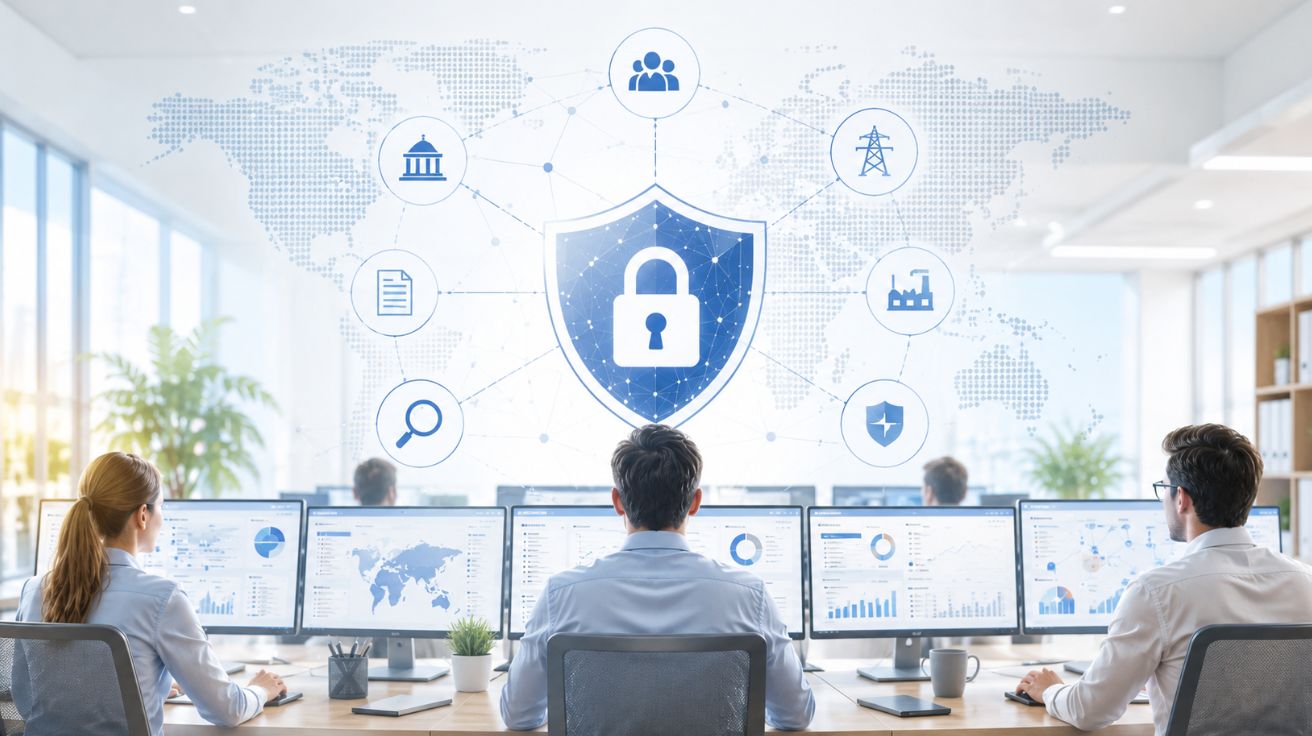

Security operations does not function in isolation. The threats that enterprise security teams face are not unique to any single organization they are documented across sectors, analyzed by government agencies, and tracked by industry consortia whose entire purpose is to share that intelligence with the organizations in their member communities. The teams and programs that engage with these external networks gain access to threat context that would be impossible to develop independently. SecOps, when practiced at maturity, is as much about how an organization connects with the broader security ecosystem as it is about the internal tools and processes it operates.
Why Collaboration Multiplies the Value of Internal SecOps Capability
A security operations team working entirely on its own telemetry and threat research operates with a narrow field of view. It can see what is happening inside its own environment, but it cannot see the early indicators of a campaign that has not yet reached it, the technique an attacker used successfully against a peer organization last week, or the infrastructure being staged for an attack that has not begun.
External collaboration expands this field of view without requiring the internal team to generate the intelligence themselves. When a threat actor is actively targeting organizations in a specific sector, the first organizations to be hit will have indicators of compromise, observed tactics, and recovery insights that can dramatically shorten the detection and response time for every organization that receives that information before the attacker reaches them.
Understanding SecOps benefits for team collaboration as extending beyond the internal team reframes the security operations function as a node in a larger defensive network rather than a self-contained protective system.
Information Sharing and Analysis Centers
Information Sharing and Analysis Centers ISACs are sector-specific organizations that exist to collect, analyze, and distribute cyber threat information among member organizations. They operate across virtually every critical infrastructure sector, including financial services, energy, healthcare, transportation, communications, and water systems. Their defining characteristic is that they operate on a trust model: member organizations share threat information with the ISAC and, in return, receive aggregated, anonymized intelligence from the entire membership base.
For enterprise security operations teams, ISAC membership provides several direct operational benefits. Early warning of campaigns targeting the sector arrives via ISAC alerts before those campaigns reach every member organization, giving security teams time to implement proactive defensive measures. Indicators of compromise shared by other members can be operationalized directly into detection rules and threat intelligence platforms. And the ISAC community provides a vetted network of peer security contacts at other organizations people who can be reached directly when a team needs to understand whether a suspicious activity pattern is being seen more broadly.
The value of these shared networks in building effective enterprise cyber defenses is well documented. Guidance on how information sharing between private sector organizations and government serves as a foundational cybersecurity resource covering both ISACs and the broader landscape of Information Sharing and Analysis Organizations is available through cyber threat information sharing resources from CISA, which coordinates the federal government’s engagement with these sector-based sharing communities.
Public-Private Collaboration During Incidents
When a cyber incident reaches a threshold of significance affecting critical infrastructure, involving nation-state threat actors, or causing damage at a scale that has national security implications the collaborative response extends beyond the enterprise’s own security operations team and its ISAC. Government agencies have defined roles in supporting private sector organizations during major cyber incidents, and understanding how to engage them is a meaningful SecOps capability.
The United States National Cyber Incident Response Plan defines how federal, state, and local government agencies will coordinate with affected private sector organizations during significant incidents. The plan establishes four lines of effort: asset response, led by CISA to provide technical assistance and vulnerability mitigation; threat response, led by the FBI and Department of Justice for law enforcement and investigative activity; intelligence response, led by the Office of the Director of National Intelligence for situational threat awareness and intelligence sharing; and affected entity response, which is the organization’s own operational recovery effort.
Reporting on the updated national incident response collaboration framework describes the plan as providing organizations with a clear understanding of what government resources are available to them during a major incident and how to access them a distinction from the common assumption that enterprise incident response is an entirely private-sector exercise. Security operations teams that understand this framework and have established contacts with CISA and FBI field offices before an incident occurs are in a meaningfully better position than those who attempt to establish those relationships in the middle of a crisis.
The Incident Response Retainer as a Collaboration Structure
Most enterprise security operations programs maintain relationships with external incident response firms through retainer agreements. These retainers ensure that when an incident exceeds the internal team’s capacity in scope, in technical complexity, or in the legal and regulatory coordination it requires specialist external resources are available immediately, with access agreements and legal frameworks already in place.
The operational value of a pre-established retainer relationship goes beyond the availability of additional headcount. Retainer firms typically have familiarity with the organization’s environment from prior assessments, established secure communication channels, and defined handoff processes that allow them to integrate into the response effort without the delays that come from establishing access and trust from scratch during an active incident.
From the SecOps team’s perspective, the retainer relationship is a collaborative structure that extends the program’s effective response capacity without requiring the permanent headcount to cover the full range of incident scenarios that might arise. It is particularly valuable for forensic investigation, recovery operations, and the communications and regulatory coordination that major incidents require.
Managed Detection and Response as Collaborative Extension
Managed detection and response providers extend the enterprise SecOps team’s monitoring and detection capability through an ongoing collaborative model. The MDR provider runs a separate security operations center with visibility into the organization’s telemetry, applying detection logic informed by threat intelligence from their full client base rather than only the enterprise’s own environment.
The collaborative benefit here is intelligence at scale. An MDR provider monitoring thousands of organizations across sectors sees threat campaigns as they develop and can update detection coverage across their entire client base when a new technique is observed faster than any individual organization’s security operations team could develop and validate equivalent coverage. The enterprise SecOps team gains the benefit of this broader threat visibility while retaining ownership of the security program strategy and the decisions about how incidents are escalated and resolved.
Cross-Industry Tabletop Exercises and Red Team Exercises
Collaboration in security operations also takes the form of joint exercises structured scenarios that allow security teams to practice coordination with external partners under conditions that simulate a real incident without the operational consequences. Sector-wide tabletop exercises, organized through ISACs or government agencies, bring together security operations teams from multiple member organizations to work through response scenarios that reflect the threat environment specific to their sector.
These cross-organization exercises build the relationships and communication channels that matter during actual incidents. When a security operations analyst needs to contact a peer at another organization to ask whether they are seeing the same suspicious activity pattern, the likelihood of that call being answered promptly is significantly higher if the two people have already met in a tabletop exercise context. The interpersonal trust built in exercises translates directly into faster and more effective collaboration when it is needed in an actual incident.
Government-sponsored exercises, including those run by CISA for critical infrastructure sectors, simulate large-scale scenarios that involve coordination between private sector organizations and government agencies testing the same public-private collaboration pathways that the National Cyber Incident Response Plan describes, so that the teams involved are not learning those pathways for the first time during an actual event.
Threat Intelligence Platforms as Collaboration Infrastructure
The technical infrastructure that enables security operations teams to act on externally sourced intelligence is the threat intelligence platform a system that ingests indicators of compromise, threat actor profiles, and campaign intelligence from multiple sources, normalizes them into a common format, and makes them available to the detection rules, investigation workflows, and analyst queues that make up the internal SecOps environment.
For collaborative threat intelligence to deliver operational value, it must be actionable turned into detection rules, watchlist entries, or investigation leads rather than stored as reports that no one has time to read. The threat intelligence platform is the mechanism by which information from ISACs, government advisories, and commercial threat feeds becomes part of the daily SecOps operation rather than background reading.
Organizations that invest in this operationalization layer the workflow that takes external intelligence and converts it into internal detection action extract significantly more value from their collaborative relationships than those that receive the same intelligence but have no systematic process for acting on it.
Frequently Asked Questions
How does an enterprise security operations team begin engaging with its sector ISAC?
ISAC membership is typically initiated through the sector’s ISAC website, where organizations can apply and begin the onboarding process. Most ISACs require a basic vetting process to confirm that the applicant is a genuine member of the sector. Once onboarded, members gain access to the ISAC’s intelligence-sharing platforms, alert distribution lists, and community forums. The most effective engagement goes beyond passive receipt of alerts actively contributing indicators, and participating in community discussions generates goodwill and typically results in more responsive peer engagement during incidents.
What should be included in an incident response retainer agreement?
A retainer agreement should define the scope of services the firm will provide, the response time guarantees for different incident severity levels, the access and legal authorization frameworks that allow the firm to work in the organization’s environment without delay during an active incident, the escalation and communication processes between the firm and the internal security operations team, and the billing model. Organizations should also ensure that the retainer agreement covers the geographic regions in which the organization operates, since some IR firms have stronger coverage in specific regions than others.
How can SecOps teams ensure that externally sourced threat intelligence actually improves detection?
The key is a defined workflow that converts incoming intelligence into detection actions on a consistent schedule. This means assigning responsibility for intelligence review to specific roles, establishing a process for evaluating new indicators against current detection coverage, prioritizing intelligence that relates to techniques observed in peer organizations or described in government advisories as actively exploited, and tracking whether detection rules added based on external intelligence subsequently fire on internal telemetry. Without this workflow, intelligence accumulates without improving the operational detection capability it was intended to support.
Read More: The Future of Financial Crime Detection and AML Technology


Leave a Comment