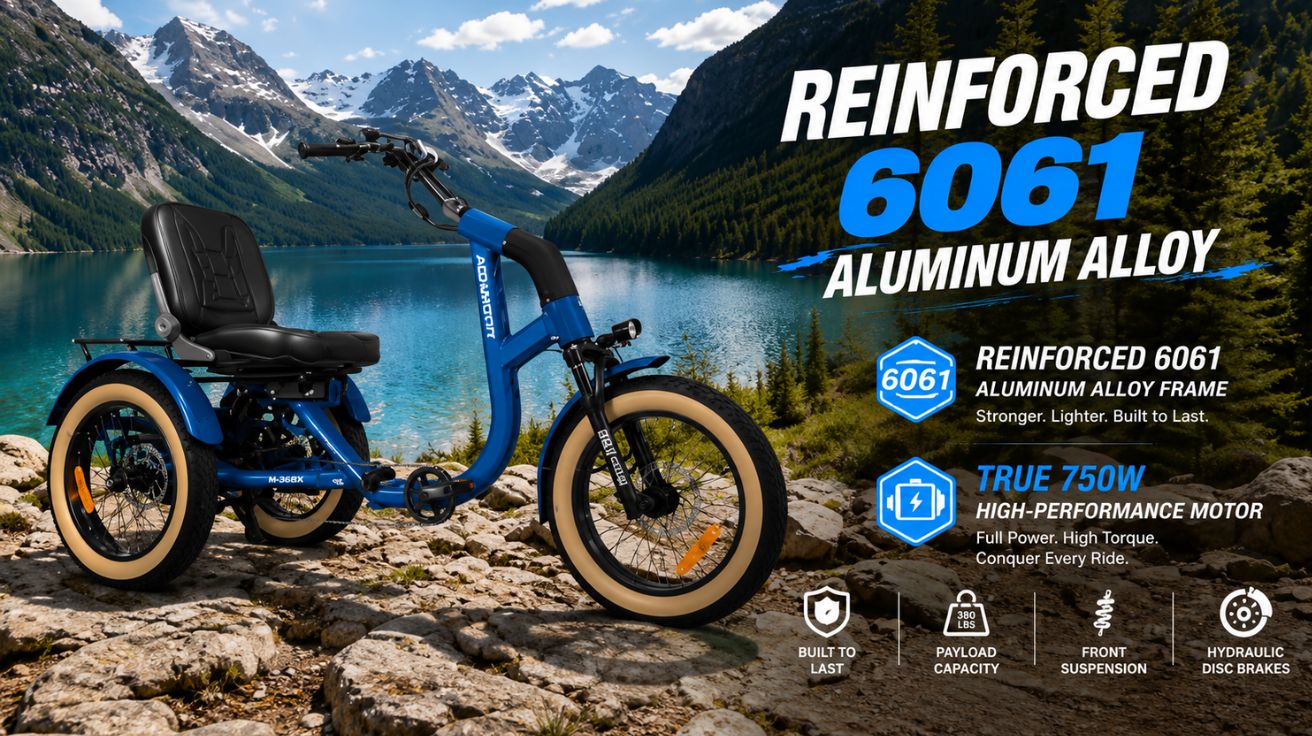

I review a lot of e-bikes and trikes, and I’ve gotten used to a familiar pattern: a manufacturer sends over a spec sheet full of big numbers, and half of those numbers don’t survive contact with reality. So when I sat down to dig into the Freetan M-368X — Addmotor’s full-suspension, semi-recumbent eTrike — I went in expecting to find at least one corner cut somewhere. Instead, I found a trike built the way I wish more of this category was built: safety-first, no unnecessary flash, and materials that actually back up every number on the sheet.
Addmotor’s Philosophy Is Baked Into This Trike
Addmotor doesn’t design around “what looks impressive in a listing photo.” Their approach is safety first, practicality second, everything else after — which sounds like a marketing line until you compare a trike built on that principle against one that isn’t. The M-368X is the clearest example I’ve come across at this price point, and it’s also a direct rebuke of something that genuinely bothers me about this market: trikes priced at the premium end that quietly use the same underrated components as the cheapest option on the shelf. Charging premium money for budget engineering isn’t a value trade-off a buyer knowingly accepted — it’s just deceptive, and it’s exactly what this trike doesn’t do.
The Motor Actually Hits the Numbers It Claims
The M-368X runs a 750W rear-drive brushless hub motor rated for a 1,400W peak, paired with a 25A controller on Addmotor’s EB 2.0 platform, delivering 90 Nm of torque. On paper, unremarkable. What matters is that this motor is physically sized to actually be a 750W motor.
A lot of brands slap a 750W badge on what’s really a 500W motor — you can’t tell from the spec sheet, but you can tell from the housing size and stator winding count. Underrated motors get shrunk down to save material cost, and fewer windings means a weaker magnetic field and less real torque, which shows up the moment you hit an incline or load the rear rack. The M-368X’s motor is visibly larger and thicker, with a stator built to actually support its rated output — which is also the only reason it can genuinely reach a 1,400W peak instead of just claiming to.
The Battery Pack Is Where “Safety First” Really Shows
This is the part I found most impressive. The pack is 48V 20Ah, Samsung lithium-ion cells, UL 2271 certified — solid baseline specs. But the detail that actually matters is that it’s fully potted: every gap between cells is filled with thermally conductive resin instead of being left as air.
Air is a poor heat conductor, so in a standard pack, whichever cell runs hottest just stays hot with nowhere for that heat to go. In a potted pack, heat conducts outward evenly across the whole structure — so even under a 1,400W surge, the temperature spread between cells stays small and the system never has to throttle down to cool off. There’s a second, quieter benefit too: cells expand and contract slightly with every charge cycle, and that repeated flexing is what eventually loosens a pack’s internal structure and degrades capacity. Potting locks the entire cell block into one rigid mass, physically resisting that fatigue over years of use.
Then there’s the safety case, which matters most. Battery fires almost always start the same way: one cell overheats, and that heat spreads to its neighbors in a chain reaction until the whole pack is involved. A potted pack builds a physical thermal barrier between every single cell, so an abnormal hot spot gets locked down at its source instead of spreading. That’s not a marketing detail — it’s the literal difference between a battery that fails quietly and one that fails dangerously.
The Parts Nobody Checks: Wiring, Tires, Hubs
The stuff that never makes it onto a spec sheet is where I look hardest, because it’s where corners get cut without anyone noticing until later.
- Wiring. The M-368X uses thicker copper cross-sections than I typically see at this price point. Thicker copper means lower resistance, and lower resistance means less heat generated under sustained load. Thin wiring is one of the more common — and completely preventable — causes of electrical fires in cheaper e-bikes and trikes, and it’s invisible right up until it isn’t.
- Tires. 20 × 4.0-inch fat tires on dual-layer rims. Genuine, freshly compounded rubber stays pliable, grips well in wet conditions, and resists cracking for a year or more. Cheap tires built from reclaimed rubber and heavy mineral filler go stiff fast, crack within months of sun exposure, and often carry a sharp burnt-rubber smell — a giveaway that low-grade vulcanizing oils replaced proper anti-aging additives. On a trike rated for a 380 lb total payload, tire integrity isn’t a comfort feature, it’s a load-bearing one.
- Hubs. Dual-wall wheel hubs instead of single-wall. A dual-wall hub holds its shape under sustained load; a single-wall hub can deform over time, which affects both ride quality and long-term structural safety.
Frame, Suspension, and the Ride Itself
The frame is a single-piece, aerospace-grade 6061 aluminum alloy build — not the low-end carbon steel that shows up in a lot of budget trikes, which is heavier and more prone to corrosion over time. Up front, an Addshox triple-clamp fork gives 80 mm of independent front suspension travel; out back, a coil shock is tuned for riders in the 200–250 lb range. Steering runs through a universal-joint system on a proprietary steel gear mesh that decouples steering from suspension movement, giving a tight ~2-meter turning radius despite the trike’s size.
The seating position is semi-recumbent — a 17.3 × 13.7 inch PU-cushioned seat with a backrest that reclines from 90° to 170°, paired with an automotive-style sliding footrest. Combined with an ultra-low 290 mm step-over height, it’s genuinely one of the easier trikes to mount and dismount that I’ve tested, regardless of rider height (it’s built to fit 5’1″ to 6’7″).
The Bottom Line
None of the things that actually matter on this trike — the potted battery, the honestly-rated motor, the copper gauge, the tire compound — show up in a product photo or a spec-sheet headline. That’s exactly the point. The M-368X isn’t trying to win on flash; it’s built on the principle that a rider shouldn’t have to think about whether their trike is going to overheat, crack, or short out. At this price point, that’s a rarer thing to find than it should be — and it’s the reason I’d point anyone shopping in this category toward asking these exact questions before they buy anything else.
Read More: The Complete Guide to Buying a High-Performance Refurbished Gaming PC


Leave a Comment