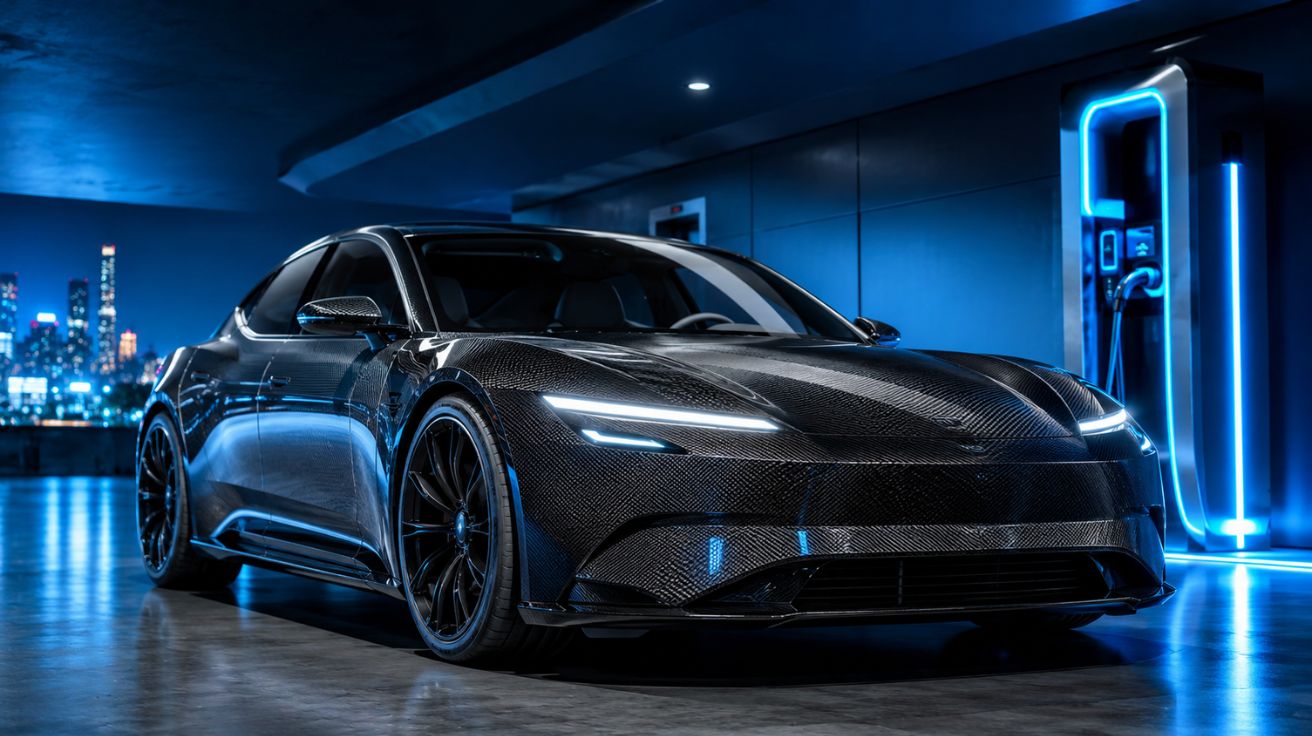

Carbon fiber has a motorsport biography that reads like a highlight reel. Its adoption by Formula 1 in the early 1980s changed what chassis design meant. Its appearance on Le Mans prototype racers through the 1990s and 2000s contributed to lap records and endurance victories that redefined what was possible at sustained high speed. It arrived in production supercars — first as an exotic option, then as a standard feature at the performance tier — carrying with it the prestige of all those racing wins and the technical credibility of aerospace-grade materials science.
That story is well known. What is less frequently discussed is how the same material properties that made carbon fiber the choice of motorsport engineers are now being evaluated as a serious contributor to one of the automotive industry’s most pressing and commercially significant problems: getting more range out of an electric vehicle battery pack.
Why Range Is a Materials Problem, Not Just a Chemistry Problem.
The popular conversation about EV range improvement focuses almost entirely on battery technology — energy density, charging speed, cell chemistry, thermal management. These are genuine and important variables, and progress on all of them is real. But there is a parallel variable that receives less attention and has a more immediate path to impact: the weight of everything that isn’t the battery.
An EV carries its battery wherever it goes. The battery is heavy — typically 400 to 600 kilograms in a full-size passenger vehicle. Every other kilogram of vehicle mass that this battery must move reduces the distance it can travel before depletion. Conversely, every kilogram removed from the vehicle’s non-battery components extends range without any improvement in battery chemistry whatsoever. The physics is straightforward: less mass to accelerate, decelerate, and carry over hills means less energy consumed per mile, which means more miles per charge.
This is the context in which automotive engineers developing electric vehicles are looking at structural and body components and asking a question that motorsport engineers have been asking for decades: what is this part made of, and is that the lightest material that will do the job?
Where the Weight Lives in a Vehicle Body.
A conventional steel vehicle body — the structural shell that determines both safety performance and aerodynamic profile — contributes several hundred kilograms to total vehicle mass. Stamped steel is the manufacturing choice of volume production because it is fast, mature, and cost-effective at scale. It is not the choice of weight minimization.
Aluminum alloys reduce body structure weight meaningfully compared to steel — roughly 40 percent for equivalent structural performance. Several major OEMs have moved to predominantly aluminum body structures for this reason. But aluminum, while lighter than steel, is substantially heavier than carbon fiber-reinforced polymer, which can achieve equivalent or superior stiffness and strength at less than half the weight of steel and roughly 60 percent of the weight of aluminum.
The performance arithmetic is significant. A vehicle body structure that weighs 250 kilograms in steel might weigh 150 kilograms in aluminum and 80 to 100 kilograms in well-engineered carbon fiber composites. In an EV where every kilogram reduction translates directly to reduced battery demand, the difference between the steel and carbon fiber scenarios could represent a range extension of 15 to 25 percent on an equivalent battery pack — without touching battery chemistry at all.
The Manufacturing Challenge That Has Kept Carbon Fiber in Motorsport.
The reason carbon fiber body structures have remained largely in motorsport and ultra-high-end production vehicles while aluminum and steel dominate volume manufacturing is not a material limitation — it is a manufacturing limitation. Traditional carbon fiber lamination is labor-intensive, slow, and sensitive to quality variation in ways that stamping steel or die-casting aluminum is not. The autoclave cure cycles that produce aerospace-quality parts are measured in hours per component rather than seconds. The tooling investment per part geometry is substantial.
This manufacturing constraint is precisely where the development story of the past decade has been most active. Automated fiber placement, resin transfer molding, press-cured sheet molding compound, and thermoplastic composite processing have all advanced to the point where carbon fiber car parts can be produced at cycle times and cost structures that are beginning to approach the economics of volume automotive manufacturing — not quite there for mass market vehicles, but within reach for premium and performance segments.
Why the EV Transition Accelerates This Conversation.
The economics of weight reduction are different in an EV than in an internal combustion vehicle, and they are different in a direction that makes composites more financially attractive. In a combustion vehicle, reducing body weight provides improved performance and fuel economy, but the connection between mass reduction and operating cost is diffuse and slow to materialize. In an EV, weight reduction has a direct relationship to the size of battery required to achieve a target range — and battery pack cost is currently the dominant cost variable in EV manufacturing, at roughly $100 to $150 per kilowatt-hour.
A 100-kilogram reduction in vehicle mass, translating to a meaningful reduction in required battery capacity to achieve the same range target, can justify a significant premium in body structure material cost. The lightweighting investment pays back through battery cost reduction on the same vehicle, creating an economic case for premium materials that simply didn’t exist at the same scale in combustion vehicle manufacturing.
This is the argument that composite material engineers and fabricators are now making to automotive development teams — not as a performance narrative borrowed from motorsport, but as a cost optimization argument grounded in the economics of battery electrification. The material that won at Le Mans may find its most commercially significant application not on a race track, but in a commuter car calculating range to the next charge point.
Read More: Where Can I Get Same Day Car Repair In Aldershot?


Leave a Comment