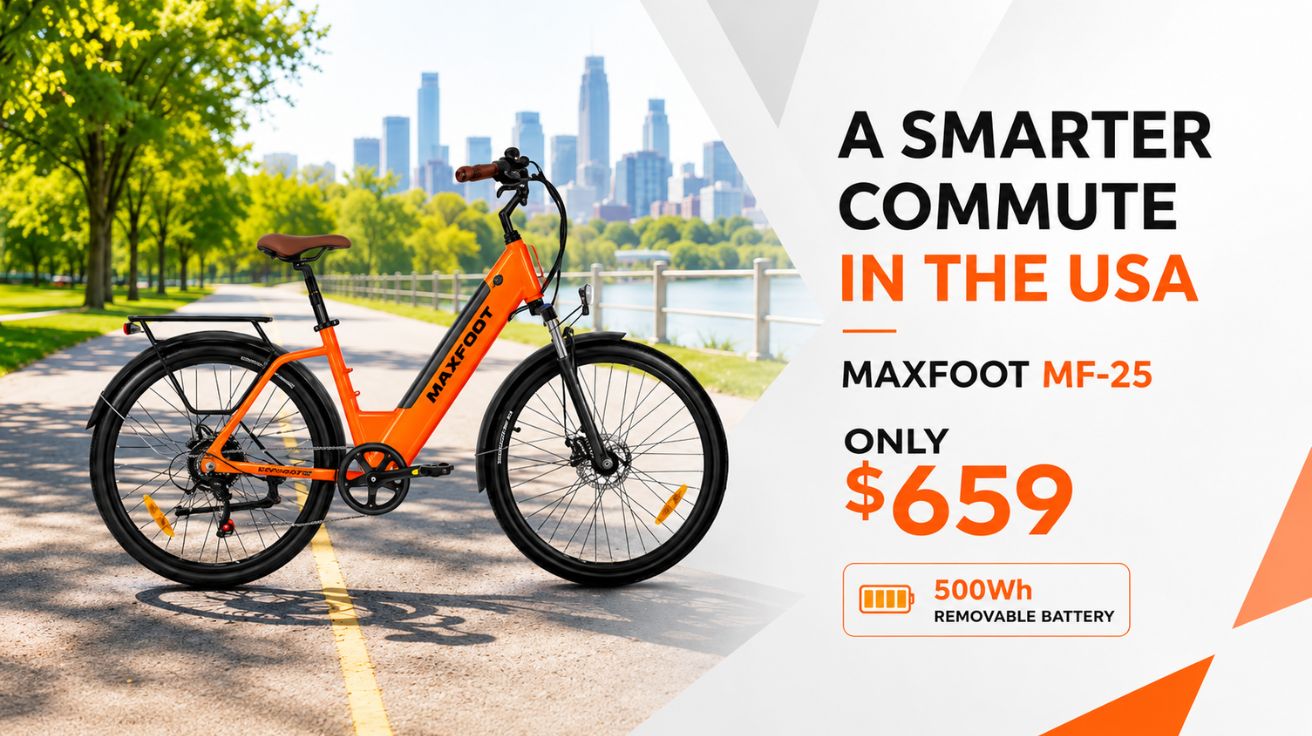

Urban commuters increasingly rely on e-bikes to skip traffic, but at the sub-$700 price point, a lot of models quietly cut corners where it counts — steel frames dressed up as “premium,” and “waterproof” claims that amount to little more than a coat of paint. Maxfoot’s latest release, the MF-25 (Burning Orange edition), is trying to break that pattern. At $659 (down from $1,299), its three core selling points — an aluminum frame, all-weather waterproofing where it matters, and honest, purpose-built tires — are worth a closer look.
The Frame: 6061 Aluminum Alloy, Not Cheap Steel
Plenty of e-bikes in this price range cut costs on the frame first, using basic stamped steel and calling it “high-strength.” Steel is cheap, but it comes with two real drawbacks:
- It adds noticeable weight to the bike, making it harder to lift and carry.
- It’s prone to rust after prolonged exposure to rain or humid climates — corrosion that can eventually compromise structural integrity.
The MF-25 uses a 6061 aviation-grade aluminum alloy frame. This is the same alloy widely used across bicycles, motorcycles, and even aerospace components, prized for balancing light weight with strength — at equal wall thickness, 6061 aluminum is over 30% lighter than standard steel, while offering excellent corrosion resistance without needing extra rustproofing treatment. For a daily commuter, that translates into two practical benefits: an overall lighter bike that’s easier to carry up stairs or load into a car, and far less worry about long-term outdoor storage causing rust damage.
Paired with the MF-25’s step-thru frame geometry — the mid-frame section is dropped significantly lower — riders don’t need to swing a leg high over a top tube to get on or off. That makes it genuinely easy to ride in a skirt or dress pants without a second thought. The bike accommodates riders from 5’3″ to 7’3″ (roughly 160–220 cm), a range wide enough to cover nearly everyone in a household.
Waterproofing: Protecting the Parts That Actually Matter
The real threat to most e-bikes isn’t sun exposure — it’s a sudden downpour. A lot of e-bikes market themselves as “waterproof,” but that claim often only covers the outer shell. The battery compartment and wiring connectors — the parts most vulnerable to failure — are frequently left under-protected, and water intrusion there can trip safety cutoffs at best, or fry the electronics at worst.
The MF-25 addresses this at the source with an IPX6-rated waterproof battery. IPX6 is one of the higher tiers in the ingress protection standard, meaning the battery can withstand powerful water jets from any direction — the kind of exposure you’d get riding through a storm or splashing through standing water — without moisture reaching the internals. Combined with a removable battery design, that means riders don’t have to worry about getting stranded mid-commute in the rain, and can simply pop the battery out to charge indoors afterward. This is a more precise approach than a vague “fully waterproof” claim — it targets the single component where water damage does the most harm: the battery and its electronics.
Tires: An Honest Tradeoff, Not a Marketing Gimmick
On tires, we want to be straightforward. The MF-25 rolls on 26 x 1.95-inch puncture-resistant rubber tires, with a reinforced tread layer designed to resist glass shards, nails, and sharp debris — the kind of everyday hazards that matter most for city commuting.
But let’s be clear about what this isn’t: these are not the 4-inch “fat tires” you’ll see marketed on some other e-bikes. At $659, once you factor in an aluminum frame, an IPX6-rated battery, and a 1000W-peak motor, some tradeoff on tire spec is a reasonable way to allocate the budget.
Fat tires are really built for:
- Sand.
- Snow.
For the vast majority of asphalt commuting, standard puncture-resistant tires actually make more sense:
- Lower rolling resistance.
- A lighter ride.
- Better suited to real-world use.
It’s an honest design philosophy — put the budget where it actually improves the ride and the bike’s lifespan, rather than padding a spec sheet with numbers that don’t apply to how most people will actually use the bike.
Power and Everything Else
The MF-25 runs on a 500W-rated brushless motor (1000W peak) delivering 82 N·m of torque, making hill climbs and loaded starts noticeably easier. A 48V 10.4Ah battery supports up to 70 miles of range (varies with riding mode, rider weight, and terrain), and a 2A fast charger cuts down charging time compared to many bikes in this class. Gearing comes from a Shimano 7-speed rear derailleur, giving enough range to handle varied city grades.
On the safety and comfort side, the MF-25 comes standard with:
- A switchable front suspension fork.
- A shock-absorbing seat post to smooth out rough pavement.
- An integrated LED headlight.
- A brake-sensing taillight for visibility after dark.
- A 5-inch color LCD display that keeps speed, battery level, and mileage in clear view.
Load capacity tops out at 300 lbs (rider plus cargo), with the rear rack alone rated for 25 kg — enough for a grocery run or a loaded commute. The whole bike weighs in at around 59 lbs (27 kg), which is light for a build that includes an aluminum frame and a battery this size.
Bottom Line
At $659, the MF-25 puts its budget into three things that actually shape the long-term ownership experience: a 6061 aluminum frame to solve the weight-and-rust problem, an IPX6-rated battery to solve the rain problem, and puncture-resistant tires to solve the everyday commuting problem. It skips the marketing shortcuts — oversized tires for show, vague waterproofing claims — in favor of the details riders actually notice, and the ones that tend to cause the most headaches when a bike is built cheap. That’s arguably what a commuter e-bike at this price should look like: practical, durable, and honestly specced.
The MF-25 currently ships from a U.S. warehouse within 2 business days, with Affirm financing available (4 payments of roughly $164.75), and optional accessory bundles — front basket, rear rack bag, mirrors, and more — offering savings of up to $75.
Read More: The Quiet Rise of the AI Video Maker in Modern Marketing


Leave a Comment