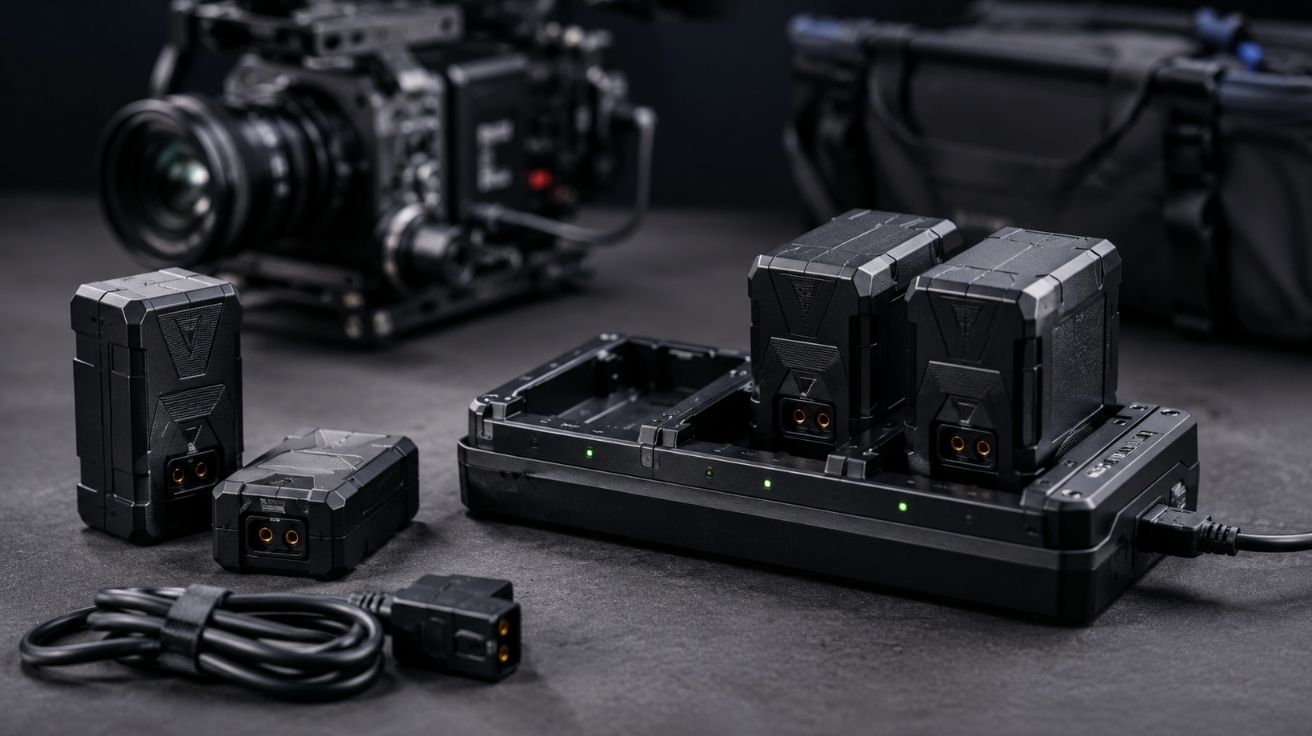

In production environments, field operations, and broadcast workflows, power reliability is not a secondary concern. It is the condition that determines whether a day’s work proceeds or stops entirely. When battery systems fail mid-operation — or when the wrong charger degrades battery performance over time — the cost is rarely just the price of a replacement unit. It is lost time, disrupted schedules, and the compounding frustration of avoidable decisions made too quickly at the point of purchase.
D-tap power systems have become a standard part of how professionals manage portable energy across cameras, monitors, wireless transmitters, and a wide range of field equipment. Yet the charger itself is frequently treated as an afterthought — selected on price alone, or assumed to be interchangeable across battery types and use cases. That assumption leads to real operational problems. This article addresses how to evaluate a d-tap battery charger with enough clarity to avoid the most common and costly specification mismatches.
Understanding What a D-Tap Battery Charger Actually Does in a Working System
A d-tap battery charger is not simply a device that transfers electricity into a battery cell. It is a system that must communicate with the battery’s internal management circuitry, deliver current at a controlled rate appropriate to the cell chemistry, and stop or adjust that charge at the right moment to protect long-term capacity. When this process is handled correctly, batteries hold their rated capacity across hundreds of cycles. When it is handled poorly — through cheap or mismatched chargers — that capacity degrades faster than expected, and the total cost of ownership rises considerably.
For professionals managing battery-dependent workflows, the resources available at d tap battery charger provide a useful reference point for understanding how charger specifications align with real field use cases and battery compatibility requirements.
Why Charger and Battery Chemistry Must Be Matched
Different battery cell chemistries charge differently. Lithium-ion cells require a specific charge profile that involves a constant current phase followed by a constant voltage phase, and the charger must be designed to execute both correctly. A charger that does not support the correct profile for a given battery type will either undercharge the cells — leaving usable capacity on the table — or overcharge them, which accelerates internal degradation and, in some conditions, creates safety risks.
This is not a theoretical concern. Professionals who use high-capacity batteries for extended shoots or field operations often notice that batteries charged with generic or off-brand chargers report reduced runtime far sooner than the manufacturer’s rated cycle life would suggest. The reason is almost always a mismatch between the charger’s output behavior and the battery’s charge management requirements.
The Role of Communication Between Charger and Battery
Modern professional batteries contain battery management systems that monitor cell temperature, state of charge, and cycle history. Better chargers read this data and adjust their output accordingly. Lower-cost chargers often bypass this communication entirely, applying a fixed charge rate regardless of what the battery actually needs at that moment. Over time, this blunt approach reduces cell balance within multi-cell battery packs, which shortens effective capacity even when the total stored charge appears normal.
Charging Speed and What It Actually Costs You in the Field
Charging speed is one of the most frequently misunderstood specifications in battery charger selection. The instinct is to prioritize faster charging — and in high-turnover environments, that instinct is reasonable. But charging speed involves a direct trade-off with battery longevity, heat management, and charger complexity. Understanding where your operation sits on that spectrum is what separates a good purchasing decision from an expensive one.
Fast Charging Is Not Always the Right Priority
In environments where batteries rotate through overnight and are ready for the next day’s work, a slower, more controlled charge cycle is often the better choice. Slower charging generates less heat, which is one of the primary drivers of battery cell degradation over time. A battery that charges gently over six to eight hours will typically retain its capacity across more cycles than one pushed through a fast charge cycle repeatedly.
Fast charging becomes operationally justified when turnaround time during an active day is the limiting factor — for example, in event coverage or multi-camera productions where batteries are swapped and recharged between setups. In those cases, a higher-output charger with proper thermal management makes sense. The key is matching the charging approach to the actual operational rhythm, not defaulting to the fastest available option because it sounds more capable.
Multi-Bay Chargers and Sequential Charging Behavior
Many professionals working with multiple batteries at once choose multi-bay chargers for convenience. What is less often examined is whether those chargers distribute power evenly across all bays simultaneously or sequence through them. A charger that charges all bays at full rated output simultaneously requires a higher total power draw from the outlet or distribution panel, which may create issues in field locations with limited power access. A charger that sequences — fully charging one battery before moving to the next — takes longer in total but operates within a smaller power envelope.
Neither approach is universally better. The important thing is knowing which behavior the charger exhibits before deploying it in a situation that assumes the other.
Physical and Environmental Factors That Affect Charger Selection
Choosing a charger based entirely on electrical specifications while ignoring physical and environmental factors is a common error. In practice, where a charger will be used matters as much as how it performs under ideal conditions. According to IEC standards for electrical equipment used in professional and industrial environments, thermal and mechanical performance ratings exist precisely because operating conditions vary significantly across real deployment scenarios.
Build Quality and Heat Dissipation
Chargers generate heat as a byproduct of the power conversion process. Chargers designed for professional use incorporate heat sinks, internal fans, or thermally managed circuit designs that allow them to operate at rated output for extended periods without thermal throttling or shutdown. Consumer-grade or budget chargers may function well in short cycles but begin to throttle output or shut off entirely when run continuously across multiple battery cycles — exactly the condition common in working production environments.
The physical housing of a charger also affects durability. Units that will travel in equipment cases, be set up and broken down repeatedly, or operate in outdoor or industrial environments need construction quality that reflects those demands. Loose connectors, fragile housing materials, and minimal strain relief on power cables are early indicators of a unit that will not hold up under regular field conditions.
Input Power Compatibility Across Locations
For professionals working across different regions or facilities, input voltage compatibility is a practical consideration that is often overlooked until it causes a problem. Chargers with wide-range input voltage accept power from both standard North American outlets and the higher-voltage systems common in Europe and many parts of Asia. Chargers with narrow input ranges require step-down converters when used outside their rated voltage, which adds cost, weight, and an additional potential point of failure in the field.
Warranty, Support, and Long-Term Cost of Ownership
The purchase price of a charger is rarely its true cost. A charger that fails after moderate use and carries no meaningful warranty — or comes from a manufacturer with no accessible support — forces a full replacement purchase that eliminates any initial savings. For equipment used in professional workflows, the availability of warranty service and replacement parts over time is a legitimate part of the total cost calculation.
What Warranty Terms Actually Signal
Manufacturers who offer longer warranty periods are making a statement about their confidence in the product’s durability under real conditions. A one-year warranty on a charger intended for daily professional use is minimal. A two-year or longer warranty, particularly one that covers manufacturing defects without requiring proof of single-use conditions, reflects a product built with professional durability in mind.
Support accessibility matters beyond the warranty period as well. The ability to reach a technical contact who understands the product — and can advise on compatibility questions or troubleshoot performance issues — has genuine operational value for teams that cannot afford extended troubleshooting delays on-site.
Thinking in Total Cycles, Not Just Current Price
A useful way to evaluate charger cost is to think in terms of battery cycles protected rather than unit price paid. If a higher-quality charger preserves full battery capacity across a meaningfully greater number of cycles, the avoided battery replacement cost can exceed the price premium of the charger itself many times over. This is particularly true for operations running expensive, high-capacity professional batteries where each unit represents a significant capital investment.
Closing Thoughts on Making the Right Charger Decision
The process of selecting a d-tap battery charger rewards deliberate thinking more than most equipment decisions. The consequences of a poor match — degraded battery life, operational interruptions, safety concerns, and repeat spending — accumulate quietly but consistently over time. They rarely announce themselves as a single dramatic failure. They appear as shortened runtimes, batteries that no longer hold expected charge, and chargers that stop functioning reliably after a season of use.
The right approach is to work backward from your actual operating conditions. Understand the chemistry and communication requirements of the batteries already in your system. Assess your true turnaround time needs rather than defaulting to maximum speed. Consider where the charger will physically operate and what build standards are appropriate for that environment. And treat warranty and support terms as meaningful indicators of product quality, not just contractual fine print.
A d-tap battery charger that fits your actual workflow will cost less over time, perform more consistently, and contribute to the kind of operational reliability that professionals in any field-dependent industry depend on. The specification that matters most is not always on the label — it is the match between what the charger does and what your specific batteries and working conditions require.
Read More: The Complete Checklist for Auditing Your PTV Logistics Reporting and KPI Tracking Setup in 2025


Leave a Comment