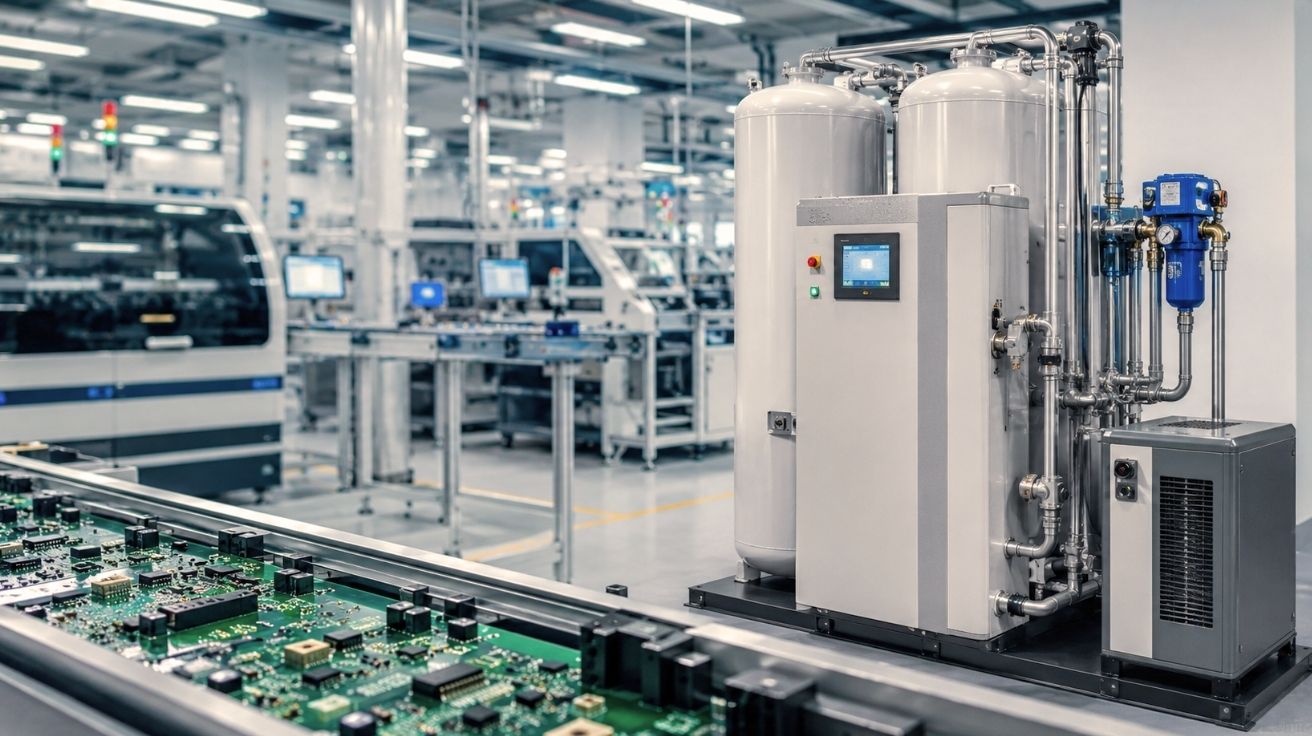

Across the United States, electronics manufacturers are quietly reassessing one of the most foundational inputs in their production environment: nitrogen. For decades, bulk liquid nitrogen deliveries and high-pressure cylinder contracts were the default. They were familiar, they were manageable, and most operations built their workflows around them. But familiarity is not the same as reliability, and as production demands tighten, the limitations of third-party nitrogen supply have become harder to absorb.
The shift toward on-site nitrogen generation is not driven by novelty. It is being driven by operational pressure — the kind that accumulates when a missed delivery disrupts a soldering line, when contract pricing climbs without warning, or when a facility simply cannot afford variability in a critical process input. These are the conditions that prompt engineers and plant managers to look more carefully at what they actually control, and what they are leaving to someone else.
This article outlines the specific reasons US electronics manufacturers are making this transition in 2025, based on the realities of modern production environments and the demands placed on nitrogen as a process gas.
1. Supply Chain Disruptions Have Made External Nitrogen Dependency a Liability
When facilities rely on delivered nitrogen — whether in liquid form or compressed cylinders — they are exposed to supply chain variables they cannot control. Industrial gas distribution networks have faced pressure from transportation costs, driver shortages, and regional demand fluctuations. For electronics manufacturers, even a short gap in nitrogen availability can halt wave soldering, reflow processes, or conformal coating operations entirely.
The decision to move to on-site generation is, in part, a risk management decision. Facilities that generate their own nitrogen are not waiting on a truck. They are not subject to allocation limits during high-demand periods. They are not calling a supplier to expedite a delivery when inventory runs low. The nitrogen is produced continuously, on demand, from compressed air already present in the facility.
Operations teams evaluating nitrogen generators for electronics manufacturing are often responding directly to disruptions they have already experienced — not theoretical risks, but real production stoppages that revealed just how thin the margin for error had become.
The Compounding Effect of Supply Uncertainty
Single delivery delays are inconvenient. Repeated delivery variability, however, forces operations managers to carry excess inventory, over-order to maintain safety stock, or redesign production schedules around anticipated shortages. Each of these responses adds cost and complexity that has nothing to do with making a better product. On-site generation eliminates the need for that buffer entirely.
2. Purity Control Becomes an Internal Responsibility
Nitrogen purity is not a fixed variable in delivered supply chains. Cylinder and bulk deliveries can carry trace moisture, residual oxygen, or contaminants depending on the source, handling, and age of the supply. In electronics manufacturing, where nitrogen is used to protect sensitive solder joints and prevent oxidation during thermal processes, even modest purity deviations can produce inconsistent results at the board level.
On-site generators allow facilities to set and maintain purity levels that correspond directly to their process requirements. The purity output is consistent because it is governed by equipment the facility controls and maintains. There is no variation introduced by the supply chain, and there is no uncertainty about what is entering the production environment.
Why Purity Consistency Matters Beyond Quality Metrics
When oxidation-related defects appear on a finished board, tracing them back to a nitrogen purity issue can take time. That time translates into rejected assemblies, rework labor, and delayed shipments. For contract electronics manufacturers especially, defect accountability is closely scrutinized by customers. Owning the nitrogen generation process means owning that variable, which removes one potential source of uncertainty from quality investigations.
3. Long-Term Cost Structure Becomes Predictable
Industrial gas pricing is not static. Contract rates shift with energy costs, regional supply conditions, and supplier margins. Facilities that have operated under long-term bulk nitrogen agreements have often found, at renewal, that pricing has moved substantially. This creates a planning problem for operations that need stable input costs to hold their own margins steady.
On-site nitrogen generation converts a variable operating expense into a capital investment with a defined cost profile. The ongoing costs — electricity and routine maintenance — are far more predictable than gas commodity pricing. For facilities that consume nitrogen at scale, this shift in cost structure can meaningfully improve financial planning over a three-to-five-year horizon.
Total Cost Comparisons Over Time
The initial capital outlay for on-site generation is often the primary hesitation. But when evaluated across actual nitrogen consumption volumes and realistic price escalation scenarios for delivered gas, on-site generation consistently becomes the lower-cost option within a reasonable payback period. Facilities with high nitrogen throughput reach that crossover point faster. Even mid-volume operations often find the economics justify the investment when factoring in the elimination of delivery fees, rental charges for cylinders or dewars, and emergency procurement costs.
4. Regulatory and Safety Obligations Are Easier to Manage
Stored cryogenic liquid nitrogen and high-pressure cylinders come with specific regulatory requirements around storage, handling, labeling, and employee safety training. These requirements are not burdensome in isolation, but they add compliance overhead that consumes time and administrative resources. Facilities in some states also face inspection requirements tied to the volume and type of compressed or cryogenic gas stored on premises.
On-site generators produce nitrogen at the point of use, which reduces or eliminates the need for bulk storage infrastructure. There are no cryogenic vessels to manage, no high-pressure cylinder storage areas to maintain, and fewer documentation requirements associated with hazardous gas inventory. This simplifies the regulatory picture, which matters to facilities that are already managing a complex compliance environment across other aspects of their operation.
The Practical Safety Dimension
Nitrogen is odorless and colorless, and in an enclosed space, an oxygen-displacing leak from stored nitrogen can create a hazard before it is detectable. While industrial gas suppliers provide safety guidance, the responsibility for preventing incidents lies with the facility. Reducing the volume of stored nitrogen on-site reduces the potential severity of a displacement event. On-site generators produce and consume nitrogen in a near-continuous flow rather than holding large reserves, which changes the risk profile at the facility level.
5. Operational Continuity Improves Across Shifts and Production Cycles
Electronics manufacturing lines do not always run on predictable schedules. Short-run contract work, prototype builds, and seasonal demand all create variability in when and how much nitrogen a facility needs on any given day. With delivered supply, consumption variability can result in either over-ordering — which ties up capital and storage space — or running short at an inconvenient time.
On-site generation scales with actual demand. Nitrogen is produced when the system runs, in the volume the process requires. There is no minimum order quantity, no scheduling window to work around, and no dependency on a supplier’s logistics operation. This operational flexibility is particularly valuable for facilities that run multiple shifts or that experience irregular production volumes.
Integration with Existing Compressed Air Infrastructure
Most electronics manufacturing facilities already operate compressed air systems to power tools, actuators, and other equipment. Nitrogen generators draw from that existing infrastructure, which means integration into the facility does not require building an entirely new utility system. The addition is modular and can be sized to match current consumption with room to adjust as production scales. This makes the transition more straightforward from an engineering standpoint than many facilities initially expect.
6. Environmental Commitments Are Easier to Support
The transportation of industrial gases — including bulk liquid nitrogen — contributes to a facility’s indirect emissions footprint. Every delivery vehicle making a run to the plant represents fuel consumption and associated emissions that, under evolving sustainability reporting frameworks, may need to be disclosed or reduced. As more electronics manufacturers report against frameworks like those developed by the Environmental Protection Agency’s Scope 3 guidance, supply chain emissions are receiving closer attention.
On-site generation does not eliminate energy consumption — the generator draws power — but it does eliminate the transportation leg of the nitrogen supply chain entirely. For facilities working toward carbon reduction targets or responding to customer sustainability requirements, this is a meaningful change in their emissions accounting.
Reporting Transparency and Auditability
When a facility generates its own nitrogen, it has direct visibility into energy consumption associated with that process. That data is measurable, auditable, and can be reported with confidence. Delivered gas consumption involves more estimation in emissions accounting, particularly when supplier transportation data is incomplete or estimated at an industry average level. Internal generation gives sustainability teams a cleaner set of numbers to work with.
7. The Technology Has Matured to a Point Where Entry Is Straightforward
Earlier generations of nitrogen generation technology required more maintenance attention, had narrower operating windows, and were less forgiving in variable-demand environments. Modern pressure swing adsorption systems and membrane-based generators are considerably more robust, with longer service intervals and more consistent performance across a range of operating conditions.
This maturation has reduced the technical risk associated with adoption. Facilities that were cautious about on-site generation five or ten years ago — because the technology felt less proven or the maintenance burden seemed high — are now evaluating it against a different set of assumptions. The equipment is more reliable, service and support networks have expanded, and the operational learning curve has flattened considerably.
Sizing and Scalability Are No Longer Complex Engineering Problems
Matching a nitrogen generator to a facility’s production requirements used to require detailed engineering analysis and long lead times. Current systems are available in configurations that cover a wide range of consumption levels and can be scaled incrementally as production grows. For a mid-sized electronics manufacturer, the path from evaluation to installation is substantially shorter than it was in earlier generations of the technology, which removes one of the practical barriers that had previously delayed adoption.
Closing Perspective
The movement toward on-site nitrogen generation in US electronics manufacturing is not a reaction to a single problem. It is a response to a convergence of pressures — supply chain fragility, cost unpredictability, purity requirements, safety obligations, and sustainability commitments — that have collectively made the delivered gas model harder to justify at scale.
What makes 2025 a notable inflection point is not any single technological breakthrough. It is the accumulation of operational experience across facilities that have already made the transition, the maturation of the equipment itself, and a broader shift in how manufacturing operations think about controlling the inputs that their production processes depend on.
For facilities still weighing the decision, the practical question is not whether on-site generation is theoretically better. It is whether the specific conditions of their operation — consumption volume, purity requirements, space availability, and risk tolerance for supply disruption — make the transition worthwhile. For a growing number of US electronics manufacturers, the answer in 2025 is yes.


Leave a Comment