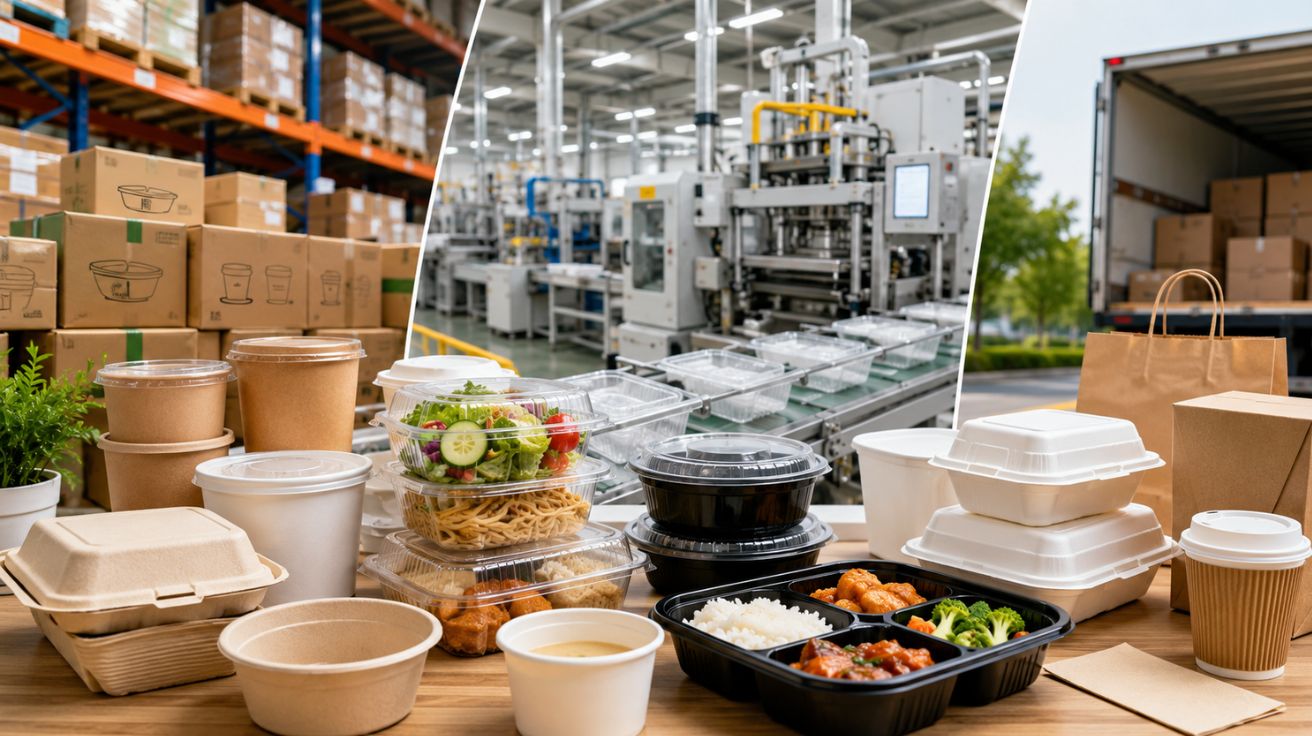

A cheap food container can become expensive very quickly when it slows down a kitchen, leaks during delivery, collapses in storage, or brings customer complaints back to the restaurant. For food packaging distributors, the old habit of comparing suppliers by unit price alone is no longer enough. Restaurant groups, importers, meal-prep operators, and regional chains now expect distributors to understand how a container performs in real operating conditions before recommending it.
A disposable container affects kitchen speed, portion control, delivery presentation, storage space, custom branding, and repeat-order reliability. Before asking a source factory for a final quotation, the buyer needs to define the food type, serving temperature, lid requirement, order volume, packaging material, branding need, carton configuration, and expected reorder cycle. That is where distributor sourcing has become more technical.
Distribution Is Becoming More Technical
Food packaging distributors are no longer only comparing price lists. They are being asked to explain why one container works for hot rice bowls, another is better for chilled salads, and another fails when stacked inside a delivery bag. This requires more product knowledge than many traditional sales teams needed in the past.
A clear example is the difference between PP, PET, paper, and sugarcane bagasse packaging. PP containers are often chosen for hot food because they can handle higher temperatures better than many clear plastic options. PET lids may offer strong visibility for cold or room-temperature foods, but they can deform when exposed to high heat. Paper bowls may need oil-resistant or water-resistant linings to prevent leakage, while bagasse containers can perform well for many takeaway meals but still need testing against moisture, oil, and holding time.
This means the distributor must understand not only what the container looks like, but how it behaves under pressure, steam, stacking, reheating, refrigeration, and delivery movement.
Mixed Product Lines Create Supplier Pressure
A distributor may need bowls, trays, hinged containers, soup containers, compartment boxes, cups, lids, and custom printed items from the same supplier. If the factory can only produce one category well, the distributor may still face problems across the wider catalog.
Mixed product lines create real pressure because every packaging family has different risks. Soup containers need reliable lid fit and wall strength. Salad bowls need clarity and presentation. Meal-prep trays need consistent compartment depth. Hinged containers need hinge durability. Paper containers need lining control. Custom packaging needs accurate print placement and repeatable color.
When a factory cannot hold quality across several lines, the distributor inherits customer complaints, replacement requests, stock confusion, and sales-team uncertainty. The best source factory is not only the one with the lowest quote; it is the one that can support several product families with stable specifications and repeatable production.
Factory Visibility Helps Sales Teams
A distributor’s sales team can sell more confidently when it understands how the factory produces, tests, packs, and repeats the product. Factory visibility helps the sales team answer practical customer questions instead of relying on generic catalog descriptions.
For example, a restaurant may ask whether a container can hold saucy noodles for 25 minutes during delivery without softening. A meal-prep company may ask whether the lid stays tight after refrigeration. A regional chain may ask whether a branded bowl can be reordered with the same print color three months later. These are not simple price questions. They are operational questions.
When the distributor understands production methods, material options, lid testing, carton packing, and quality checks, it can explain why two containers that look similar may behave differently in real kitchen and delivery conditions.
Customization Needs Better Coordination
Private-label and logo projects require more coordination than stock products. Artwork, print color, mold details, label placement, carton marks, material selection, and repeat production all need to be controlled before the distributor offers customization to its customers.
A digital mockup is not enough for serious custom packaging work. The buyer should request a physical sample or a machine-run proof before approving mass production. This is especially important for logo embossing, printed bowls, branded sleeves, and custom carton markings. Small errors in color, spacing, mold depth, or print alignment can turn into a full shipment problem.
Customization also affects lead time. A stock product may be available quickly, while a custom printed or molded item may require artwork approval, plate preparation, mold confirmation, sample testing, and production scheduling. If the distributor does not understand these steps, it may promise customers a delivery timeline the factory cannot safely meet.
Source Factory Capability Matters More Than Catalog Size
A large catalog can be useful, but it is not proof of factory strength. A distributor should look beyond product photos and ask how the supplier controls production across different packaging families.
For business readers comparing supplier models, references such as Wanhui’s packaging factory can be useful when reviewing how a source factory presents its production range, product categories, and manufacturing structure. In the same way, the Wanhui food container manufacturing overview can help buyers understand how a factory explains multi-line production capabilities to distributors and importers.
The important point is not simply whether a factory displays many products online. The buyer needs to know whether the factory can provide clear samples, stable specifications, packaging details, repeat stock communication, and practical product education for the distributor’s sales team.
A Strong Factory Relationship Reduces Friction
The best supplier relationship gives the distributor more than a container. It gives the distributor clear samples, stable stock communication, product education, reliable packing details, and repeatable production. That support makes the distributor more useful to its own customers.
A strong factory relationship also reduces internal friction. Sales teams can answer questions faster. Customer-service teams can handle complaints with better evidence. Warehouse teams can plan carton space more accurately. Buyers can compare repeat orders against approved samples instead of relying on memory or informal chat messages.
In a real buying file, this topic usually appears as a packaging distributor deciding whether a source factory can support several product families at once. The people involved are not only the buyer; commercial directors, distributor buyers, sales trainers, warehouse teams, and customer-service teams all read the decision differently. The purchasing note should name those groups so that distributor education, multi-line sourcing, and repeat stock are not left for a warehouse or store team to solve after the container has already shipped.
Purchase Review Notes
When the buyer later reviews the order, the decision should be judged by fewer substitutions, cleaner sample approval, fewer packing surprises, and a clearer reorder path. That is the value of treating distributor education as an operating decision rather than a disposable line item.
The main failure mode is expanding a catalog faster than the factory can support samples, repeat stock, and technical product explanations. A short price comparison will not catch that problem. The buyer needs a small evidence packet built from product-family maps, line-capability summaries, reorder records, sample notes, packing details, sales training notes, and complaint-resolution logs. That packet gives the team a way to challenge an attractive quote without turning the supplier discussion into guesswork.
A useful sample review should connect distributor education with sales enablement. The reviewer should test the container under the food, route, storage, and service conditions named in the RFQ. If the sample passes on a clean desk but fails in a working kitchen or delivery route, it is not ready for a volume purchase.
Documentation also matters. The buyer should keep the final quotation, approved sample notes, carton packing details, product specification, and approval rule in the same project folder. That habit protects factory capability because the next reorder can be compared with the approved sample instead of relying on memory.
The supplier conversation should end with practical questions: what changes the lead time, which detail changes the mold or print plan, how many cartons fit the shipment, how the factory confirms lid fit, and who approves the sample before production. These questions make multi-line sourcing and repeat stock visible before the deposit is paid.
The Source Factory Verification Framework
Before signing off on a high-volume container order, procurement teams should vet source factories using five operational checks.
1. Thermal and Transit Rigidity
Do not rely only on catalog specifications. Test sample containers under real kitchen conditions. Hot soup, steamed rice, oily noodles, chilled salads, and saucy meals all create different packaging stress. The buyer should check lid seal integrity, wall strength, stack-crush resistance, and leakage after realistic holding and delivery movement.
2. Material Breakdown Tolerances
Require clear documentation on material composition. PP, PET, paper, bagasse, and lined paper products do not behave the same way. If a factory changes material grade, wall thickness, lining quality, or lid composition across repeat production, the distributor may face cracking, clouding, warping, leakage, or softening complaints from customers.
3. Pre-Deposit Proofing
For custom private-label or logo packaging, reject any agreement that relies only on digital mockups. Request a physical sample or machine-run proof to confirm print color, logo position, mold detail, lid fit, carton marks, and packing format before releasing the manufacturing deposit.
4. Warehouse and Carton Fit
Match carton configuration against warehouse slotting, pallet planning, and delivery handling. A container may pass the kitchen test but still create problems if the carton is oversized, weak, poorly marked, or inefficient to store. Distributor buyers should review carton dimensions, pieces per carton, pallet quantity, and stacking strength before approval.
5. Reorder Variance Audits
Set baseline tolerances for wall thickness, lid snap-fit, usable capacity, color, clarity, and print placement. Compare repeat shipments against the approved sample batch. This helps catch subtle changes in mold wear, material substitution, or production control before customers notice the difference.
Final Review Before Purchase
Before approving a wholesale packaging order, the buyer should confirm product scope, sample approval, material choice, lid fit, carton packing, branding rule, production lead time, documentation, and repeat-order support. This final review reduces the risk that a cheap sample becomes a costly operating problem.
Food packaging distributors are asking more from source factories because their customers are asking more from packaging itself. A container is no longer just a disposable item. It is part of kitchen workflow, delivery performance, brand presentation, warehouse planning, and customer satisfaction. The factory that can support those realities gives the distributor a stronger product, a clearer sales story, and a safer reorder path.
Read More: How Payment Processors Shape the Future of Digital Transactions


Leave a Comment