
Introduction
In the realm of precision manufacturing, particularly within the medical and automotive sectors, a pervasive challenge is the disconnect between design and production. Designers focus on functionality and innovation, while manufacturing engineers grapple with translating complex designs into parts that are efficient and economical to produce. This misalignment frequently results in costly design iterations, budget overruns, missed deadlines, and even innovative concepts being shelved due to manufacturability issues.
The root cause lies in the traditional, segmented collaboration model. Design, prototyping, and mass production are often handled by different teams or even separate suppliers, leading to information loss and inconsistent standards. The absence of seamless collaboration and data traceability from concept to volume production is the primary culprit behind quality inconsistencies and project overruns. This article explores how an integrated workflow based on end-to-end CNC machining solutions provides the key to unlocking this dilemma, demonstrating how the seamless integration of manufacturability design analysis, CNC prototyping, and rigorous quality control enables a flawless transition from blueprint to final product.
Why Does The Traditional Segmented CNC Machining Model Often Lead To Cost Overruns And Delays?
The conventional linear workflow of “design-quote-manufacture” is fraught with inefficiencies that silently escalate costs and stretch timelines. This model relies on sequential handoffs between siloed teams, creating multiple points of friction where critical information can be misinterpreted or lost. The lack of integrated collaboration from the outset turns the development process into a high-risk endeavor, where problems are discovered too late, demanding expensive and time-consuming corrective actions.
- The High Cost of Communication and Misalignment: In a segmented model, the designer and manufacturer operate with different priorities and lexicons. What is functionally elegant in CAD may be prohibitively expensive or impossible to machine. Without early and deep collaboration, this disconnect only surfaces during the quoting or, worse, the production phase. Each subsequent design change request triggers a new cycle of communication, re-quoting, and re-scheduling, accruing significant soft costs in project management and eroding the project’s financial and temporal buffers.
- Design Rework Due to Late-Stage Manufacturing Feedback: When design verification services and manufacturability analysis are deferred until after the design is “finalized,” the feedback is reactive, not proactive. A feature requiring a non-standard tool, an unsupportable thin wall, or an unnecessarily tight tolerance may only be flagged once production toolpaths are being generated. Correcting these issues then requires going back to the design stage, invalidating previous work and causing substantial delays. This cycle of late-stage rework is a primary driver of budget overruns and missed launch windows.
- Accountability Gaps in a Multi-Vendor Landscape: Engaging different suppliers for prototyping and production introduces severe accountability gaps. The prototype shop may achieve the form and fit, but not with a scalable, cost-effective process. The production supplier, receiving a prototype made with different methods, may struggle to replicate it consistently. When quality issues arise, determining responsibility — was it the design, the prototype process, or the production setup? — becomes a contentious and time-consuming ordeal. This fragmentation is the enemy of reliable risk mitigation strategies and predictable outcomes.
How Does Integrated DFM Analysis In The Early Design Phase De-Risk The Entire Project?
The most powerful tool for preventing downstream failures is proactive intervention at the concept stage. Design for Manufacturability (DFM) analysis is not a simple checklist; it is a collaborative engineering discipline that applies manufacturing intelligence directly to the digital model. When integrated early within a custom CNC machining services workflow, DFM acts as a systematic “failure mode pre-check,” identifying and eliminating potential pitfalls before they are committed to metal, which is the most effective form of preventive cost control.
1. Proactive Geometry And Tolerance Optimization
A skilled DFM engineer analyzes the 3D model through the lens of machining physics. They identify features that will challenge tool access, such as deep cavities or internal sharp corners, and suggest design modifications like adding radii or adjusting depths. They scrutinize tolerance stacks, recommending where to apply tight tolerances only for Critical-To-Function (CTF) features and where to use standard machining capabilities for others. This optimization ensures the design is not just possible, but optimally efficient to produce, directly influencing the custom CNC machining services quote and timeline.
2. Strategic Material And Process Selection Guidance
DFM extends to material science. An expert can advise on the most suitable alloy or medical-grade polymer that balances performance, machinability, and cost. They can also recommend the optimal sequence of operations and whether a 3-axis, 5-axis, or mill-turn approach is best. This front-loaded manufacturability design analysis transforms the design phase from an isolated creative exercise into the first step of production planning, aligning the CAD model with the realities of the workshop.
3. DFM As The Foundation For Cost Predictability
Ultimately, professional DFM optimization services provide cost predictability. By addressing manufacturability issues digitally, they eliminate the “unknown unknowns” that cause quotes to balloon during production. The cost drivers are identified, understood, and often optimized away before the job is quoted. This results in a more accurate, stable price and prevents the budget overruns that plague projects lacking this early engineering synergy. Engaging a partner for a comprehensive custom CNC machining services review at this stage is an investment that pays dividends throughout the project lifecycle.
From Prototype To Production: How To Ensure Quality Consistency And Traceability?
The true test of a manufacturing process is its ability to faithfully replicate the success of a prototype across thousands of production units. This requires more than capable machines; it demands a systemic bridge of quality control that connects every stage. A robust framework encompassing first-article validation, statistical process monitoring, and full digital traceability is essential to achieve zero-defect goals in regulated industries like medical device manufacturing.
1. First Article Inspection: The Critical Gateway
The journey from prototype to production is gated by a rigorous First Article Inspection (FAI). This is not a simple check; it is a comprehensive validation process where the first part off the production line is measured against all design dimensions, geometric tolerances (GD&T), and material specifications using high-precision equipment like Coordinate Measuring Machines (CMMs). The resulting FAI report provides objective, data-driven proof that the production process is capable of making a part that matches the approved design intent, serving as the baseline for all future production.
2. Statistical Process Control For Ongoing Assurance
Mass production quality control relies on Statistical Process Control (SPC). Key characteristics identified during DFM and FAI are continuously monitored using control charts. This data-driven approach detects trends — like gradual tool wear or machine drift — before they cause parts to fall out of specification. SPC transforms quality assurance from a reactive “inspect and scrap” activity into a proactive process of maintaining stability, which is fundamental to quality consistency assurance in long production runs.
3. The Imperative Of A Complete Digital Thread
For medical and automotive components, full traceability is non-negotiable. A production traceability system creates an immutable digital thread linking every finished part back to its raw material batch (with mill certifications), the specific machine and program that produced it, the operator, and all inspection data (FAI, SPC, final audit). This system enables instant root-cause analysis if an issue arises and provides the documented evidence required for regulatory audits. It ensures that CNC prototyping and production are not separate acts, but connected phases within a single, controlled, and documented CNC machining from design to production lifecycle.
How Do Flexible Manufacturing Systems Maintain Competitiveness With Small-Batch, High-Mix Orders?
The market increasingly demands customization and rapid response, moving away from monolithic production runs toward small-batch, high-variety production. Competing in this landscape requires agility without sacrificing precision or economics. Modern flexible manufacturing solutions achieve this by combining advanced quick-changeover technology, intelligent production scheduling, and modular workholding, creating a responsive ecosystem that treats variety as the norm, not the exception.
1. The Agility Of Rapid Setup And Changeover
The cornerstone of flexibility is quick changeover technology. This involves standardized, modular fixtures, pre-set tooling packages, and machine designs that allow for the rapid swapping of workpieces and programs. By dramatically reducing non-productive setup time between different jobs, manufacturers can economically produce batches as small as one unit. This agility allows companies to respond swiftly to design changes, produce multiple design iterations concurrently, or fulfill low-volume custom orders without the penalty of traditional long setup times.
2. Intelligent Scheduling And Digital Workflow Management
Flexibility is orchestrated by software. Advanced Manufacturing Execution Systems (MES) intelligently schedule a diverse queue of jobs across a network of machines, optimizing for due date, tooling commonality, and machine utilization. This digital backbone ensures that the flow of small-batch, high-variety production is smooth, visible, and efficient, preventing bottlenecks and providing real-time transparency into the status of every unique order, a critical advantage in fast-paced development environments.
3. Delivering Production-Grade Quality At Any Volume
A true flexible manufacturing solution does not compromise on quality for smaller batches. The same quality management systems, in-process inspection protocols, and certified processes (e.g., ISO 9001, IATF 16949) that govern mass production are applied uniformly. This means a prototype or a 10-piece order receives the same level of scrutiny and controlled manufacturing as a 10,000-piece run, ensuring that part quality and performance are consistent regardless of order size, which is essential for building trust in iterative development processes.
Can We See The Tangible Impact Of Integrated CNC Machining Solutions In A Real-World Case?
Theory is proven in practice. A compelling illustration comes from the development of transmission components for a surgical robotics system. The client faced the extreme challenge of machining parts with micron-level precision and stringent biocompatibility requirements, but their multi-vendor approach led to inconsistent quality, high scrap rates, and an inability to meet the strict medical standards for a successful product launch. The resolution of this crisis demonstrates the transformative power of a fully integrated approach.
1. The Challenge: Precision, Consistency, And Compliance
The components required exceptional dimensional stability and surface integrity for reliable, long-term operation within the human body. The client’s fragmented supply chain, however, introduced unacceptable variability. Different vendors used different processes and interpretations, leading to a high rate of non-conforming parts that failed to meet the rigorous medical devices precision machining standards, threatening to derail the entire product program.
2. The Integrated Solution: From Deep DFM To Closed-Loop Control
The engagement began with an exhaustive manufacturability design analysis to optimize the part geometry for both function and production. The solution leveraged 5-axis precision CNC machining services to achieve the complex forms and tight tolerances in a single setup, minimizing error accumulation. Crucially, a closed-loop quality control monitoring system was integrated, using in-process probing and post-process CMM verification to ensure each part matched the digital twin perfectly. This end-to-end control, managed under a unified ISO 9001 and ISO 13485 certified quality system, provided the necessary traceability and consistency.
3. The Measurable Outcome: Speed, Yield, And Cost
The results were dramatic. The integrated end-to-end manufacturing services approach yielded a 99.9% improvement in final product yield and compressed the development timeline by 40%. Furthermore, the total cost of part development was reduced by 25%. This case exemplifies how precision CNC machining services, when delivered as a cohesive, accountable solution, can de-risk complex projects, accelerate time-to-market, and ensure compliance in the most demanding sectors. For organizations seeking this level of integration and capability, partnering with a provider of a true high precision cnc machining service is often the decisive factor for success.
Conclusion
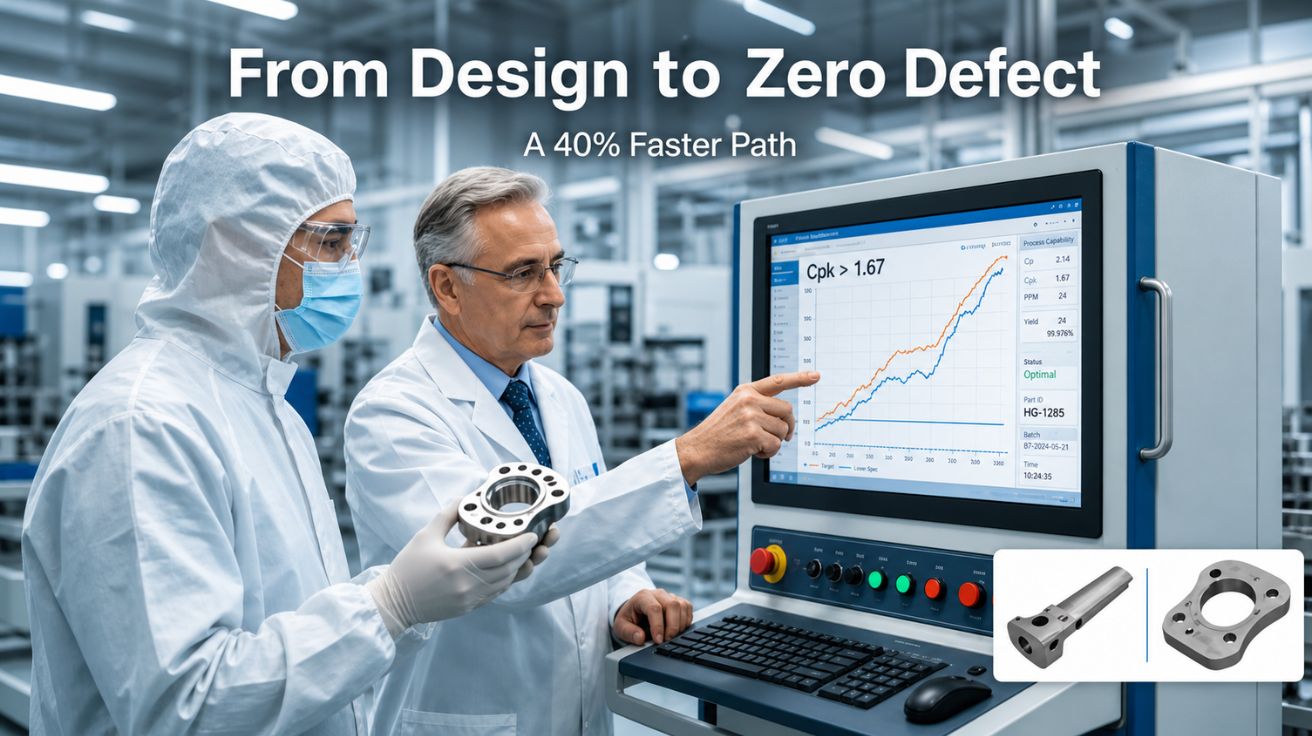
In conclusion, the fragmented, sequential model of product development has become a major bottleneck for innovation in precision component manufacturing. The path to shortening development cycles by 40% and achieving zero-defect outcomes lies in adopting a holistic end-to-end CNC machining solution. This integrated methodology seamlessly blends expert design for manufacturability, agile prototyping, robust mass production, and unbreakable quality traceability into a single, accountable workflow. It solves the chronic issues of communication silos and late-stage surprises by embedding manufacturing wisdom at the design phase, transforming potential obstacles into optimized, predictable processes. This approach is not merely a service but a strategic partnership that ensures project success, accelerates market entry, and maximizes return on investment.
FAQs
Q: In a CNC machining project, how critical is DFM (Design for Manufacturability) analysis?
A. DFM analysis is absolutely critical. It acts as the essential bridge between design intent and economical production. Professional DFM identifies and eliminates potential manufacturing obstacles early, optimizing for cost, reliability, and lead time. It is the most effective preventive measure to avoid costly late-stage design changes and project delays.
Q: For small-batch R&D projects, can we expect the same quality service as mass production?
A. Yes. A quality-focused, integrated service provider applies the same certified quality management systems and statistical process controls regardless of order size. From First Article Inspection (FAI) to in-process monitoring, the rigorous quality assurance framework ensures that even prototype or small-batch parts receive production-grade scrutiny and consistency.
Q: How do you ensure part quality remains consistent from prototype to mass production?
A. Consistency is ensured through a complete production traceability system and Statistical Process Control (SPC). By establishing a validated process during prototyping and continuously monitoring key parameters in production, we maintain process stability. This data-driven approach guarantees that the quality of the 10,000th part is identical to the first approved prototype.
Q: What files should I provide to a machining service besides the 3D model?
A. In addition to the 3D CAD file, provide complete 2D engineering drawings. These should clearly specify critical dimensions, geometric tolerances (GD&T), surface finish requirements, and material specifications. Clear documentation alongside the 3D model minimizes communication errors and ensures accurate quoting and manufacturing.
Q: What core qualifications should I look for in a CNC machining partner?
A. Prioritize partners with relevant industry certifications (ISO 9001, IATF 16949, AS9100D), proven end-to-end project management capabilities, deep DFM expertise, and a portfolio of successful case studies in your industry. These elements form the systemic foundation for delivering reliable, high-quality components consistently.
Read More: How Do Businesses Source Hard-To-Find Electronic Components?


Leave a Comment