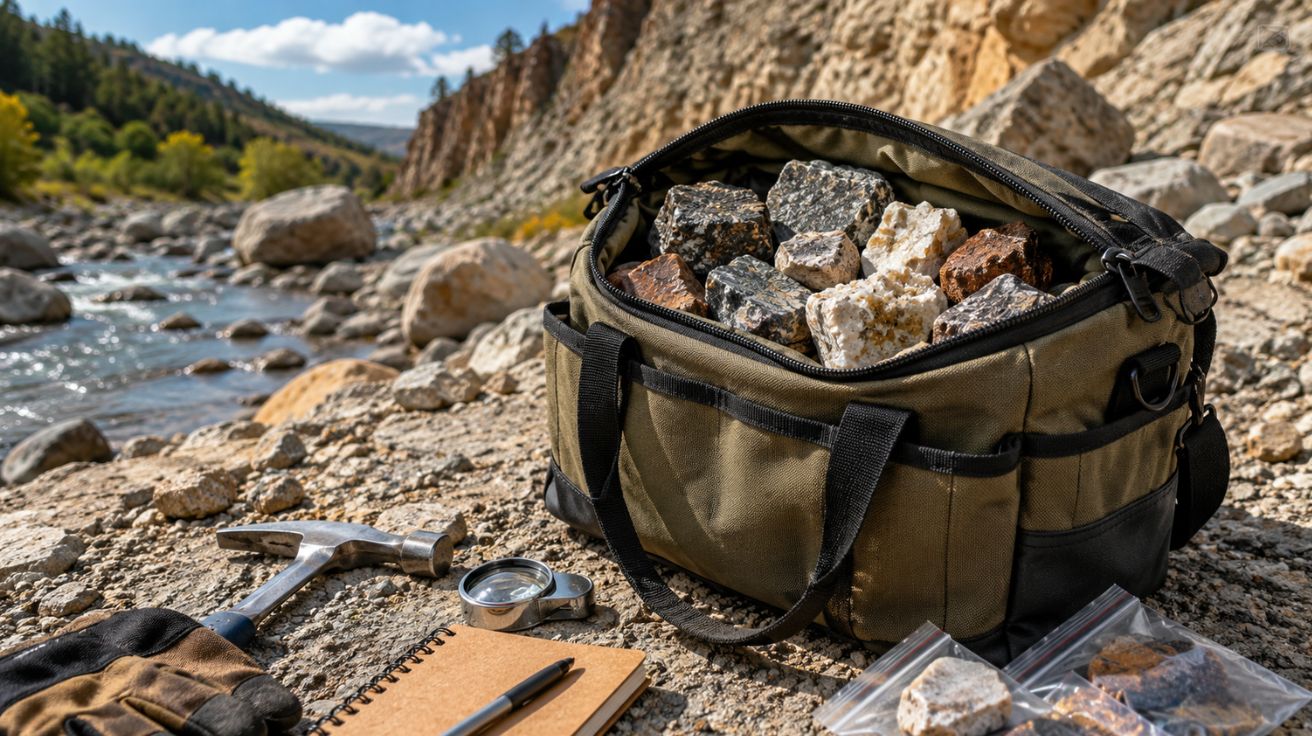

Carrying rocks sounds straightforward until you’re doing it regularly. Whether you’re pulling samples from a riverbed, working a dig site, or building a personal mineral collection, the container you use to transport material has a real effect on how your work goes. Rocks vary enormously in weight, shape, and edge sharpness. A bag that works for one type of fieldwork may fail quickly under different conditions. Torn seams, broken handles, and inadequate closures are not minor inconveniences — they interrupt workflow, risk damaging specimens, and sometimes cause physical strain on the collector carrying them.
Choosing the right rock bag is less about finding the most popular option and more about understanding what conditions you’ll actually face in the field. This guide addresses that process in a practical, straightforward way.
Understanding What a Rock Bag Actually Needs to Do
A rock bag is not simply a heavy-duty version of any general-purpose bag. It is a tool designed to hold dense, irregular, and often sharp material under physical stress — repetitive loading, outdoor exposure, uneven terrain, and extended carrying. When you treat it as a general container, you will encounter failure points that could have been avoided with a more deliberate selection process.
This distinction matters early in the decision-making process. A solid Rock Bag guide will typically start here — with the operational demands of the task — before moving into materials, construction, or sizing. Understanding the function first prevents over-investing in features you won’t use and under-investing in the ones that will determine whether the bag holds up.
Rock bags are used across a wide range of contexts: amateur mineral collecting, geological fieldwork, landscaping and stone transport, construction material sampling, and educational use in geology programs. Each context places different stresses on the bag. A collector pulling small quartz specimens from a creek bed has very different requirements than someone hauling heavy core samples across rough terrain. The right starting point is an honest assessment of your actual use case.
Weight Distribution and Load Capacity
Rocks are among the densest materials a bag can carry. Even a modest volume of stone adds up to significant weight quickly, which puts unusual strain on handles, straps, and attachment points. A bag designed for general outdoor use — even one marketed as durable — often concentrates load stress at the seam where the handle meets the body. That seam will fail before the rest of the bag shows any wear.
Load capacity should be understood as a structural consideration, not just a volume one. A bag with reinforced stitching at stress points, double-layered base panels, and wide shoulder or carry straps distributes weight more evenly across the structure. For collectors who carry consistently heavy loads, this structural quality is non-negotiable. Ignoring it leads to frequent bag replacement, which adds up in cost and disruption over time.
Material Durability Against Sharp and Abrasive Content
Rock surfaces are unpredictable. Even well-wrapped specimens can shift during transport, and unwrapped field samples often have exposed edges that work against interior fabric with every movement. Canvas, waxed cotton, and heavy-duty synthetic fabrics designed for abrasion resistance handle this differently — and the right choice depends partly on what you are typically carrying and how often you are loading and unloading.
Thin nylon bags, despite being lightweight and weatherproof, are particularly vulnerable to puncture from angular stones. Heavy canvas has excellent resistance to abrasion but absorbs moisture, which can affect both the bag’s weight and the preservation of certain mineral specimens. Understanding the material trade-offs at this level helps you make a selection based on your actual working conditions rather than general reputation or price.
Types of Rock Bags and When Each Type Makes Sense
Rock bags come in several physical formats — tote-style, backpack, bucket-bag, and field pouch — and each format exists because it solves a specific problem. Choosing the wrong format, even if the quality is good, will create friction in your workflow that affects how efficiently you can collect, sort, and transport material.
Tote-Style and Open-Top Bags
Open-top designs allow fast loading and easy access, which is particularly valuable during active fieldwork when you’re making frequent additions to your collection. The trade-off is stability — rocks shift during movement, and without a secure closure, material can spill on uneven ground. These bags work well for short-distance, low-volume collecting where access speed matters more than containment security.
Tote-style bags with reinforced bases are also common in landscaping and garden stone work, where the visual inspection of material is ongoing and weight distribution over a flat base is more practical than a structured container. For this application, the durability of the base and the quality of the side seams matter most.
Backpack and Frame-Support Designs
When volume increases or distances are longer, carrying weight on your back rather than in your hands becomes a functional necessity. Backpack-style rock bags distribute load across the shoulders and hips, significantly reducing strain on the arms and lower back. This matters particularly for collectors who are also hiking to their collection sites, where uneven ground and elevation changes make hand-carrying a heavy tote impractical and physically taxing over time.
According to guidance maintained by the Geological Society of America, proper load management is a real consideration in extended fieldwork, and the choice of carrying system affects both safety and endurance on longer trips. A backpack format with padded shoulder straps and a hip belt is not just about comfort — it is about maintaining functional capacity throughout the day.
Field Pouches and Sample Bags
Smaller pouch-style bags serve a specific purpose: transporting individual specimens or small batches of samples without contamination or contact with other material. These are common in geology programs and mineral collecting where provenance matters — each sample needs to be kept separate to preserve context about where it came from. A pouch used carelessly for mixed material loses that value immediately.
Field pouches are not a replacement for a primary carrying bag. They function as part of a layered system — the pouch holds individual specimens, and the larger bag holds the pouches. Collectors who overlook this distinction often end up with mixed, unlabeled material that has limited value for study or display.
Closure Systems and Access Design
How a bag opens and closes affects both specimen protection and the efficiency of your fieldwork. A closure that is difficult to operate with dirty or gloved hands slows you down. A closure that is not secure enough allows rocks to shift or fall during transport, risking damage to softer specimens or creating an unbalanced load.
Buckle, Drawstring, and Zipper Closures
Each closure type has practical limitations in field conditions. Drawstrings are simple and reliable but reduce the accessible opening size, which can be frustrating when loading larger pieces. Zippers offer clean closure but are vulnerable to damage from grit and dust — common in any outdoor rock-collecting environment. Metal buckles and roll-top closures generally hold up well under repeated use but require more deliberate operation.
The best closure system is the one that matches how frequently you open and close the bag during a typical session. A bag you open once at the site and once at home needs a different closure than one you open and close dozens of times during active collecting. This is a simple question, but it has a concrete effect on how the bag performs over time.
Practical Considerations Before You Buy
Beyond material, format, and closure, there are a few practical considerations that affect how a rock bag performs in real use. These are not secondary — they are often what separates a bag that lasts years from one that fails within a season.
- Interior lining matters more than it appears: an unlined interior with rough stitching can scratch softer mineral specimens during transport, reducing their display or study value.
- Handle attachment points should be inspected closely — look for bartacked reinforcement or riveted hardware, not just topstitching, especially on bags intended for heavy or repeated loads.
- Pocket organization is useful for tools and labeling materials but should not come at the cost of structural integrity; external pockets on cheap bags often fail at the base seam first.
- Washability is worth considering if you work in environments with clay-heavy soil, iron-staining minerals, or saltwater — residue buildup affects fabric performance over time.
- Sizing should be matched to your typical session volume, not your maximum possible load; consistently overfilling a bag damages it faster and increases carrying strain significantly.
Matching the Bag to the Collector’s Stage of Practice
There is a meaningful difference between what a beginner needs and what an experienced collector or fieldwork professional requires. A beginner collecting casually near accessible sites needs a reliable, mid-weight bag with simple access and adequate durability. Investing in professional-grade equipment before developing a consistent practice often results in underuse or mismatch.
As collecting becomes more systematic — longer trips, greater volume, more fragile or valuable specimens — the demands on the bag increase. At that stage, structural quality, ergonomic carry design, and specialized interior organization become genuinely useful rather than excessive. The transition is gradual, and most collectors find that their first serious bag replacement is driven by a specific failure they experienced with a cheaper option.
Understanding your current stage honestly will save both money and frustration. A bag that is right for where you are now, and that you can replace when your practice outgrows it, is a more useful approach than buying ahead of your actual needs.
Conclusion
Selecting a rock bag is a practical decision with real consequences for how your fieldwork or collecting practice runs. The wrong bag creates avoidable problems — strain, specimen damage, interrupted workflow, and recurring replacement costs. The right bag, chosen based on actual use conditions rather than price point or general reputation, becomes a reliable part of your kit that requires little additional thought.
The framework here is straightforward: start with your actual workload and field conditions, evaluate structural quality at stress points, match the format to how you carry and access material, and choose a closure system that fits your working pace. These decisions compound. A bag built correctly for your specific application will outlast several cheaper alternatives and reduce the small frictions that accumulate over a season of regular use.
Whether you are just starting out or refining a more established collecting practice, the time spent on this decision at the beginning is returned in reliability throughout the life of the bag.
Read More: Procurement Opportunity Analysis 101: The Framework Every US Supply Chain Manager Should Know


Leave a Comment