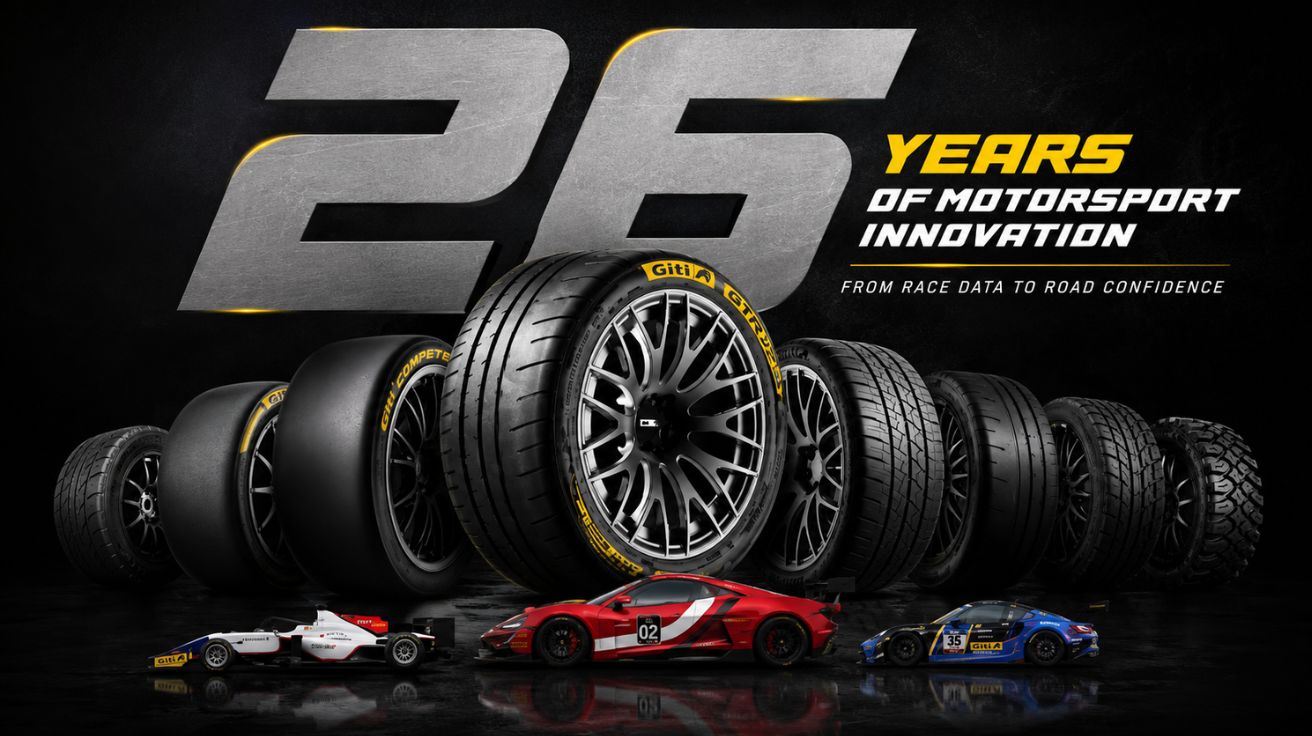

Giti Marks 26 Years of Motorsport Innovation: From Race Data to Road Confidence
For more than a quarter century, Giti Tire has treated motorsport as more than a test of speed. It has used racing as a demanding engineering environment where tire behavior can be studied under pressure, across heat, rain, long-distance endurance, rough terrain, high-speed cornering and repeated braking. As Giti marks 26 years of motorsport involvement, that legacy is not only about competition. It is about how race-proven learning can shape safer, more responsive and more durable tires for everyday drivers.
The connection between racing and road tires is direct. On a circuit, every lap produces feedback. On off-road terrain, every impact challenge casing strength, tread integrity and grip consistency. In endurance racing, tires must continue performing when heat, wear and fatigue build over hours rather than minutes. These are exactly the types of conditions that help engineers understand where materials, tread patterns and tire structures can be improved.
That is why Giti’s motorsport story matters. It is not a separate branding exercise sitting apart from product development. It is part of a wider technical approach that connects racing experience, global R&D, original equipment programs, EV-ready tire development and sustainable innovation.
A Motorsport History Built on Demanding Conditions
Giti’s 26-year motorsport journey has covered a broad range of environments, from professional racing circuits to rugged off-road competition. The company’s participation in the Giti 4×4 Extreme Series, active since 2009, has placed its tires in demanding off-road situations where traction, durability and impact resistance are critical. These conditions are particularly relevant to SUV and all-terrain tire development because they expose weaknesses that ordinary road use may not reveal quickly.
Giti has also spent the past decade competing in Nürburgring endurance racing in Germany, including events connected with one of the world’s most demanding race circuits. Long-distance competition at this level creates a different type of stress test. Tires must maintain grip, steering response, braking stability and temperature control through changing track conditions and extended running time.
The company’s broader motorsport calendar also shows how wide this testing environment has become. Giti’s 2026 motorsport activity includes Nürburgring events, Thailand Super Series, British Truck Racing Championship, Malaysia Touring Car Championship, RAAT Thailand Endurance Championship, Malaysia Speed Festival and Macau Grand Prix activity. This range matters because each race format stresses tires differently. A touring car, an endurance vehicle, a truck and a street-circuit race car do not ask the same things from a tire.
Motorsport as an Accelerated R&D Environment
Giti describes motorsport as an accelerated R&D environment, and that is the strongest way to understand its value. Race tracks compress years of ordinary driving stress into intense, measurable events. Engineers can review how a tire reacts under heavy cornering loads, high temperatures, wet surfaces, aggressive braking and repeated acceleration. They can also gather feedback from professional drivers, race teams and technical specialists who are trained to notice small differences in grip, balance and consistency.
This type of feedback has practical value. It can inform compound selection, tread-block behavior, sidewall construction, belt design, drainage, contact patch stability and heat management. In racing, a tire that loses consistency quickly creates immediate consequences. On the road, the same engineering lessons can support everyday confidence, especially during emergency braking, wet-weather driving, highway heat buildup or sudden steering inputs.
Giti’s dedicated motorsport tires, including GitiCompete products, demonstrate this technical focus. The company highlights race-tire features such as wet and dry versions, optimized crown arcs, racing-spec steel belts, high-temperature cap ply materials, bead reinforcement and track-specific carcass material selection. These are not casual design details. They show how motorsport forces tire engineers to solve problems at the edge of performance.
From Track Learning to Road Tire Confidence
The real value of motorsport comes when learning moves from the track to consumer tire development. Giti’s wider technology platform is built around the same performance questions that racing exposes: how to improve control, how to manage heat, how to preserve grip, how to reduce noise, how to maintain durability and how to balance safety with efficiency.
This connects closely with Giti’s AdvanZtech 2.0 platform, which the company presents as the next evolution of its tire technology. AdvanZtech 2.0 is designed around growing market demand for quality, high performance and safety, while also expanding into eight areas of expertise that include sustainability, eco-conscious compounds and energy-efficient manufacturing. That matters because modern tire development is no longer about performance alone. Drivers now expect tires to support safety, comfort, EV efficiency, lower noise and environmental responsibility at the same time.
The same principle appears in Giti’s Technology First approach. The company states that technology is integrated across its work, supported by engineers with experience in quality, safety, performance, continuous improvement and sustainability. Motorsport strengthens that approach because it gives engineers a live proving ground where design theory is tested against real pressure.
Why EV Development Makes Racing Insight More Important
As electric vehicles become more common, the link between motorsport and road tires becomes even more relevant. EVs place different demands on tires because of higher vehicle weight, instant torque delivery, low-noise expectations and the need for rolling-efficiency performance. Giti’s EV-ready work already reflects these priorities across products such as the GitiControl P10, GitiSynergy H2+ and GitiSport S2+.
The company’s recent OE activity reinforces this direction. In 2026, Giti announced OE nominations for the all-electric BMW iX1 and BMW iX2 with the GitiSynergy H3 in 245/40 R20 99Y XL. According to Giti, the tire was developed for BMW Group requirements around performance, efficiency and sustainability, with focus areas including low rolling resistance, reduced noise, wear life, aerodynamic sidewall design and wet-grip performance.
This is where motorsport credibility and OE development begin to reinforce each other. Racing helps pressure-test performance ideas. OE programs require those ideas to be refined into repeatable, validated tire solutions that meet manufacturer requirements. For Giti, both paths support the same objective: developing tires that perform under real-world demands, not just controlled laboratory conditions.
Sustainability Without Separating from Performance
A modern motorsport story also has to address sustainability. The mistake would be to treat environmental progress as separate from performance engineering. Giti’s own innovation work shows the opposite direction. The company has highlighted a prototype tire with 93% sustainable material composition, including 53% renewable materials and 40% recycled materials. These include nature-derived and recycled inputs such as sustainable natural rubber, pine resin, rice husk silica, plant-based antioxidants, recycled rubber, carbon black, steel and PET from plastic bottles.
For a performance-focused brand, the important point is not simply the percentage. The important point is whether future tire technology can balance responsibility with grip, durability, wet traction, rolling resistance and driver confidence. Giti’s sustainability work gives the motorsport milestone a broader meaning: the next phase of tire performance must be cleaner, smarter and more efficient without abandoning the control and safety drivers expect.
A Global Brand with Technical Momentum
Giti’s 26-year motorsport milestone also arrives during a period of broader brand momentum. The company’s official brand information describes more than 70 years of tire-industry experience, five manufacturing facilities, four R&D centers, one tire testing center and more than 100,000 points of sale worldwide. Giti also reports that Brand Finance ranked it as the 8th most valuable tire brand globally in 2026 and the fastest-growing tire brand that year, with brand value rising 37.7% year over year to USD 1.47 billion.
These figures matter because motorsport claims are stronger when supported by a wider engineering and market base. A race program on its own can create visibility. A race program connected to R&D, OE nominations, EV-ready product work, sustainability development and global distribution creates a more credible story of applied innovation.
The Road Ahead for Giti Motorsport
After 26 years, Giti’s motorsport journey is still moving forward. The next chapter will not be judged only by trophies, lap times or race calendars. It will be judged by how effectively racing insight continues to improve the tires used by everyday drivers, EV owners, SUV drivers, commercial fleets and performance enthusiasts.
That is the stronger meaning behind this milestone. Motorsport gives Giti a place to test ideas under extreme conditions. Technology platforms such as AdvanZtech 2.0 help turn those ideas into structured product development. OE programs validate engineering against demanding automaker standards. Sustainability initiatives push the company to rethink materials and manufacturing for the future of mobility.
For Giti, 26 years of motorsport excellence is not just a celebration of where the brand has been. It is a statement of how the company intends to keep developing tires: tested under pressure, refined through technology and built for the changing needs of drivers around the world.
Read More: Why Do Niche Automotive Brands Continue to Thrive?


Leave a Comment