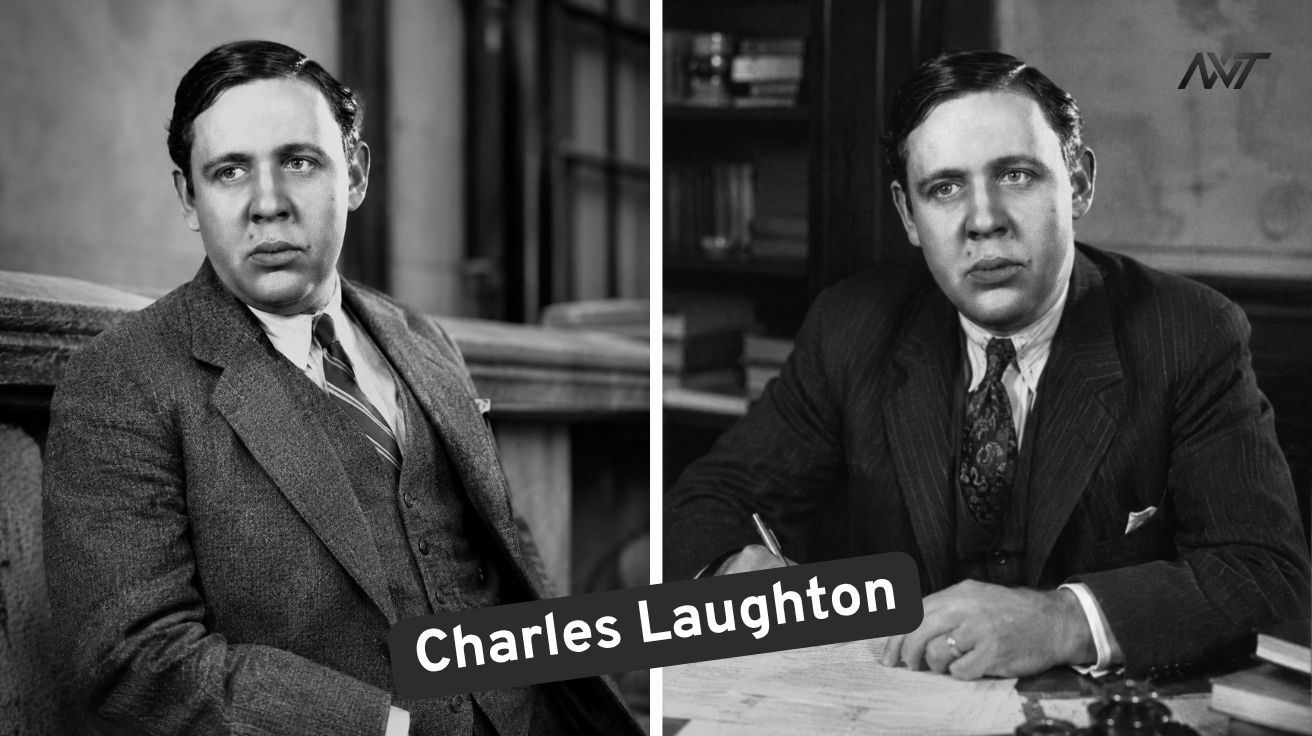

Charles Laughton did not look like the usual film star, and that was part of his power. He had a heavy face, a watchful gaze, a body that seemed to carry private discomfort, and a voice that could turn from silk to gravel in a single line. He did not sell beauty. He sold appetite, shame, fear, vanity, cruelty, tenderness, and intelligence. That made him one of the most fascinating actors of the twentieth century.
Laughton’s career moved across stage, British cinema, Hollywood, radio, public readings, and directing. He won an Academy Award, played kings and beggars, terrified audiences as Captain Bligh, broke hearts as Quasimodo, and directed one film, The Night of the Hunter, which later became one of the most admired American films of its period. His life was full of contradictions. He was famous but insecure, commanding but fragile, married but privately conflicted, theatrical but often painfully human on screen.
His best roles still feel alive because he did not flatten people into heroes or villains. He found the weak spot inside power. He found pride inside humiliation. He could make a monster funny, a coward touching, and a judge theatrical without making him false. Laughton’s gift was not only transformation. It was exposure. He showed what people try to hide.
The Face That Refused to Behave
Charles Laughton’s face was never neutral. It could sag, sharpen, leer, soften, or freeze into wounded stillness. Many actors work hard to control every angle. Laughton often seemed to let the face misbehave, then used that misbehaviour as drama. His mouth could suggest greed, wit, disgust, or panic. His eyes could look cruel in one shot and almost childlike in the next. He understood that the camera did not need polished symmetry. It needed thought.
This quality separated him from the handsome leading men of his time. Hollywood had plenty of straight backs, clean profiles, and square jaws. Laughton brought something stranger. He made audiences look at discomfort. He did not ask to be admired in the usual way. He asked to be watched.
His voice was just as important. He could make a sentence sound formal, comic, wounded, or dangerous. He had the training of a stage actor, but he learned how to reduce his force for the camera when the role required it. In some performances, he filled the room with theatrical size. In others, he withdrew until the viewer leaned towards him.
Laughton also had a rare talent for playing authority as a form of weakness. His rulers, officers, barristers, and senators often appear strong at first glance. Then the cracks show. Pride hides panic. Cruelty hides fear. Manners hide hunger. He understood that power is rarely calm inside. His best characters are not firm statues. They are unstable men trying to keep control.
That is why Laughton remains so watchable. His acting does not feel like a museum piece when it works. It feels too alive to sit still. Even when the style belongs to another era, the emotional logic feels sharp. People still recognise his vanity, resentment, loneliness, and need to be seen.
From Scarborough to the Stage
Charles Laughton was born in Scarborough, Yorkshire, in 1899. His family ran a hotel, and his early life placed him close to performance before he had a formal name for it. Hotels are theatres of manners. Guests arrive with status, demands, secrets, and habits. Staff learn how people behave when they want comfort, attention, or control. That world may have helped Laughton observe class, vanity, impatience, and social performance.
His path into acting was not instant. He served during the First World War and later entered the family business before choosing the stage. He trained at the Royal Academy of Dramatic Art, where he developed the vocal and physical discipline that became central to his work. He soon built a reputation in British theatre, where his presence could fill a room before cinema gave him an international audience.
The stage mattered to Laughton throughout his life. He was not simply a film actor who happened to know theatre. He came from a tradition where language, rhythm, and physical detail shaped performance. Even in film, he often carried a stage actor’s awareness of timing. He knew when to pause. He knew when to let a line land heavily. He knew when to make silence feel like a verdict.
His marriage to Elsa Lanchester became one of the most recognisable partnerships around him. Lanchester was an actress with a distinct screen presence of her own, best remembered by many for Bride of Frankenstein. Their marriage lasted for decades, and they appeared together in several projects. The public image suggested an eccentric artistic couple, witty, theatrical, and unusual.
The private reality was more difficult. Laughton’s sexuality has been discussed by biographers, and Lanchester later wrote with candour about the marriage. Their relationship cannot be reduced to a simple label. It contained affection, collaboration, distance, tension, and performance. It belonged to a time when public reputation placed heavy pressure on private truth. Laughton lived under those pressures while building a career that often depended on emotional exposure.
This tension may help explain the depth of his acting, though it should not be used as a neat key to every role. Laughton knew something about masks. He knew about appearing one way while feeling another. He knew about shame, concealment, and the cost of being watched. His best work often carries that knowledge.
The Roles That Built the Myth
Laughton’s breakthrough as a major film actor came through roles that allowed him to be large without becoming hollow. He did not simply play famous men. He played appetite, fear, rot, wit, and decay inside famous men.
His performance in The Private Life of Henry VIII turned him into an international star and won him the Academy Award for Best Actor. The film’s Henry is not a distant historical figure. He is hungry, vain, funny, childish, dangerous, and absurd. Laughton understood that Henry’s power did not make him dignified. It made his appetites more visible. He ate, shouted, sulked, flirted, and raged like a man who had never been forced to control himself.
The role could have become pure costume acting. Laughton avoided that by making Henry both ridiculous and frightening. He lets the audience laugh, then reminds them that this comic figure can destroy lives. That tension gives the performance its bite. He turns monarchy into theatre, but the theatre has bodies behind it.
In Mutiny on the Bounty, Laughton created one of cinema’s defining portraits of authoritarian cruelty. His Captain Bligh is not a wild brute. He is worse than that. He is controlled, precise, and convinced of his own rightness. Laughton gives him a tight, pinched quality. The cruelty appears bureaucratic. Punishment becomes procedure. Bligh’s horror lies in his belief that discipline excuses anything.
This performance works because Laughton does not beg the audience to hate him. He trusts the details. The voice, the posture, the thin smile, the rigid sense of order, all build a man who has turned command into personal obsession. He made Bligh memorable not by shouting constantly, but by showing how cruelty can sit inside formality.
His Quasimodo in The Hunchback of Notre Dame showed another side of his talent. Under heavy make-up and physical distortion, Laughton built a performance of pain, confusion, loyalty, and longing. He did not treat Quasimodo as a monster. He treated him as a man shaped by isolation. The body is twisted, but the emotional life is clear.
The role demanded more than sympathy. It demanded physical discipline. Laughton had to move in a way that suggested years of bodily hardship without reducing the character to a display. His Quasimodo is touching because he does not ask for pity in every moment. He can be frightened, tender, desperate, and fiercely protective. The sadness comes from his humanity, not from the make-up.
In Ruggles of Red Gap, Laughton played comedy with unusual warmth. The film gave him a role far from tyrants and grotesques. As Marmaduke Ruggles, an English valet taken to America, he allowed restraint to become comic and then quietly moving. The performance shows how well he could play dignity without stiffness.
The famous Gettysburg Address scene in the film remains one of his most moving moments. Laughton lets the words work through the character. The scene could have been sentimental, but he gives it sincerity. Ruggles discovers not only a new country, but a new sense of self. Laughton makes that discovery visible in small changes of voice and posture.
His later role in Witness for the Prosecution proved that he could still dominate a film without relying on size alone. As Sir Wilfrid Robarts, he plays intelligence, impatience, illness, vanity, and legal cunning with comic precision. He shares scenes with strong performers, including Marlene Dietrich and Tyrone Power, yet he never disappears.
Sir Wilfrid is theatrical, but Laughton gives him a human body. He coughs, complains, resists medical advice, and pushes himself back into battle because the courtroom is where he feels most alive. The role suits Laughton perfectly. It lets him turn age into authority and physical weakness into timing.
In Spartacus, he played Senator Gracchus with a different kind of force. The role has political weight, but Laughton avoids making him a simple noble Roman. Gracchus is witty, worldly, strategic, and aware of decay around him. He understands power because he has lived inside it. He can be charming without being innocent.
His work in Advise & Consent also belongs to this late-career phase, where his body and voice had grown heavier but his mind on screen remained quick. He could sit in a room and change its temperature. He no longer needed to chase the camera. He could let the camera come to him.
Laughton’s best roles are not tied together by genre. They are tied together by contradiction. Henry VIII is comic and lethal. Bligh is controlled and savage. Quasimodo is feared and gentle. Ruggles is proper and quietly rebellious. Sir Wilfrid is frail and ferocious. These parts show why Laughton mattered. He did not play one type of man. He played the struggle inside men.
For more interesting topics visit NV Times
The Director Who Made One Film and Left a Ghost
Charles Laughton directed only one feature film, The Night of the Hunter, released in 1955. That single credit would be enough to secure his place in film history even if he had never acted. The film was not a commercial success when it first appeared, and its reception discouraged him from directing again. Over time, its reputation grew until it became regarded as one of the most distinctive American films of the 1950s.

The film follows a murderous preacher, Harry Powell, played by Robert Mitchum, who hunts two children after learning that their dead father hid stolen money. The story sounds like a thriller, but Laughton shaped it into something stranger. It has the rhythm of a nightmare, the morality of a fable, and the visual force of silent cinema. Shadows stretch across rooms. Rivers become dream passages. Houses feel like traps. Songs become threats.
Laughton’s direction shows that he understood performance from both sides of the camera. Mitchum’s preacher is terrifying because he is calm, charming, and theatrical. He performs goodness as a costume. The famous tattoos on his fingers, spelling “love” and “hate”, could have become a gimmick. Under Laughton’s direction, they become part of a travelling sermon, a cheap trick with deadly force behind it.
The children in the film are not treated as decorative victims. Their fear carries the story. Laughton gives their point of view real weight, which helps explain the film’s dreamlike quality. Children see adults as giants, rooms as caves, rivers as escape routes, and voices as threats before words are fully understood. The film captures that world with rare precision.
Lillian Gish brings moral strength to the final act. Her presence links the film to silent cinema, and Laughton uses that connection with care. She does not play goodness as softness. She plays it as resistance. Her character protects children with a calm that feels harder than Powell’s violence.
The film’s failure hurt Laughton. He had taken a risk, and the public did not reward it at the time. That failure remains one of cinema’s great losses, because it stopped a directing career that might have produced further unusual work. Yet the one film he left behind has the density of a full artistic statement. It shows his interest in masks, performance, innocence, corruption, and the terror of false authority.
The Night of the Hunter also reveals how deeply Laughton understood evil as performance. Powell is dangerous not only because he kills, but because he knows how to play holiness. That idea connects with many of Laughton’s acting roles. He knew that people in power often perform virtue, discipline, patriotism, or respectability while hiding appetite underneath.
The Private Man, the Reader, and the Odd Corners
Laughton’s life was not only a chain of film roles. He was also a reader, teacher, stage performer, and public speaker. Later in his career, he became known for dramatic readings, bringing literature to audiences through voice and presence rather than costume or set. These performances suited him. He could make language physical. He knew how to hold attention without moving much.
His interest in reading also points to the centre of his craft. Laughton loved text, but he did not treat words as decoration. He used them as pressure. A line in his mouth could reveal class, insecurity, cruelty, humour, or self-defence. He had the actor’s instinct for what a person says and what the person means underneath.
He also had a reputation for insecurity. This matters because his screen confidence can look overwhelming. He appears so commanding in some roles that it is easy to assume he possessed the same certainty in life. Accounts of him suggest a more troubled figure. He worried about his looks, his talent, his body, and his place in the world. That insecurity may have fed the strange intensity of his work.
Laughton’s body was central to how audiences saw him, and he knew it. He was often cast in roles that used his size or face as part of the drama. Some actors might have resisted that. Laughton turned it into art. He used the body as a map of appetite, suffering, and authority. He could make a slow movement feel heavy with meaning. He could make stillness seem defensive.
His marriage to Elsa Lanchester remains one of the most discussed parts of his life. Their partnership produced work, companionship, and public fascination, but it was not a conventional romantic story. Lanchester later wrote about Laughton’s homosexuality, and later biographical discussions have returned to the subject often. The subject should be handled with care because Laughton lived in a period when openness carried real professional and social risk.
This private pressure gives some of his work an added sadness. Not because every role should be read as confession, but because he understood divided life. He understood how a person could perform one identity in public and carry another truth in private. That knowledge appears in his best acting. His characters often seem to know more pain than they say.
There are other odd corners in his story. He became a British actor who found deep success in Hollywood without becoming smoothed out by it. He moved between prestige drama, historical films, courtroom thrillers, literary adaptations, and political drama. He could seem at home in a costume film, then appear startlingly modern in a close-up.
He also avoided easy glamour. Even when films placed him in grand surroundings, he brought human mess into the frame. His kings were not clean symbols of rule. His officers were not simple men of duty. His lawyers were not pure minds in wigs. He made authority sweaty, vain, hungry, and mortal.
This is one reason writers and critics keep returning to him. Laughton’s career is not only a set of famous titles. It is a study in how an actor can use what the industry might consider flaws. His face, body, voice, and anxieties became tools. He did not erase himself to fit roles. He pushed himself into them.
He also reminds us that screen acting does not depend only on realism as modern viewers often understand it. Some of his performances are large by today’s standards. They come from an older theatrical tradition. Yet the best of them remain convincing because the emotional choices are exact. He may enlarge a gesture, but he does not empty it.
The restaurant seating in a film scene may change with fashion, but Laughton’s kind of screen presence still feels recognisable because it comes from behaviour rather than decoration. He watches, reacts, calculates, shrinks, swells, and attacks. He turns thought into visible action.
Why Charles Laughton Still Feels Modern
Charles Laughton still matters because he challenged a narrow idea of what screen charisma could be. He did not need beauty, youth, or ease. He made discomfort compelling. He made the viewer look at people who were morally twisted, socially awkward, physically marked, or emotionally cornered. He did not ask that they be liked. He made them impossible to ignore.
Modern acting often values contradiction, and Laughton was built from contradiction. He could be theatrical and intimate. He could be grotesque and tender. He could dominate a scene while revealing weakness. He could make a villain funny without making him harmless. He could make a sympathetic character difficult without losing the audience.
His performances also resist simple moral sorting. Captain Bligh is cruel, but not chaotic. Henry VIII is funny, but not safe. Quasimodo is gentle, but not sentimental. Sir Wilfrid is charming, but vain. Gracchus is civilised, but politically stained. Laughton’s people are rarely clean. They carry mixed motives, which is why they continue to feel alive.
His work as a director adds another layer to his legacy. The Night of the Hunter proves that his imagination was not limited to acting. He understood fear, innocence, false holiness, and visual storytelling. He knew how performance could become a weapon. The fact that he never directed another film gives that achievement a strange sadness. It stands alone, like a door briefly opened and then shut.
Laughton’s life also speaks to the cost of public performance. He lived at a time when parts of himself had to remain guarded. He built a career from revealing human secrets while protecting his own. That tension does not reduce his art to biography, but it deepens the sense of risk around him. He knew what masks were for. He knew what they cost.
His influence can be seen in later actors who refused conventional glamour and built careers from intelligence, oddness, danger, or vulnerability. He belongs to a line of performers who prove that the camera loves thought as much as beauty. A face does not need to be perfect if it can think. A body does not need to be ideal if it can carry history. A voice does not need to be soft if it can tell the truth.
The most interesting thing about Laughton is not that he played famous roles. It is that he made inner conflict visible. He could show a man enjoying power and hating himself for needing it. He could show a frightened soul trapped inside an alarming body. He could show a mind moving faster than the people around it. He could make pride look lonely.
That is why his best work has not gone cold. Some details belong to his period: the make-up, the studio lighting, the theatrical rhythms, the formal diction. Yet the emotional engine still runs. People still know what it means to hide shame, to crave respect, to fear exposure, to perform confidence, or to use power as armour.
Charles Laughton turned those private battles into public art. He gave cinema some of its great tyrants, outsiders, eccentrics, and wounded men. He left behind one extraordinary film as a director and a body of acting that still rewards close attention. He was not smooth, and he was not simple. That was his greatness.
Read More: Why Henry Aftermarket Stocks Are Becoming The Go-To Upgrade For Hunters


Leave a Comment