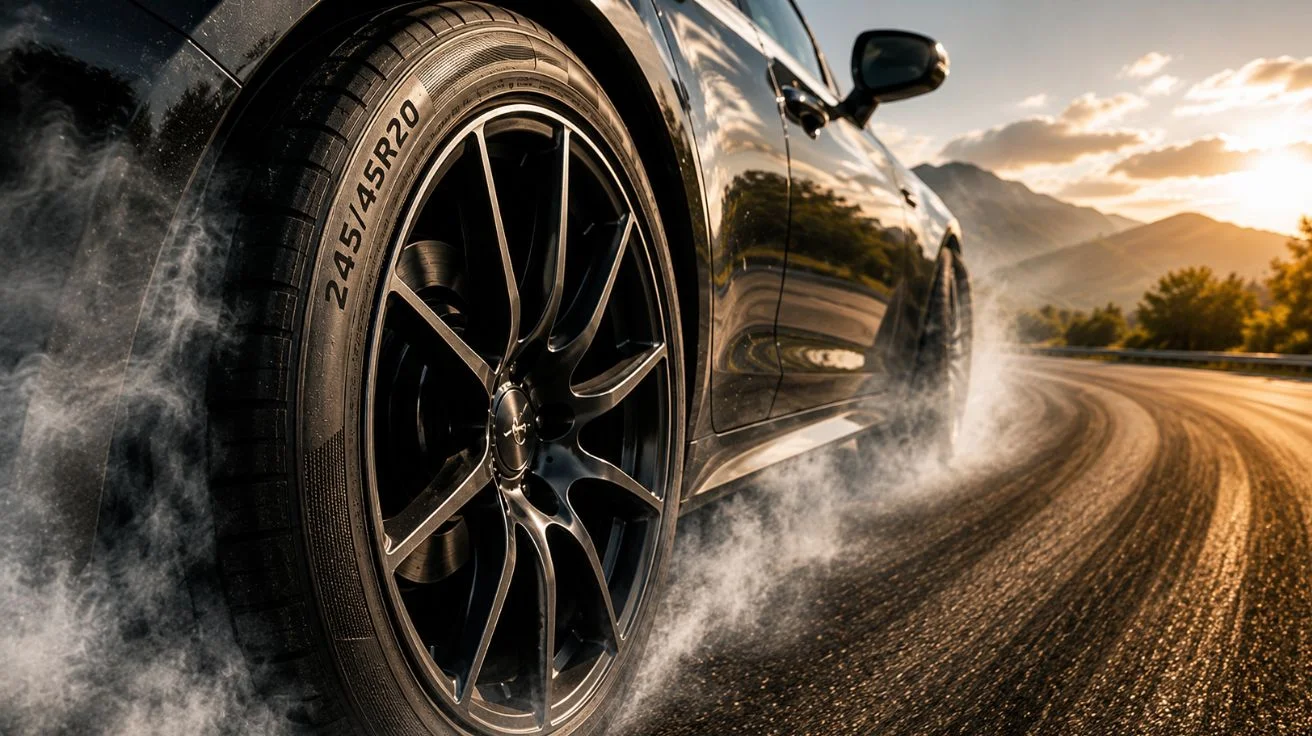

The 245/45R20 tires is a demanding size. It sits on premium and performance vehicles, BMWs, Audis, Porsches, Lexus grand tourers, American muscle and every one of them has a different set of handling expectations. Pick the wrong tire and you’re undermining what the vehicle was built to do. This guide covers the full landscape: what the size means, what categories are available, which tires are confirmed in this fitment, and what each one actually delivers.
Decoding 245/45R20: What the Numbers Mean
Before evaluating any tire, understand what the size specification actually tells you, because every number has a direct consequence for how the tire performs.
- 245 is the section width in millimeters, measured from sidewall to sidewall on the correct rim under proper inflation. It determines how wide the contact patch is, which influences lateral grip and rolling resistance.
- 45 is the aspect ratio, the sidewall height as a percentage of the width. On this tire, that means 110 mm of sidewall (245 × 0.45). That’s tall enough to absorb road imperfections reasonably well and protect expensive 20-inch wheels from pothole damage, but low enough to limit sidewall flex under hard cornering. It’s a deliberate middle ground.
- R means radial construction, the universal standard for passenger and performance tires, with ply cords running perpendicular to travel direction for superior heat management and longevity.
- 20 is the wheel diameter in inches. The physical consequences: overall diameter of 28.7 inches (728 mm), circumference of 90.1 inches, approximately 703–704 revolutions per mile, and a required rim width range of 7.5 to 9.0 inches.
Most 245/45R20 performance tires are spec’d as 103Y XL. That means a maximum load per tire of 875 kg (load index 103), a maximum speed rating of 300 km/h (Y), and Extra Load construction requiring higher inflation pressures than a standard load equivalent. If your vehicle specifies 103Y XL, that is your minimum requirement across all three parameters, not a suggestion.
Which Vehicles Run 245/45R20?
Understanding the OEM fitment list explains why this size spans so many tire categories. These are not all the same kind of vehicle.
- BMW X3 and X4 (M-Sport trims): staggered setup — 245/45R20 front, 275/40R20 rear
- Audi A6 Allroad (2019–2026): 245/45R20 XL 103Y
- Porsche Taycan: confirmed 245/45R20 fitment
- Lexus LC 500, LC 500h, LS 500, and LS 500h
- Cadillac XT4, Lincoln Corsair, Buick Envision
- Dodge Charger, Dodge Challenger, Ford Mustang Mach-E
- Land Rover Discovery Sport, Range Rover Evoque
A Porsche Taycan and a Dodge Charger share a tire size but have almost nothing else in common. The Taycan is a heavy EV with near-instant torque delivery that demands exceptional traction under acceleration. The Charger is rear-wheel-drive muscle with very different balance characteristics. Choosing a tire for this size means choosing for your specific vehicle, not for the size in the abstract.
The Three Performance Categories Available in 245/45R20
UHP Summer Tires
Summer UHP tires prioritize dry and wet grip at the expense of cold-weather usability and tread longevity. They use rubber compounds that stay in their optimal temperature range above approximately 7°C (45°F). Below that threshold, the compound hardens, grip degrades, and wet braking distances increase substantially. They are not suitable for use in freezing conditions.
In their operating range, they offer the sharpest steering response, the highest lateral grip limits, and the shortest braking distances of any category. If you drive a genuine performance car and change to dedicated winter tires when temperatures drop, this is the category to be in.
UHP All-Season Tires
All-season UHP tires trade some peak summer performance for a wider usable temperature window. Some carry the Three-Peak Mountain Snowflake (3PMSF) symbol, indicating they’ve passed a standardized snow traction test, though this is not the same as a dedicated winter tire. This category suits drivers in regions with mild winters who prefer a single set of tires year-round.
The honest trade-off: they’re not as fast in the wet as a dedicated summer tire, and they’re not as safe in snow as a dedicated winter tire. They are the most versatile compromise, not the best performer in any single condition.
Grand Touring All-Season Tires
Grand touring tires shift priorities toward ride comfort, low noise, and tread life. For vehicles like the Audi A6 Allroad or Buick Envision where long-distance comfort matters as much as dynamic ability, this can be the correct choice. Tread life warranties of 60,000–70,000 miles are common in this category, versus no warranty at all for most summer performance tires.
245/45R20 Performance Tires: 2026 Comparison
The following tires are confirmed available in 245/45R20 as of mid-2026. All specifications are sourced from manufacturer product pages. Price tiers reflect relative positioning, not specific retail pricing, which varies by retailer and region.

Individual Tire Profiles
Michelin Pilot Sport 4S — 245/45ZR20 103Y XL
The Pilot Sport 4S is Michelin’s flagship street-performance summer tire and one of the benchmark references in the UHP category. It is available in 245/45R20 as a POR (Porsche OEM) fitment variant. The 4S uses a bi-compound tread, two different rubber formulations across the contact patch, harder on the inner section for longevity, softer on the outer shoulder for grip. Independent testing from publications including Auto Bild and Tyre Reviews consistently places it among the top performers in its class for both wet and dry conditions.
Trade-offs: it is one of the most expensive options in this size and carries no tread life warranty. Pilot Sport 5 availability in this exact size varies by region, so do not assume the PS4S is the only Michelin performance option everywhere. Check the current Michelin size chart in your market before making a final choice.
Pirelli P Zero (PZ4) — 245/45R20 103Y XL
Pirelli’s P Zero is the standard OEM fitment tire for a significant portion of the luxury and performance vehicles that run this size, including multiple Porsche and Audi variants. The PZ4 generation is available in multiple variants in 245/45R20: standard, ELECT (optimized for EV acoustic and load requirements), and Run Flat versions. The ELECT variant specifically addresses the weight and torque characteristics of electric performance vehicles.
Trade-offs: OEM-spec tires like the P Zero are typically priced at the premium end of the market. The Run Flat variant carries a significant ride quality penalty compared to the standard tire. No tread life warranty.
Continental ExtremeContact Sport 02 — 245/45R20 103Y
The ExtremeContact Sport 02 is the most value-oriented of the mid-premium summer options in this size. It carries a 30,000-mile tread life warranty for standard fitments, unusual for a UHP summer tire — and Continental’s SportPlus technology, which includes wear indicators for both dry (D) and wet (W) performance: tread indicators that disappear when the tire is no longer optimized for each condition respectively.
Independent user data and reviewer assessments consistently highlight its wet performance and daily usability. The ExtremeContact Sport 02 uses an asymmetric performance tread design, so installation should follow the tire’s inside/outside sidewall marking rather than a directional rotation arrow. Trade-offs: not at the absolute ceiling of dry grip versus the Michelin or Pirelli, and the 30,000-mile warranty reflects the softer compound used for performance, wear will accelerate under aggressive use.
Bridgestone Potenza Sport — 245/45R20 103Y XL
The Potenza Sport is Bridgestone’s street UHP offering, positioned as a daily-drivable performance tire rather than a track-focused product. It uses an asymmetric tread pattern with a large footprint and wide grooves. Bridgestone rates it as delivering up to 6% shorter dry braking distances compared to the previous-generation Potenza S-04 Pole Position. No tread life warranty is offered.
The Potenza Sport AS (All-Season) variant is also available in 245/45R20 with a 50,000-mile warranty and 103Y XL spec, this is the all-season version and should not be confused with the summer Potenza Sport when making a category decision.
GT Radial SportActive 2 — 245/45R20 103Y XL
GT Radial’s SportActive 2 is the value-tier UHP summer option in this size. It achieves an EU wet grip A label rating, the same top-category rating as the premium options above, through a four-groove drainage design and new compound formulation. The SportActive 2 is manufactured under GITI Tire Group’s production infrastructure, which also supplies OEM tires to Citroën, Peugeot, and Dacia.
The honest position for the SportActive 2 is this: it matches the top wet grip label rating of tires that cost significantly more, and it’s the only GT Radial product confirmed in 245/45R20. What it lacks compared to the Michelin 4S or Pirelli PZ4 is the depth of independent third-party test data and the OEM fitment credentials on top-tier performance platforms. User reviews from tire review platforms are positive but limited in volume for this specific size. For drivers who want EU wet grip A performance without the premium price, it is a legitimate option — not a consolation pick.
One open question flagged before this article was published: the GT Radial product page lists the 245/45R20 as 103Y without explicitly noting XL, while retailer listings in this size show 103Y XL. Verify the specific variant at point of purchase.
How to Choose: A Practical Decision Framework
Don’t start with a brand. Start with the variables that constrain your choice.
Step 1 — Lock in Your Spec
Check your vehicle door placard. If it says 103Y XL, that is non-negotiable. No lower load index, no SL tire as a substitute.
Step 2 — Decide on Your Seasonal Strategy
Summer + dedicated winter set: go UHP summer, you’ll get the best wet and dry performance in season. Single set year-round in a mild climate: UHP all-season. Touring priority with occasional spirited driving: grand touring all-season.
Step 3 — Match the Tire to Your Vehicle’s Character
An EV running this size (Porsche Taycan, Ford Mach-E) has torque loads that favour tires explicitly designed or tested for EV characteristics, the Pirelli P Zero ELECT variant exists for this reason. A staggered BMW X3/X4 setup means your front 245/45R20s will outlast your rear 275/40R20s, factor that into total cost of ownership.
Step 4 — Be Honest About Budget
There is a real performance gap between a £90 budget tire and a £170 Michelin 4S in this size. There is a much smaller gap between the Continental ECS 02 and the Michelin 4S. The GT Radial SportActive 2 sits below both on price with EU wet grip A — the trade-off is less independent test data, not less label performance.
Step 5 — Check the Staggered Fitment Reality
If your vehicle runs 245/45R20 front and a different size rear, front-to-rear rotation is impossible. Your rears will wear faster. Plan replacement timing accordingly and budget for two different sizes simultaneously.
Frequently Asked Questions
Is the Michelin Pilot Sport 5 Available in 245/45R20?
In some markets, yes. Michelin regional size-search pages now list Pilot Sport 5 under 245/45R20 results, while availability can vary by country, retailer, and exact load/speed requirement. Always verify the current local Michelin size chart and the specific sidewall marking before purchasing. If Pilot Sport 5 is not available in your market, Pilot Sport 4S may remain the main Michelin UHP summer option in this fitment.
Can I Replace a 245/45R20 XL Tire With a Standard Load (SL) Tire?
Not without risk. XL tires are engineered to operate at higher inflation pressures than SL equivalents, and many vehicles that specify XL tires are relying on that higher-pressure range for correct load capacity and handling characteristics. If your OEM specification is XL, replace with XL. Consult a qualified tire technician before making any substitution.
What Is the Difference Between the Pirelli P Zero, P Zero PZ4, and P Zero ELECT?
The P Zero PZ4 is the current-generation Pirelli UHP summer tire, replacing the older P Zero Corsa/P Zero Silver lineage. The ELECT variant is the PZ4 specifically tuned for electric vehicles, with compound and construction modifications to handle EV weight, torque, and acoustic requirements. The standard PZ4 and ELECT are both available in 245/45R20. The ELECT is the correct choice for EV applications where specified by the manufacturer.
Do Summer 245/45R20 Tires Work in Light Rain?
Yes, summer UHP tires are designed to perform in wet conditions as well as dry. The EU wet grip A rating reflects wet braking performance, and tires in this category achieve those ratings in controlled wet testing. What summer tires cannot handle safely is sustained cold weather (below approximately 7°C), ice, or snow, where the compound hardens and grip degrades significantly. Light or moderate rain at normal temperatures is within the design envelope.
What Tread Life Can I Expect From a 245/45R20 UHP Summer Tire?
Most summer UHP tires in this size carry no tread life warranty. The Continental ExtremeContact Sport 02 is an exception at 30,000 miles for standard fitments. In practice, expect 30,000–50,000 km (roughly 20,000–30,000 miles) under normal driving conditions, less with aggressive use, higher sustained speeds, or track sessions. Grand touring all-season SUV tires in the same size can reach 60,000–70,000 miles under the manufacturer’s warranty.
My BMW X3 Runs 245/45R20 Front and 275/40R20 Rear. Can I Rotate Tires?
Left-to-right rotation on the same axle is possible if the tires are not directional. Front-to-rear rotation is not possible with staggered fitments, the sizes are physically incompatible. This means your rear tires (which absorb most braking and drive forces) will wear faster than the fronts. Monitor tread depth at every service and be prepared to replace rears independently of fronts.
Bottom Line
The 245/45R20 size does not have a single correct tire, it has a correct tier for each driver. If you prioritize outright performance and your budget allows, the Michelin Pilot Sport 4S and Pirelli P Zero PZ4 have the deepest test credentials in this category. If you want strong wet and dry performance with a tread life warranty and a lower price point, the Continental ExtremeContact Sport 02 is the most balanced option. The Bridgestone Potenza Sport sits between the two camps, capable and daily-drivable. The GT Radial SportActive 2 is the honest value pick with a top-category wet grip label, OEM-grade manufacturing, and a significantly lower price than the premium tier.
Whatever you choose: match the load index and XL designation to your OEM spec, verify the size chart on the manufacturer’s website before you order, and if your vehicle runs a staggered setup, plan your replacement timing around the faster-wearing rear axle.
Read More: Giti Marks 26 Years of Motorsport Innovation: From Race Data to Road Confidence


Leave a Comment