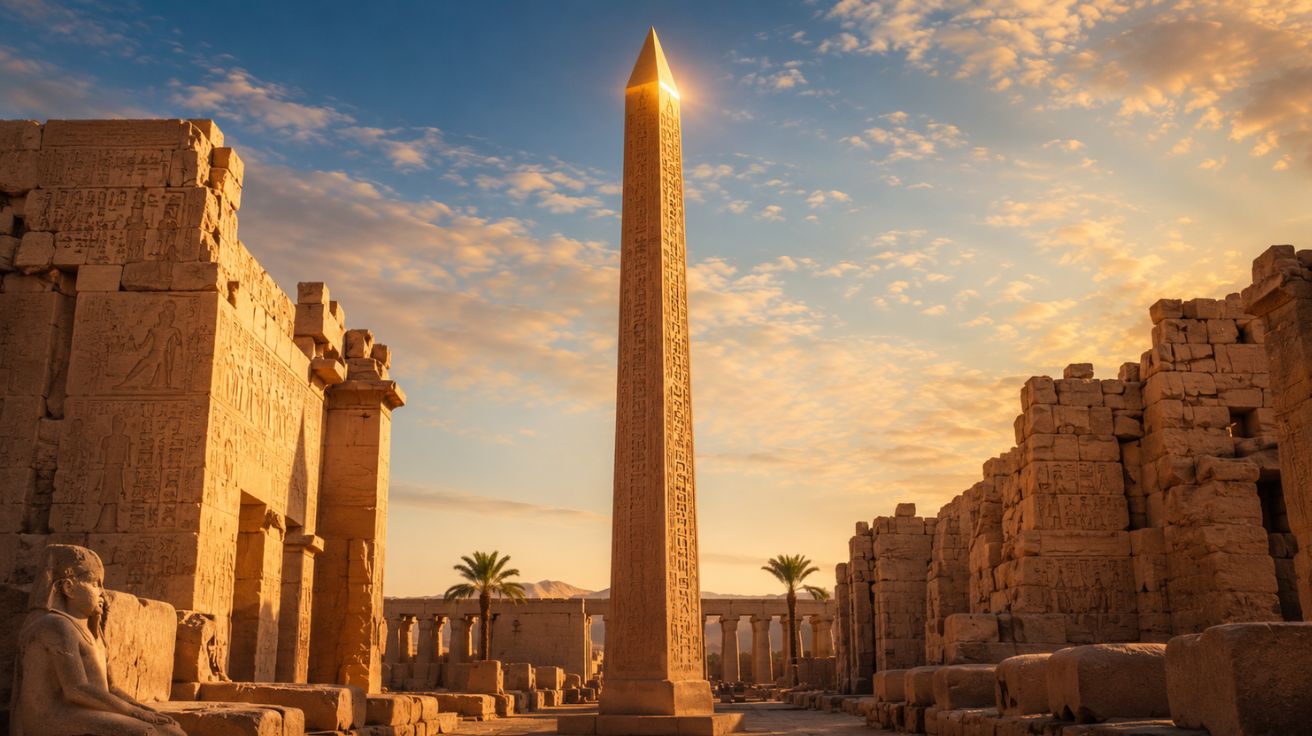

The Hatshepsut Obelisk is a giant stone pillar that stands 97 feet tall and weighs a massive 343 tons. Cut entirely from a single piece of pink granite, it is the tallest ancient obelisk still standing in Egypt today. You can find it right in the middle of the famous Karnak Temple Complex in Luxor. It matters historically because it shows how incredibly advanced ancient Egyptian engineering really was. It is also a giant piece of physical proof that honours the power of Queen Hatshepsut, one of the very few female pharaohs to ever rule Egypt.
Hatshepsut ordered this huge monument to be built around 1479 BCE during the 18th Dynasty. She raised it to celebrate her 16th year on the throne as a way to renew her royal power. In ancient Egypt, kings were almost always men, so Hatshepsut used these giant building projects to prove to her people that the gods had chosen her to rule. Standing at the bottom of this towering stone today makes you wonder: how did ancient people move and lift something this heavy using only simple hand tools, ropes, and muscle power?
Who Was Hatshepsut?
Hatshepsut came to power during the New Kingdom period. Initially, she was the queen consort to her husband, Thutmose II. When he died young, the throne passed to his infant son, Thutmose III. Because the young king was too small to rule, Hatshepsut stepped in as his regent.
Instead of staying behind the scenes, Hatshepsut gradually claimed the full title of pharaoh. To legitimise her rule in a culture that expected male kings, she changed how she was depicted. In official art and statues, she was shown wearing the traditional royal kilt and even a false ceremonial beard. Her reign lasted over twenty prosperous years, defined by lucrative trade missions, like the famous expedition to the Land of Punt, and a massive building program.
What Is the Hatshepsut Obelisk?
The Hatshepsut Obelisk at Karnak is a four-sided, tapering monument carved from a single piece of pink granite. Originally, she erected two pairs of these giant obelisks at Karnak, but only one remains standing upright today.
Key Structural Features
- The Monolith: The entire monument is a single, unbroken block of pink granite quarried from Aswan.
- The Pyramidion: The top of the obelisk, known as the pyramidion, was originally covered in electrum, a shiny natural alloy of gold and silver. This reflective coating caught the morning sun, casting bright flashes of light across the temple complex.
- The Pedestal: The obelisk rests on a massive, heavy square stone base designed to distribute its 343-ton weight perfectly evenly to prevent tilting.
Why Did Hatshepsut Build the Obelisk?
Hatshepsut raised these obelisks to mark her Sed festival, a royal jubilee celebrated in her 16th year on the throne to renew her divine right to rule.
In ancient Egypt, building monumental architecture was the ultimate proof of a pharaoh’s power and their closeness to the gods. By placing these towering monoliths in the heart of the Amun-Ra temple at Karnak, Hatshepsut sent a clear message to the priesthood, the nobles, and the public: her rule was divinely ordained. The obelisks tied her directly to Amun-Ra, the chief sun god of Thebes, ensuring her memory would live forever.
Symbolism of the Hatshepsut Obelisk
To the ancient Egyptians, an obelisk (tekhen) was much more than a decoration; it was a sacred conductor of divine energy.
The Core Spiritual Meanings
- Petrified Sunbeams: The tapering shape represented a single, solid ray of sunshine connecting the heavens to the earth. As the sun rose over Thebes, its first light hit the electrum-plated tip long before lighting up the ground below, symbolising the daily rebirth of creation.
- The Primaeval Mound: The pyramid shape at the top mirrored the benben, the mythological mound of earth where life first emerged out of chaos at the beginning of time.
- Ma’at (Cosmic Order): Standing perfectly straight, the obelisk represented stability, truth, and cosmic order, the exact concepts every pharaoh was sworn to protect.
Inscriptions and Hieroglyphics on the Obelisk
Every side of the obelisk is covered in finely carved hieroglyphics that state Hatshepsut’s titles, achievements, and intentions. Rather than using standard, dry official text, the inscriptions read like a personal journal entry from a ruler concerned with her historical legacy.
One famous section of the inscription near the base captures her voice directly:
“Now my heart turns this way and that, as I think what the people will say. Those who shall see my monuments in years to come, and who shall speak of what I have done.”
The text also describes her care for the monument, stating that she covered the tips in electrum so they would illuminate the world. These inscriptions are a rich primary source for historians, documenting the exact political and religious arguments she used to justify her historic reign.
Construction of the Hatshepsut Obelisk
How ancient engineers extracted, moved, and raised a 343-ton piece of solid granite without modern machinery is a feat that still impresses engineers today. Remarkably, the entire process of cutting the stone out of the bedrock, transporting it, and putting it in place took just seven months.
Step 1: Extraction in Aswan
Labourers began in the granite quarries of Aswan, hundreds of miles south of Luxor. Workers used heavy pounding stones made of dolerite (a rock harder than granite) to chip away at trenches around the block until it detached from the bedrock.
Step 2: Transporting Down the Nile
Once free, the massive block was slid onto a wooden sledge, pulled by hundreds of workers across tracks slicked with wet Nile mud, and loaded onto large cargo barges to float down the river to Thebes.
Step 3: Raising the Monolith
At Karnak, engineers likely used a system of enclosed dirt ramps filled with sand. By slowly letting the sand drain out from a release point at the bottom, the heavy block could be guided safely and upright onto its stone pedestal.
Archaeological Significance of the Hatshepsut Obelisk
The standing obelisk at Karnak holds immense historical and scientific value. Rather than just acting as a beautiful relic, it serves as an indispensable tool for understanding the sociopolitical and technological realities of ancient Egypt:
- Unmatched Preservation of Texts: Because it was carved from incredibly hard granite, its hieroglyphics stayed crisp and readable for thousands of years, giving us an immaculate record of 18th-Dynasty language, grammar, and royal vocabulary.
- Proof of Advanced Logistics: Completing a project this massive in just seven months proves that ancient Egypt possessed a highly centralised, hyper-efficient government capable of managing thousands of workers, supply lines, and engineering squads perfectly.
- A Timeline of Political Drama: The physical changes and walls built around the monument tell a direct, tangible story of the intense political tension between Hatshepsut and her successor, Thutmose III.
- Insights Into Ancient Technology: By studying the standing obelisk alongside the Unfinished Obelisk in Aswan, scientists have been able to decode the exact physics, tools, and mathematical methods used by ancient builders to harvest and transport heavy stone.
What Happened to the Obelisk After Hatshepsut’s Death?
After Hatshepsut passed away around 1458 BCE, Thutmose III finally took over as the sole pharaoh. Late in his rule, he started a campaign to remove Hatshepsut’s name and images from all official monuments across Egypt so it would look like she never ruled.
Instead of knocking down her giant obelisks, which might have angered the sun god Amun-Ra, Thutmose III took a different route. He ordered his workers to build high stone walls all the way around them to hide them from the public.
Ironically, trying to hide her memory actually saved the monument. The protective walls shielded the granite from desert winds, sandstorms, and vandals for thousands of years. When modern archaeologists finally took the walls down, they found the hidden carvings in near-perfect condition.
FAQs
How many obelisks did Hatshepsut build at Karnak?
Hatshepsut commissioned four obelisks for the Karnak Temple complex. Today, only one remains standing in its original position. The top portion of its fallen twin is on display nearby, near the Sacred Lake.
How heavy is the Hatshepsut Obelisk?
The standing obelisk weighs approximately 343 tons and was carved from a single piece of solid pink granite.
Why did Thutmose III hide Hatshepsut’s obelisk instead of destroying it?
Obelisks were considered sacred properties of the sun god Amun-Ra. Destroying them outright could be seen as an insult to the gods. Building a wall around them allowed Thutmose III to remove Hatshepsut from public sight while keeping the religious monuments intact.
Can you see the Unfinished Obelisk today?
Yes. The Unfinished Obelisk is located in an open-air museum at the northern quarry in Aswan, where visitors can walk along the stone trenches to see how these monuments were carved.
Conclusion
The Hatshepsut Obelisk is a true highlight of ancient Egyptian art and engineering. From its origin in the bedrock of Aswan to its preservation behind the walls of a political rival, it tells a rich story of devotion, power, and survival. Standing beneath its towering peak today offers a genuine connection to the ancient world. It is a must-see for anyone interested in the history of Egypt.
If you are planning an educational trip to explore these monuments in person, reputable tour companies like archaeologicalpaths offer expert, historian-led itineraries through Luxor, Aswan, and the ancient ruins of Egypt.
Read More: Student Accommodation Guide for International Students in 2026


Leave a Comment